Unemployment varies greatly depending on who measures it, what they want to measure and who is conveying the message. It is important to be critical of politicians' statements about unemployment.
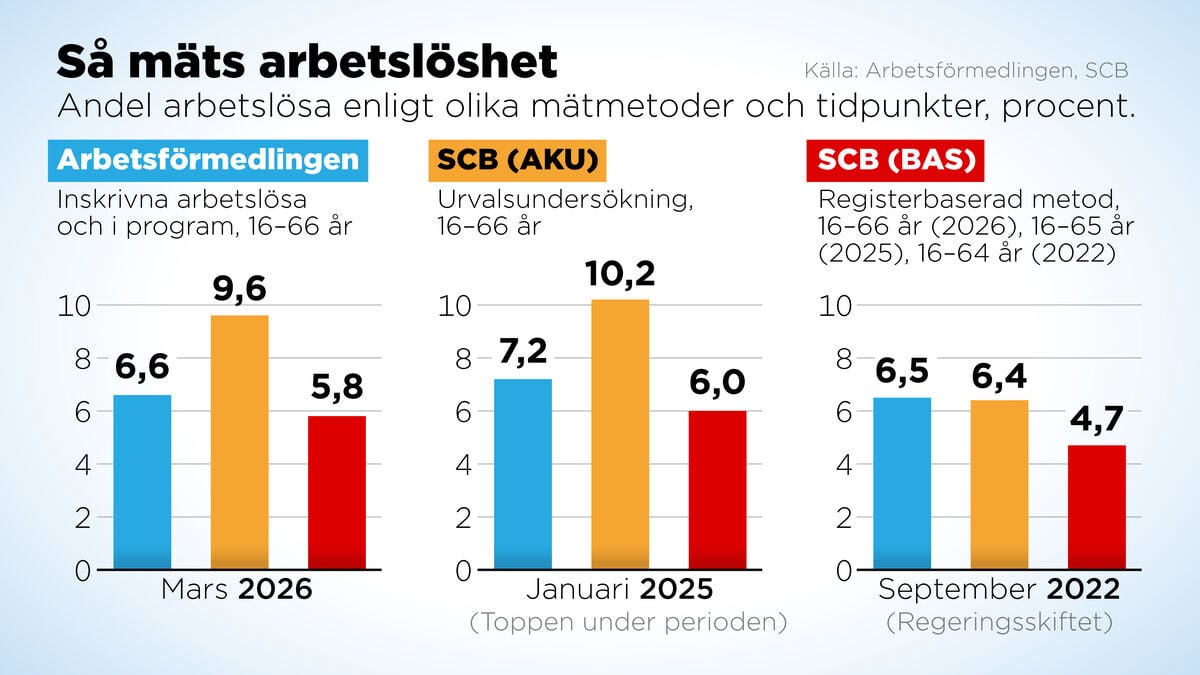
The three measures (ages 16–66) are:
The Swedish Public Employment Service, 6.6 percent.
Statistics Sweden (traditional LFS), 9.6 percent.
Statistics Sweden (BAS - a new system based on registers), 5.8 percent.
“Cannot be answered”
So, how high is unemployment today?
Anders Forslund, professor emeritus at Uppsala University and the research institute Ifau, should know.
That question is, of course, impossible to answer because there are different ways of measuring. And those different ways measure different things and are good for different purposes depending on what you are interested in.
According to Eurostat (the EU's statistical office), Swedish unemployment is 8.7 percent. Only two countries in the EU have higher unemployment rates, Finland and Spain, with just over 10 percent.
But international comparisons are very difficult to make, says Forslund.
No social problems
Among other things, Sweden has significantly more young adults registered as unemployed, which is related to other countries' apprenticeship systems and student grant systems. Of the over half a million unemployed Swedes (according to Statistics Sweden), over a third are full-time students.
The fact that you are actually trying to get a holiday job, a summer job or an extra job is a sign that you do not have many social problems.
Another reason why Sweden has higher unemployment than other countries is that labor market policy has been geared towards keeping people in the labor market. In other countries, it is more common to retire early people who are further from the labor market.
Developments since the election
So what does it look like over time? Since the change of government in September 2022, unemployment has remained stable at around 6.6 percent, according to the Swedish Public Employment Service. But according to both of Statistics Sweden's methods, unemployment has increased significantly.
Anders Forslund's assessment is that politics plays a minor role in unemployment. It is the economic situation that has the greatest importance. Political differences are more about the consequences for the unemployed, such as compensation and training.
But the logic of the election campaign is crystal clear.
Regardless of who is in opposition and who is in government, the high level of unemployment is blamed on whoever is in government.
Facts: Unemployment since the 2022 election
Public Employment Service, ages 16–66. Based on the agency's data on registered unemployed people and in programs.
March 2026, 6.6 percent
January 2025 (peak during the period), 7.2 percent
Change of government September 2022, 6.5 percent.
Statistics Sweden (AKU) 16–66 years. Based on a sample survey where it has become increasingly difficult to get people to participate over time.
March 2026, 9.6 percent
January 2025, 10.2 percent
Change of government September 2022, 6.4 percent
Statistics Sweden (BAS), register-based method based on companies' reporting of income, combined with the Swedish Public Employment Service's registered unemployed.
March 2026 (16–66 years), 5.8 percent
January 2025 (16–65 years), 6.0 percent
Change of government September 2022 (16–64 years), 4.7 percent
Source: Statistics Sweden, Swedish Public Employment Service