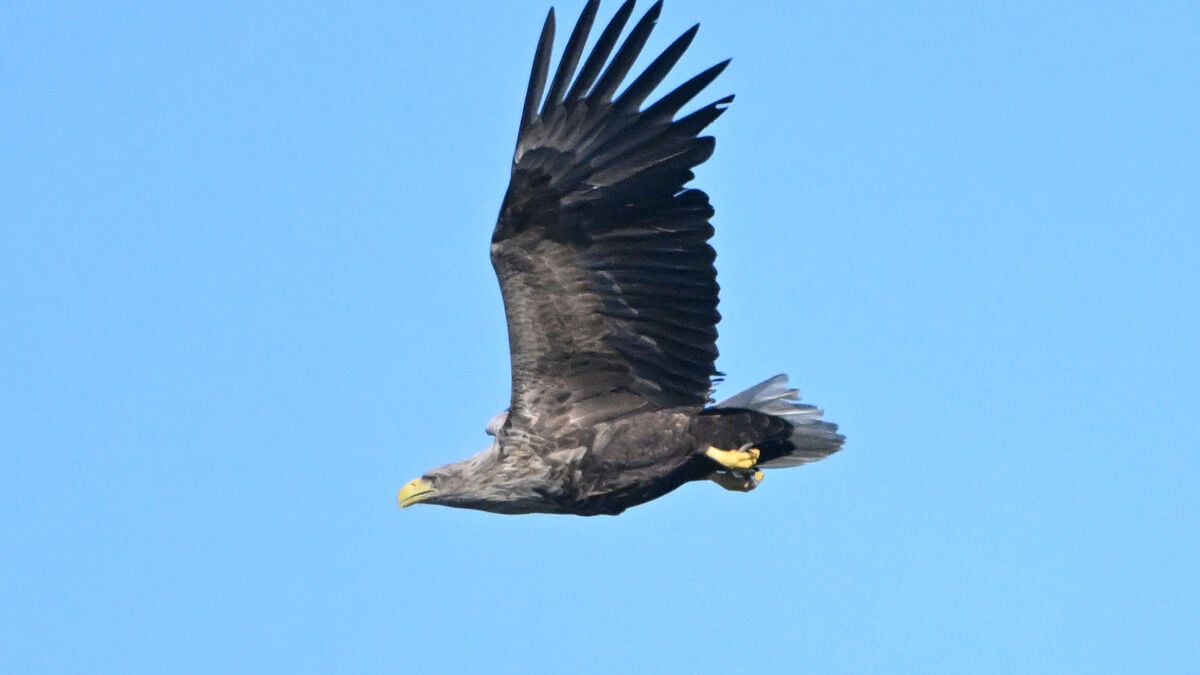
In 1973, only six white-tailed eagle chicks were born along the entire Swedish east coast. It was a low point, after severe environmental pollution in the 1960s and 1970s had almost wiped out the species.
But thanks to solid work to preserve the species, white-tailed eagles are now found throughout Sweden and the number of breeding pairs is around 1,400.
"It's still a species that can live to be quite old. They don't breed until they are 4–5 years old, so the population has built up and a lot of young have been born," says Mikael Svensson, a biologist at the SLU Species Data Bank.
In addition, the availability of food has improved.
I think increased populations of geese have been very important.
More red-listed species
This year's edition of SLU's Red List, which is released every five years, contains more good news. In addition to the white-tailed eagle, the otter, the long-legged frog and the asp fish are doing better and have been removed from the list.
But of the total of approximately 23,000 species assessed, nearly 23 percent are red-listed - an increase of ten percent compared to the latest red list from 2020. Of the total of 5,217 red-listed species, 2,373 are considered endangered.
The fact that the proportion of red-listed species is increasing is partly due to the fact that more species have been assessed in this year's report, according to SLU, but also because species that were previously classified as viable are now doing worse.
Among other things, several important food fish are new to the red list: herring, salmon and trout. The moose, hedgehog and several owls have also had their status degraded.
“A mighty sight”
So the fact that the white-tailed eagle is now doing better is a much-needed bright spot, says Mikael Svensson.
"It's a powerful sight with white-tailed eagles. I know exactly when I saw my first ones, in the spring of 1977, it was an amazing experience," he says, adding:
"Now there's talk of flocks of over 30, huge teenage gangs of white-tailed eagles roaming around. I didn't see that coming 50 years ago, it's a fantastic development."
But the sudden increase in the number of the bird of prey, the white-tailed eagle, has had unexpected consequences. For example, the eider and the little tern are being negatively affected when more eagles hunt them.
"We are in a new situation where it affects other species in a way that we couldn't really predict. It's a difficult balance," says Mikael Svensson.
Facts: SLU's red list
The SLU Species Data Bank's report Red Listed Species in Sweden is released once every five years, and the latest is for the year 2025.
The list reports the risk of individual species of animals, plants, fungi and algae disappearing from Sweden. The assessment is made by SLU employees in collaboration with over 100 species experts.
The risk of species becoming extinct is assessed according to a method developed by the International Union for Conservation of Nature (IUCN). Species that meet the criteria for any of the categories nationally extinct, critically endangered, endangered, vulnerable, near threatened or data deficient are red-listed.
Species that meet the criteria for any of the categories critically endangered, endangered or vulnerable are classified as endangered.
Source: Red listed species in Sweden 2025, SLU