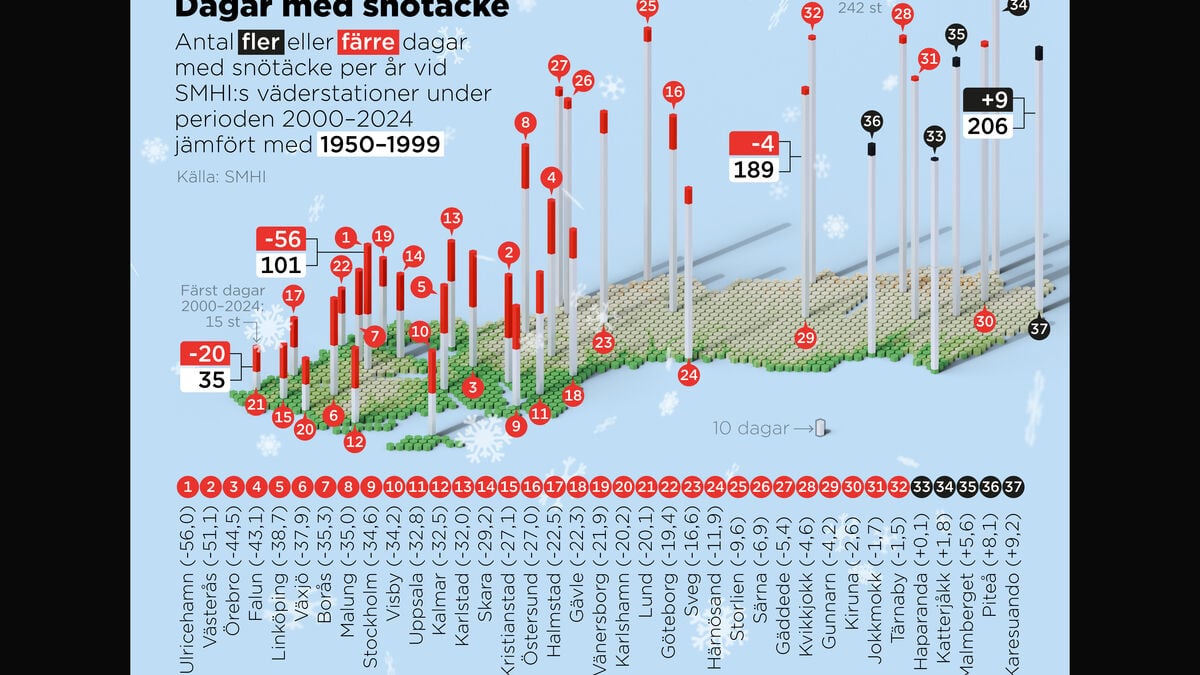
Does it feel like there was more winter in the past? That feeling is true if by winter you mean days with snow on the ground. SMHI has followed developments at 37 locations around Sweden since 1950, and the changes are clear, according to TT's review.
In several parts of the country, the last five winters have on average been half as long as the average during 1950–2000. In Västerås, Ulricehamn, Växjö, Örebro, Stockholm, Falun and Malung, the winters of the 2020s have also been the brownest to date.
We have had a tendency towards milder winters, says Sverker Hellström, climatologist at SMHI, and continues:
In those parts of the country that were previously in the border zone between rain and snow, mainly in southern Sweden and the coastal areas, an increase in temperature means that temperatures will be even higher and the probability of periods with snow will decrease.
There could be more snow
In 13 of the locations, more than a month of winter has disappeared. In Falun, 43 snow days have disappeared per season. This is down from 128 in the second half of the 1990s to 85 in the 2020s.
But there is a big difference between the northern half of the country and the south. In the north, it is not possible to say that the winter days are getting shorter. According to Hellström, this has to do with the fact that the temperature is still well below zero. Since a slightly warmer atmosphere can contain more water vapor, the result can even be the opposite.
A temperature increase from -10 to -8 or from -5 to -3 may rather mean a little more snow.
Although the trend towards less snowy winters is clear in the southern half of the country, natural variations also play a role. For example, many of the control points had record-low snow during the period 1990–1994.
“Should be aware”
Less snow is not necessarily a bad thing. The risk of winter floods increases, but at the same time the risk of spring floods decreases.
But all actors should be aware of it, so that they can take it into account in their planning, says Hellström.
This also means that there could be substantial snowdrifts in southern Sweden in the 2030s. But the probability is decreasing.
There is no indication that the trend of increased greenhouse gases is about to reverse. And as long as there is an increased concentration of greenhouse gases, it will lead, on average, to a slowly rising temperature.
TT has reviewed data for the number of days with snow cover per winter for SMHI's 37 weather stations 1950–2025.
Based on this, an average value for five-year periods has been developed, where the last five winters have been compared with the period 1950–1999.
The stations that have had the largest decrease in the comparison are Kristianstad, followed by Västerås, Lund, Ulricehamn and Kalmar. Some stations in the north, including Piteå, have had more days with snow.
On average, just over every fourth snow day has disappeared in the country during the time period, a total of 20 days.
Sweden's average temperature is increasing as a result of climate change, which is mainly caused by human combustion of fossil fuels.
The changes are most prominent during the winter. December-February is 1.5 degrees warmer, but in places in Svealand and Götaland as much as 3 degrees during the period 1991–2020 compared to 1961–1990.
The meteorological winters (average daily temperatures below freezing) have also become shorter, especially in southern Sweden. The number of stations without winter has increased from 2 to 65 during those periods.
Source: SMHI