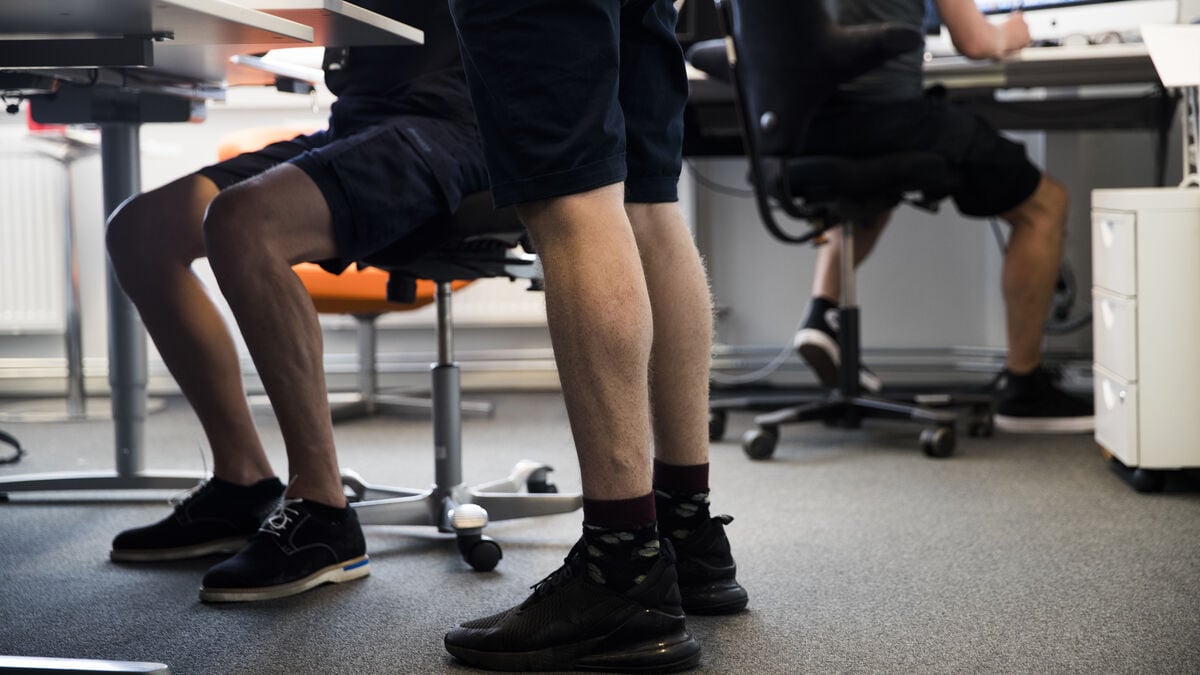
Manners and etiquette expert Mats Danielsson illustrates the importance of clothing in the workplace with an example:
Imagine that you have an important legal matter that you need help with and that you go to a lawyer in shorts and a T-shirt, then you become hesitant even though you know that the person may be super competent.
Many professions are built on professionalism and trust, and this is reflected in clothing, among other things, Mats Danielsson believes.
For some professional roles, such as healthcare and the police, there is a clear uniform for reasons of hygiene, safety and professional identity. But how do you dress when the dress code is optional?
For professions that represent a business or have customer contact, Mats Danielsson believes that shorts, short dresses, bare midriffs and other overly casual garments should be avoided.
I don't want to come across as a morality policeman, but if you work in an environment where you have to meet people and risk having to excuse your attire, it's probably not right.
Open shoes okay sometimes
In workplaces without customer contact, however, the dress code can be significantly more relaxed.
Formally, bare feet count as above the knee, according to Mats Danielsson. Short sleeves are okay - but not with a tie, he thinks. And open shoes may be okay depending on the workplace.
I personally wear light linen trousers that are airy and loose. It almost feels like wearing shorts.
Dress codes in the workplace have changed significantly over the last hundred years, according to Emma Severinsson, lecturer in fashion studies at Lund University.
It is a development that follows fashion in society at large. Since the 1950s, we have seen how our dress codes have become less strict. A more recent example is that sneakers have been used in all sorts of contexts for about 15 years.
Sneakers became more status than suits
During the 1990s, a more relaxed style became almost a status symbol in certain industries, such as tech, says Emma Severinsson.
There, a hoodie or T-shirt could signal more status than a suit.
Although shorts may be acceptable in some workplaces today, the garment has long been completely unthinkable outside a sports context.
For a long time, it has been considered wrong to show skin at work. It is about a boundary between private and public. Skånetrafiken's male employees fought for years to be allowed to wear shorts in the summer and finally got it. It shows how strong the norms are about what you should or should not wear at work.
This is what the law says about clothing in the workplace:
There is no general legislation for dress codes in workplaces, but employers have the option of introducing a dress code.
If an employee does not follow the dress code, it may be considered a breach of the employment contract, which could lead to a warning and ultimately termination.
The employer is obliged to provide equipment if required by the Work Environment Act.
Dress codes may not discriminate according to the Discrimination Act.
Source: The Discrimination Ombudsman, the Swedish Work Environment Authority, Chefstidningen.