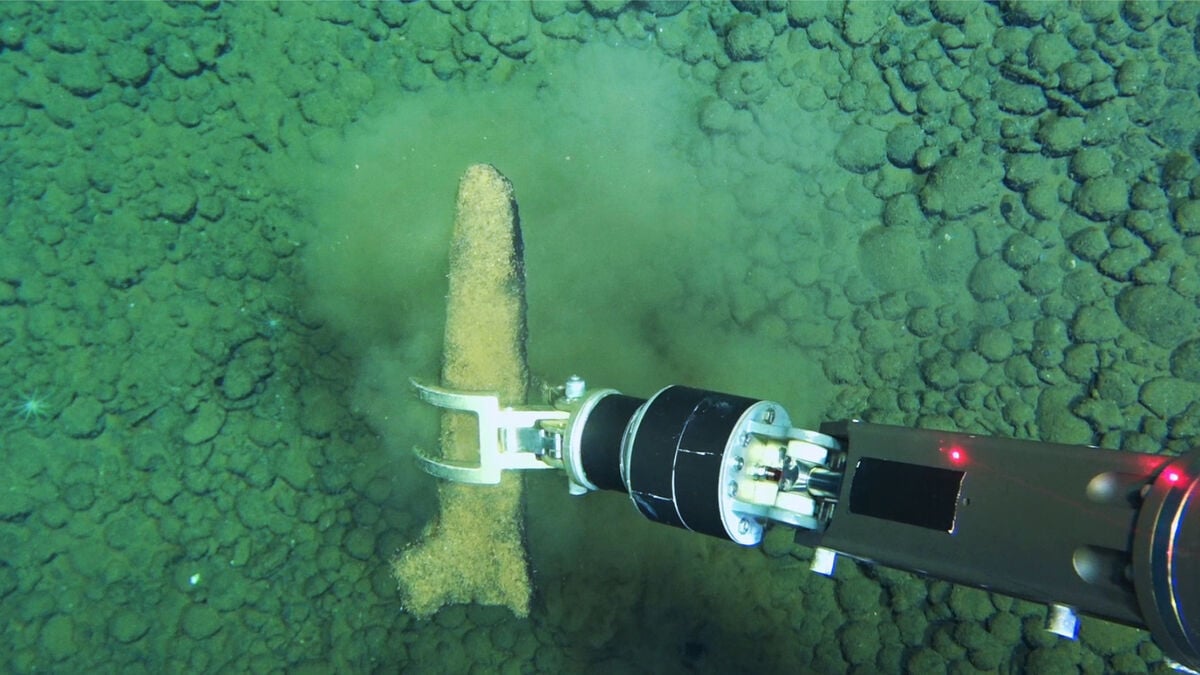
A spectacular whale graveyard has been discovered at the bottom of the Indian Ocean off the southwest coast of Australia, in an area called the Diamantina Trench. The V-shaped depression in the seabed stretches for about 1,200 kilometres and reaches as deep as 7,000 metres. The scale is enormous: scientists estimate that more than ten million whale carcasses are in the area. The oldest fossils are estimated to be about 5.3 million years old.
Remotely controlled underwater vehicle
"It was a complex feeling, a little scary, but also fascinating from a research perspective," says Xiaotong Peng, one of the researchers behind the discovery, in a written comment to TT.
“It was about dead bodies, but at the same time about seething, living ecosystems,” he continues.
The research team that first discovered the whale cemetery, including Xiaotong Peng, has been studying it for several years and has made 32 dives to the depths. Using a remotely operated underwater vehicle that filmed and examined the seabed, the researchers collected samples from 485 locations.
Several types of carcasses
The remains found were mainly from deep-sea beaked whales, which swim to extreme depths to hunt squid and sharks, among other things.
Among the finds was a five-metre-long carcass of an Antarctic beluga whale, as well as a skeleton from the extinct whale species Pterocetus benguelae that lived 5.3 million years ago. It is with the discovery of that fossil that the researchers establish the age of the whale cemetery.
In addition, a previously unknown whale species was found that the researchers named after the location, Diamantina Grave, where it was found: Pterocetus diamantinae.
Like a funnel
There are several reasons why the Diamantina Grave has become the final resting place for such a large number of whales, says Björn Källström, marine biologist and researcher at the Maritime Museum Aquarium.
It is a fracture zone that goes down into the depths and becomes like a funnel at the bottom, he says.
And if the bottom looks like a funnel, the whales will sort of fall into it, deeper and deeper, he continues.
Although beaked whales are accustomed to diving deep, the depth of the trench can be overwhelming.
They are mammals that breathe air, and even though they can dive down to a depth of three thousand metres for an hour, there is a great risk that they will die down there, says Björn Källström.
“Deep Sea Search”
The discovery of the cemetery was astonishing. But the treasure turned out to be much bigger than just the skeletal remains or the “archive” of deep-sea whales that the researchers describe it as. Far down on the ocean floor, without even an ounce of sunlight or daylight, ecosystems are built around the whale carcasses.
You could call it a deep-sea desert, says Björn Källström and continues:
And then, bang, it drops down a whale that is full of energy, nutrition and food. It becomes like an oasis.
“Velvet carcass specialists”
A single carcass becomes a buffet table for marine animals and organisms. The feast can last for years and goes through several stages.
The scavengers are the first to go. They eat the soft meat: the whale's tissue and blubber.
But what's really exciting is when the skeleton remains, says Björn Källström, talking about the next step, when smaller animals and bacteria – "whale carcass specialists" – take over after the scavengers.
It has been shown that the whale skeleton, the whale bones, contain very nutritious oil, he says.
The ecosystem is built up by bacteria that break down the oil and recycle it again. In addition, mussels, for example, feed on the bacteria.
So it's like an entire ecosystem is formed down there, which is completely built on the energy that comes from the oil in the whale skeleton, says Björn Källström.
Ten years ago I would have said that there is low biodiversity on the seabed, but research today shows that on the contrary there is high biodiversity at depth.
The whale is a mammal with around 80 modern species divided into the subspecies baleen whales and toothed whales.
Through their adaptation to a life entirely in water, whales differ so much from other mammals that they were long considered to be a completely separate group of animals.
There are whales in every ocean on Earth. Some species also occur in large rivers.
The whale's body is streamlined, smooth and hairless, and lacks skin glands.
As protection against the cold, whales have a thick layer of blubber.
Some species of whales can stay underwater for up to an hour because they can use the oxygen in the air more efficiently than other mammals.
The whale's brain is very large and on the surface similar to that of both ungulates and predators.
All whales can vibrate their larynx to produce sound and communicate. They use sound for echolocation.
Source: Species Data Bank, NE.