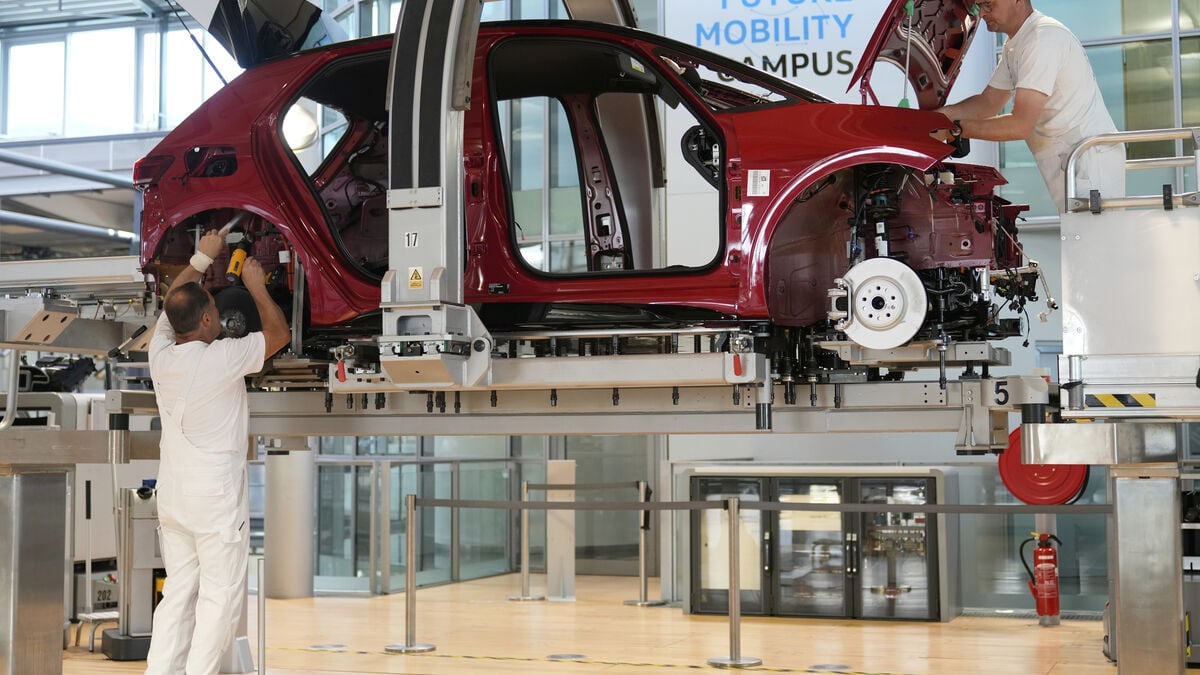
Headwinds are intensifying for Europe's largest automotive group, German Volkswagen. In connection with Friday's interim report, the company lowered its revenue forecast to, in a worst-case scenario, a 3 percent decline. This from previously expecting 0-3 percent growth. The gloomy outlook comes after the company's CEO recently announced that four production plants will be closed and up to 100,000 jobs will disappear.
I think there will be more. It is said that one job in the automotive industry creates an additional 2.5 jobs in the local area. There are many things that need to change, says Peter Bryntesson about the situation in the German automotive industry.
Can affect
He is CEO of the Automotive Component Group (FKG), the trade organization for Scandinavian suppliers to the automotive industry.
Developments in Germany could also affect the approximately 1,100 Swedish companies that supply goods and services to the automotive industry, Bryntesson points out. There are everything from giants like the listed Autoliv, which manufactures airbags, among other things, to significantly smaller players.
The components industry actually builds 75 percent of vehicles, so if things go badly for Volkswagen, things go even worse for a lot of supplier companies that supply goods to Volkswagen.
One factor that speaks in Sweden's favor, however, is that many players are primarily focused on the heavy vehicle industry, i.e. trucks. There, both AB Volvo and Traton with Scania have delivered strong quarterly reports with very bright forecasts regarding order intake.
"I still think we will do reasonably well. When it comes to the connection to German vehicle manufacturers, we are not that sensitive. If, for example, Volkswagen sells 10,000 fewer cars in Europe while Chinese BYD sells 10,000 more, it could be a zero-sum deal for Autoliv, which supplies both," says Peter Bryntesson.
China can challenge
What could theoretically be a challenge is when China will start competing on the truck side, just as it has done with passenger cars. It is not a question of if it will happen - but when it will happen, Peter Bryntesson believes.
That battle (regarding passenger cars) in Europe has in practice already been won and we will experience increased competitive pressure from Chinese vehicle manufacturers on the truck side as well, he believes.
The operating profit for the second quarter of this year of 3.47 billion euros compares with an average forecast among analysts of 4.07 billion euros, according to Bloomberg.
For the full year, VW expects revenue to be flat at best, with the lower end of the forecast being reduced to minus 3 percent. This compares with a previous forecast of up to 3 percent revenue growth.
The quarter's revenue of 82.4 billion euros was slightly higher than the expected 81.7 billion.