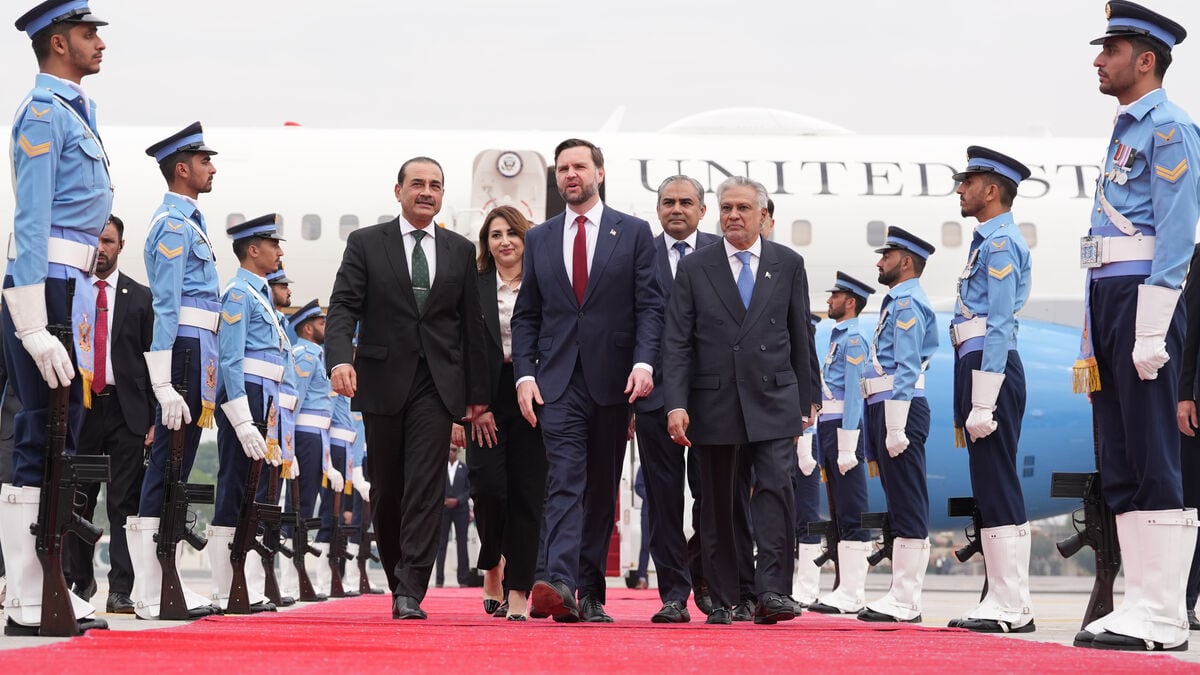
Little information has come out of Saturday's negotiations in Islamabad. Sources have told journalists outside the area that the parties have not made progress on several issues, mainly maritime traffic in the Strait of Hormuz, reports the British Financial Times, among others.
However, it is seen as a certain success that high-level representatives are even meeting - in principle, there have been no direct contacts between Washington and Tehran since the Islamic Revolution in 1979.
The US delegation is led by Vice President J D Vance, accompanied by envoys Steve Witkoff and Jared Kushner, among others.
Iran's delegation of around 70 people is led by Speaker Mohammad Bagher Ghalibaf. The Iranian side also includes Foreign Minister Abbas Araghchi.
“No difference”
After several rounds of talks, the negotiations continued, partly under the supervision of Pakistani Prime Minister Shehbaz Sharif, at a working dinner and with technical meetings later in the evening. According to Iran, new meetings were expected on Sunday.
Amid ongoing meetings, US President Donald Trump chose to comment on the development: "It doesn't matter to me if a peace deal is reached," he told reporters in Washington.
"We have completely defeated the country, so let's see what happens. Maybe they make a deal, maybe they don't; it doesn't matter. From an American point of view - we win," Trump said on his way to a helicopter at the White House.
In Islamabad, the negotiations were held in a high-end conference center, surrounded by a tight security cordon. Journalists and analysts were located less than a kilometer from the center.
The capital was compared to a ghost town, where the streets were filled with military patrols.
Points listed
Iran demanded war reparations for damage caused to the country by the US and Israeli militaries, and that Iranian assets that had been frozen internationally be returned. Iran is said to have a list of ten points.
The US's list of demands includes opening the Strait of Hormuz, which is important for maritime traffic. Issues regarding Iran's nuclear energy program are also high on the US agenda, with 15 points.