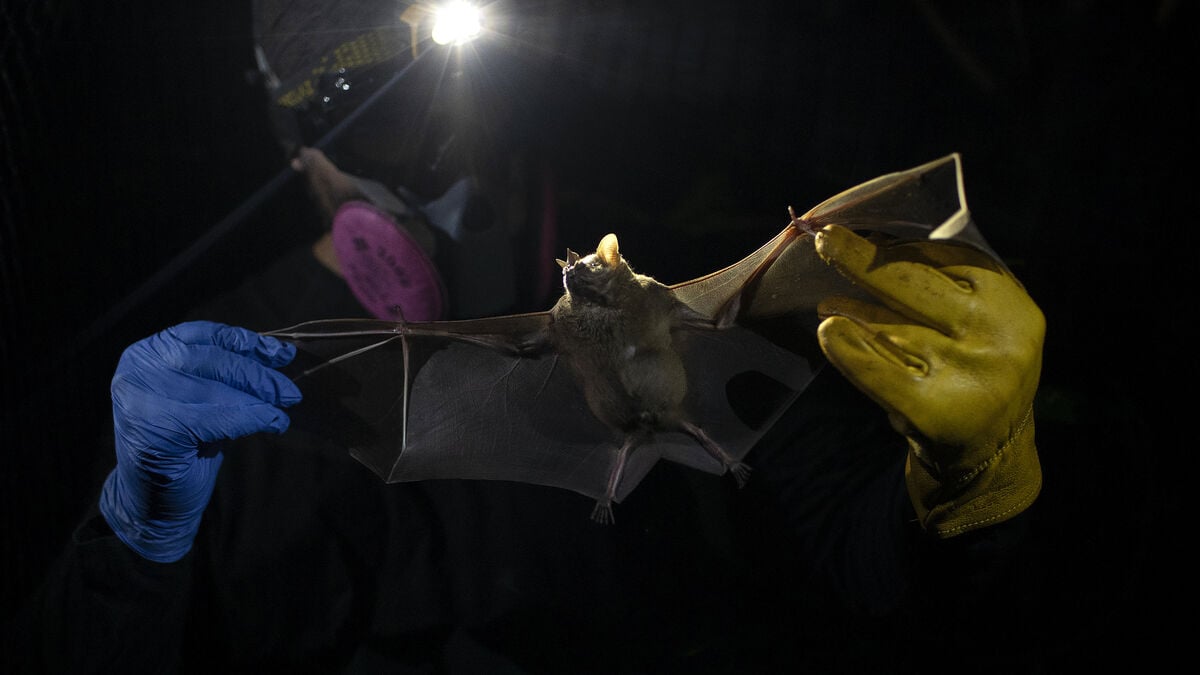
Bats have a unique ability to carry diseases without getting sick themselves. They are linked to outbreaks of serious diseases such as Covid, SARS and Ebola.
They are found practically all over the world and are known reservoirs for several viruses and suspected reservoirs for several other serious viruses, says John Pettersson at Uppsala University, who studies how new viruses arise and spread.
Scientists therefore want to be able to vaccinate bats in the wild to prevent disease outbreaks. But this is difficult with conventional methods.
Now, Chinese researchers have looked at an alternative - using mosquitoes to spread the vaccine. The researchers gave mosquitoes vaccines against rabies or Nipah in the form of a harmless, genetically modified virus. In experiments in enclosures, the mosquitoes bit the bats, or the bats ate them. Either way, the bats ingested the vaccine and began to produce an immune response.
Produced an effective response
The researchers also invented another method, a kind of salt trap that attracted the bats to a location via a salt cloud where they then drank water, which also contained the vaccine.
To test whether the methods really worked, the bats were exposed to an extremely high dose of rabies six weeks after the vaccination - high enough to kill a bat. All the bats that had drunk the vaccine through the water trap and all those bitten by mosquitoes with the vaccine survived, while 75 percent of those that had eaten vaccinated mosquitoes survived. In the control group, all the bats died.
The researchers' experiments with Nipah, which worked a little differently, also proved effective.
Are there risks?
There are, of course, ecological risks to tinkering with mosquitoes in this way and releasing them into the wild, but the researchers believe that sterilizing them beforehand and taking other control measures can reduce the risks.
"This innovative method provides a scalable and effective solution for vaccinating wild bats. It thus addresses crucial challenges for both disease control and bat conservation," the researchers write.
John Pettersson, who is not involved in the study, says it is exciting but that it is difficult to know how it would actually work in nature.
It will take a lot of mosquitoes to actually build up immunity in a certain area.
The study is published in Science Advances.
Nipah virus is found mainly in Southeast and South Asia and was discovered in 1999 when an outbreak on a pig farm in Malaysia led to spread to humans, and more than 100 people died. The virus's usual host is bats. The disease often leads to respiratory problems, coma and death.
Rabies is a viral disease found in several animals, including bats. It is essentially fatal once symptoms develop.
Source: Public Health Agency of Sweden