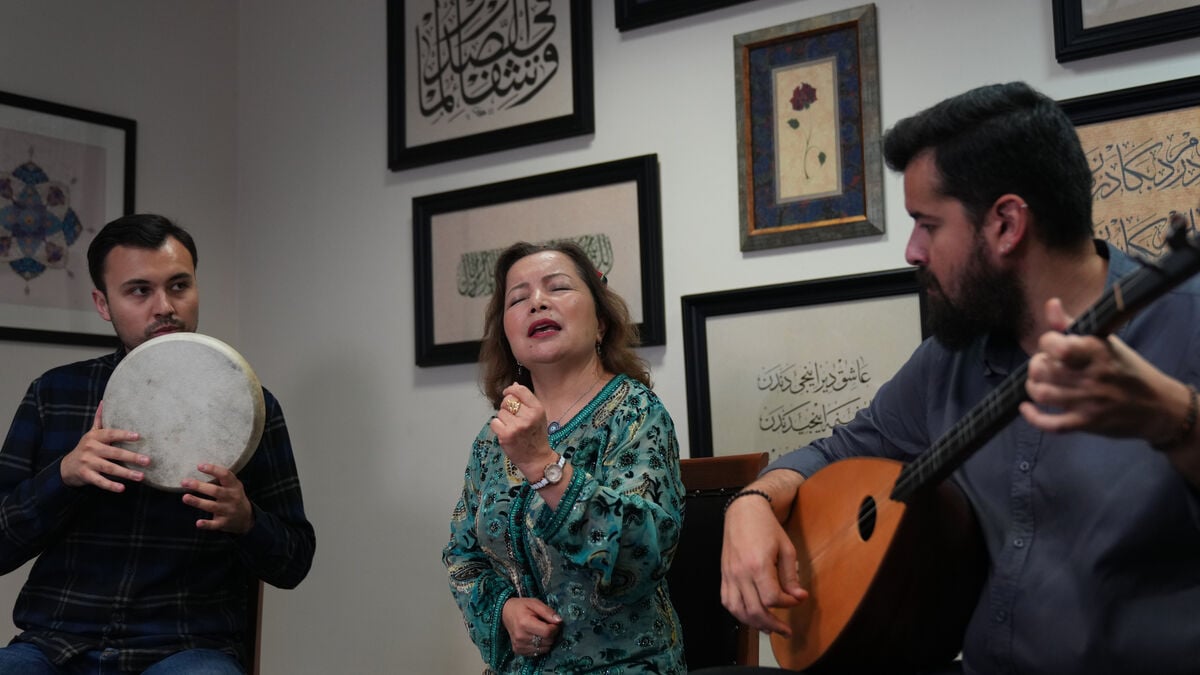
“Besh pede,” a popular folk song, is one of dozens of songs declared “problematic” by authorities in Xinjiang province in northwest China, according to a recording of a meeting with police and local authorities in the historic city of Kashgar in October, shared by the Norway-based aid organization Uyghur Hjelp .
Residents are warned that those who listen to, download or share banned songs risk imprisonment. Participants at the meeting were also urged to avoid common Muslim courtesy phrases and greetings, and in some cases to replace “God” with “Communist Party.”
The measures are confirmed by former Xinjiang residents whose relatives have been arrested for playing and sharing Uyghur music. They can range from a few days of detention to up to three years in prison, as in the case of a music producer who uploaded “sensitive” songs to his cloud account.
Subtle oppression
China continues to oppress the Uyghurs, despite international pressure to the contrary, according to Rian Thum, an East Asia expert at the University of Manchester in England. The oppression is just more subtle, he says.
"I'm not at all surprised to hear the stories of people either being threatened with arrest or being arrested or imprisoned for listening to the wrong music. These are the kinds of incidents that haven't stopped," he says.
Seven types of Uyghur songs fall under the banned category, according to the recording of the meeting.
Forbidden words
These include songs with religious references, songs that “distort the history of the Uyghurs,” songs that are considered to encourage separatism, songs that smear the Communist Party’s rule in Xinjiang, and those that are considered to encourage terrorism and extremism. Songs that encourage resistance to the government, and those that encourage “dirty thoughts and behaviors,” are also banned.
In practice, any of the Uyghur songs could be included, according to experts. “Besh pede” contains the words “God” and “ancestors” - its creator, Uyghur musician Abdurehim Heyit, was imprisoned in 2017.
The Chinese government claims that minorities in Xinjiang can freely express themselves and practice their religion. But the latest crackdown on music suggests otherwise, analysts say.
"I believe that most forms of oppression we saw in 2017–2019 have either continued or worsened," he says.
The city of Kashgar, in Xinjiang province in northwestern China, is home to 11 million Uyghurs and other mostly ethnic Turkic minorities. Xinjiang is classified as an autonomous region in China, but in practice control of the population remains tight. Between 2017 and 2019, at least one million Uyghurs and other ethnic minorities such as Kazakhs, Kyrgyz and Hui Muslims were arrested in China, according to human rights groups and foreign governments.
In 2022, the UN accused China of crimes in Xinjiang that could amount to crimes against humanity. Beijing was accused of resorting to measures such as forced labor, forced sterilizations, and family separation during a major assimilation campaign.
China has claimed that its policies have succeeded in eradicating religious extremism and terrorism in Xinjiang, after sporadic outbreaks of unrest in recent decades. Following international pressure and threats of sanctions, the government announced in 2019 that it had closed prison camps in the region. China plans to transform Xinjiang into a tourist destination.
Source: AP