"It's a huge cemetery," Omkar Joshi, a Nepalese customs officer who was rescued from a mountaintop in Timure on the border with Tibet, told AFP.
All that remains is sand and gravel, stained red by human blood.
Less than a day after the natural disaster, the landscape is devastated and covered in brown masses. Over 1,400 people are missing in the border area and in Nepal alone over 350 bodies have been found, according to authorities. From Tibet, Chinese authorities are reporting a few deaths and hundreds missing.
Searching for survivors
Footage from Wednesday shows people in different parts of the area running as the ground shakes and a thundering torrent of water bursts towards them in the settlement. Large buildings collapse, roads are washed away and buses are thrown around like toy cars.
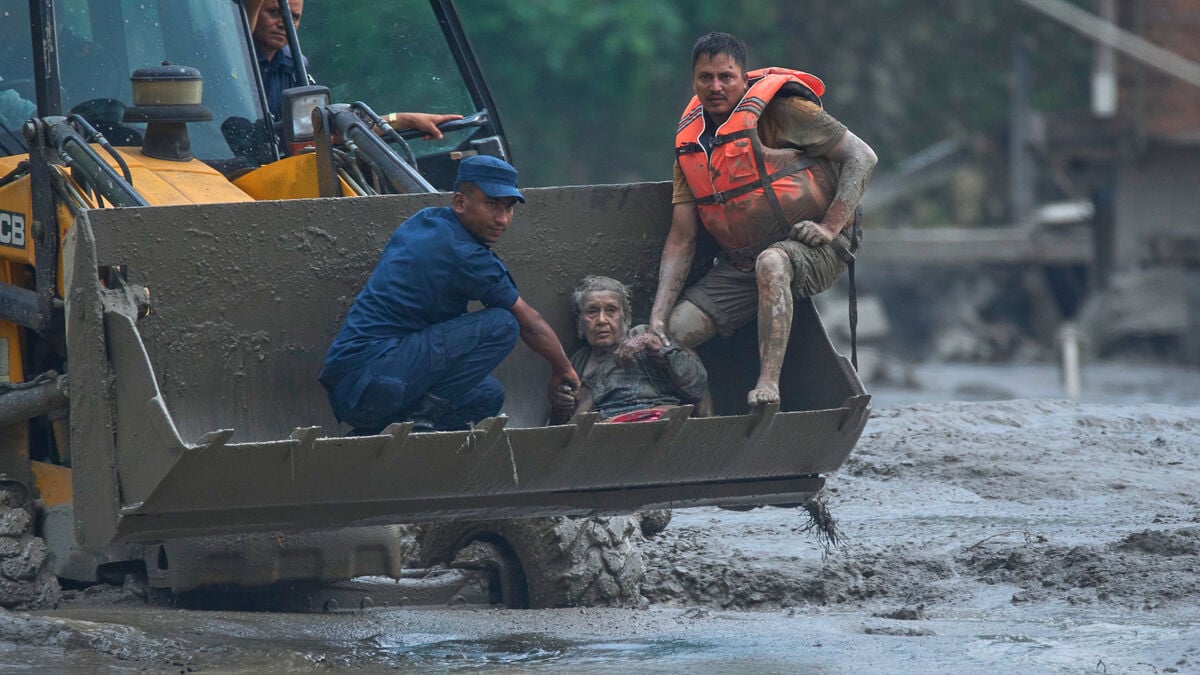
On Thursday, rescue workers and civilians are in the mud searching for survivors. One of them, Subash Khatan, is looking for his brother.
"He is one of the missing from Rasuwa (one of the worst-hit areas). That's why we are out looking for him," he told AFP.
Many of the missing people have been to the mountain region as tourists. Among them are around a hundred Indians who have been on a pilgrimage, but also dozens of people from Europe and the United States, among others.
A Swedish citizen and a foreigner resident in Sweden are among the missing, the Ministry of Foreign Affairs confirms to TT.
Started with ice avalanche
The Himalayas are home to some of the world's highest peaks and numerous glaciers. Experts believe the sequence of events began with an ice avalanche on a melting glacier. The avalanche caused such tremors that it was initially mistaken for an earthquake.
This was followed by a grey-brown flood of water and mud that swept down the valleys at high speed, causing the Lhende Khola river to rise by up to nine metres within half an hour.
Warnings have been issued for another tidal wave as there are still dams higher up in the mountains.