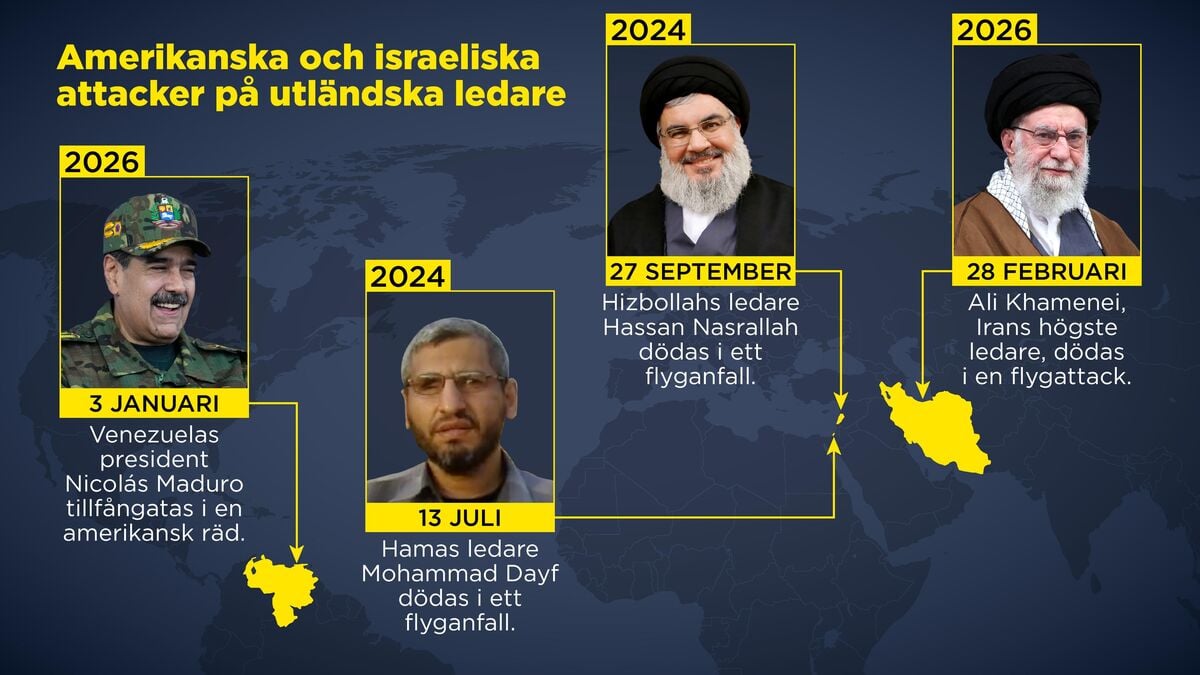
Iran's supreme leader, and before him Venezuelan President Nicolás Maduro, are just the latest in a string of high-ranking figures to be targeted by the US and Israel. Such raids astound the world but are fundamentally nothing new, says Paul McGarr, an intelligence scholar at King's College London.
Assassination attempts have been carried out by intelligence services since the beginning of time - but often without success.
The difference is that the US and Israel now seem to have achieved a completely different level of accuracy.
Lately, there has been a very high percentage of successful raids against high-ranking individuals.
McGarr explains this with new technology: satellites, drones and surveillance cameras. He also says AI now makes it possible to process gigantic amounts of data from the constantly connected devices that everyone now carries.
It seems that the Israelis have been pioneers in using social media and other billions upon billions of open data from the web, and then going through, analyzing, and filtering the data to draw life and behavioral patterns of people they are interested in.
The Prime Minister's Bodyguards
The data doesn't have to come from the main characters themselves. McGarr cites the Swedish example from last year, when Dagens Nyheter revealed that Prime Minister Ulf Kristersson's bodyguards posted their runs on the training app Strava – data that made it possible for anyone to map the movement patterns of security guards in Sweden's top government.
But to carry out actions like the capture of Maduro and the death of Khamenei also requires classic espionage, human sources on the ground - something that Israel is perhaps the best in the world at. As a small country surrounded by enemies, Israel has not had much choice, says Tony Ingesson, a researcher in intelligence analysis at Lund University.
They've been working so consciously on it for so long, ever since they were founded, really. Because otherwise they don't have a chance.
“I can’t afford it”
Iran has almost ten times the population of Israel, but not the same capabilities.
"There we had the revolution, so we had to rebuild from that. Then there are internal rivalries between different factions within their security apparatus," says Ingesson.
The Israelis can't afford to have a bunch of internal factions that fight and bicker and oppose each other, but on the contrary, they seem to be quite good at collaborating and utilizing their resources to the max.
Israel's partner, the United States, has also invested heavily in recent decades, at least since the major terrorist attacks of September 11, 2001.
It was seen as an intelligence failure and a security service failure, says Ingesson.
Then came the "war on terrorism" and in connection with it, a lot of effort was invested in reforming and building up, strengthening the intelligence apparatus.
“Shrinking almost day by day”
However, Ingesson wonders what President Donald Trump's moody rule will lead to.
I wouldn't consider it entirely certain that they can maintain this capability over time, the way they are messing with their security service and their intelligence apparatus right now. This is perhaps the culmination of their capability.
So far, the US and Israel have unparalleled capabilities to strike their enemies anywhere in the world. But even in terms of technology, the clock is ticking for their advantage.
It is becoming more and more of a double-edged sword, as the threshold for such technology is getting lower and lower, says Paul McGarr.
In the past, states had a monopoly on things like satellite imagery. Now you have commercial satellites in low orbit everywhere.
So the advantage of Israel and the United States is shrinking almost day by day. Their rivals are learning to turn these methods the other way.
Facts: Attacks on leaders in other countries
Israel and the United States have carried out a number of spectacular raids against leaders of militant organizations and other countries in recent years. Some of the most famous include:
January 3, 2020: Qasem Soleimani, Iranian general and commander of the Revolutionary Guard, is killed in a US drone strike while visiting the Iraqi capital, Baghdad.
July 13, 2024: Mohammad Dayf, the legendary military leader of Palestinian Hamas, is killed in an Israeli airstrike on the Gaza Strip.
July 31, 2024: Ismail Haniya, political leader of Hamas, is killed in an explosion while visiting Tehran to attend the inauguration of Masoud Pezeshkian as President of Iran. According to media reports, the explosion was triggered by agents of the Israeli Mossad.
September 27, 2024: Hassan Nasrallah, longtime supreme leader of Lebanese Hezbollah, is killed along with over 30 others in an Israeli airstrike on Beirut.
January 3, 2026: Venezuelan dictator Nicolás Maduro is captured in the capital Caracas by the US elite Delta Force, and is quickly taken out of the country.
Feb 28, 2026: Ali Khamenei, supreme leader for life in Iran, is killed by US bombs in Tehran.