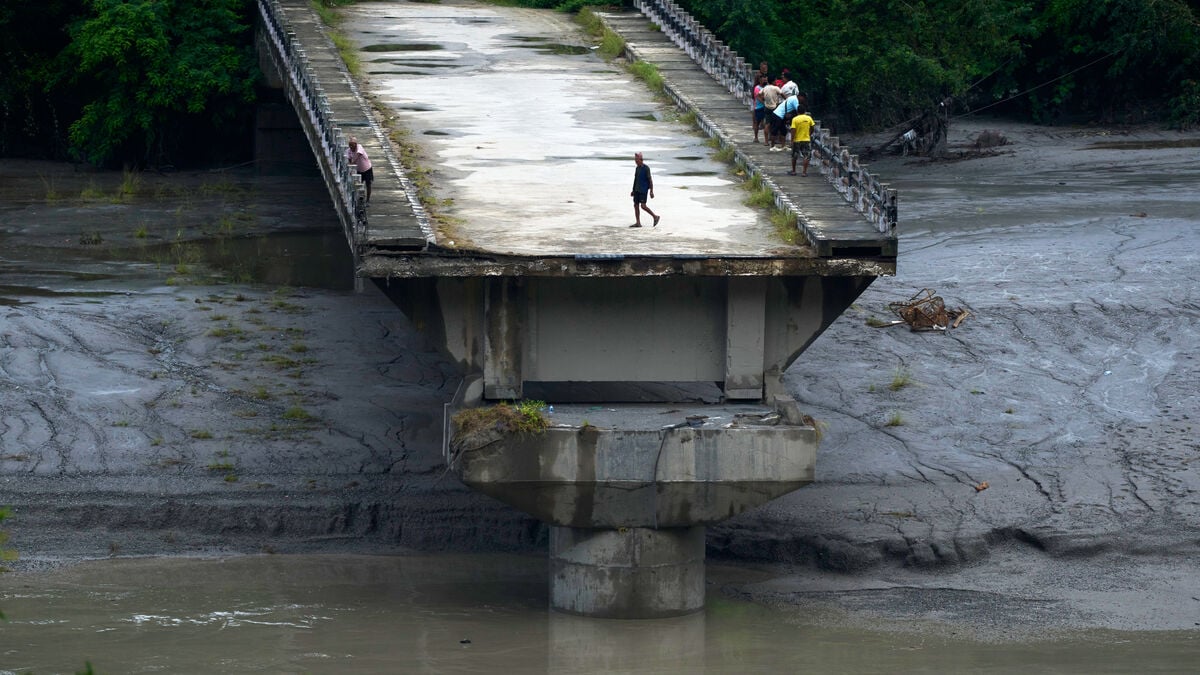
More than 900 waterworks workers are missing after Wednesday's mudslide in the Himalayas. About a hundred of them are believed to be alive and trapped in tunnels under mud and rubble for five days.
At one of the larger waterworks, Trishuli 3A, the military rescue team managed to drill a hole through the mud wall into the tunnel to get air and a camera in on Saturday evening. Conditions in the disaster area are difficult. Even finding the tunnel entrances is difficult due to the mud and debris.
Special team
Work has been paused in several places due to the risk of new flooding, and the operation at Trishuli 3A also had to be temporarily halted due to rain before it resumed on Sunday and air was able to enter through a narrow opening.
"As the water levels have receded, the team has resumed work to locate the tunnel opening using drills, excavators, hydraulic cutting tools and other equipment," the Nepalese army wrote in a statement.
Special teams from China and India have been sent to Nepal to help, and Nepalese mountain rescue experts are also participating in the search for survivors.
750 confirmed dead
So far, 750 people have been confirmed dead after the disaster, which is believed to have started with an ice avalanche on a melting glacier, followed by a huge grey-brown flood of water and mud that swept down the valleys at high speed.
More than 3,000 people are still missing in Nepal.
Chinese authorities on Sunday updated the death toll on their website to between 7 and 16 dead. 546 are listed as missing, of whom 261 are foreign nationals, according to the Xinhua News Agency.
Of the missing foreign citizens in China, 39 are reported to be Indians, 33 Latvian citizens and 18 Americans, writes the New York Times.
The United States has announced that it will send $3.6 million, equivalent to just over SEK 34 million, in humanitarian aid to Nepal. The country previously pledged $500,000 in aid following the disaster that hit Nepal and Tibet.