Although the Black Death – also called the Black Death or the Great Death – had a mortality rate of up to 60 percent in some regions of medieval Europe, the reasons why it came and spread at that time have not been fully understood.
But a new study, published in the journal Communications Earth & Environment, links a volcanic eruption at an unknown location in the tropics around 1345 with extremely cold and wet conditions in southern Europe that led to crop failures and famine.
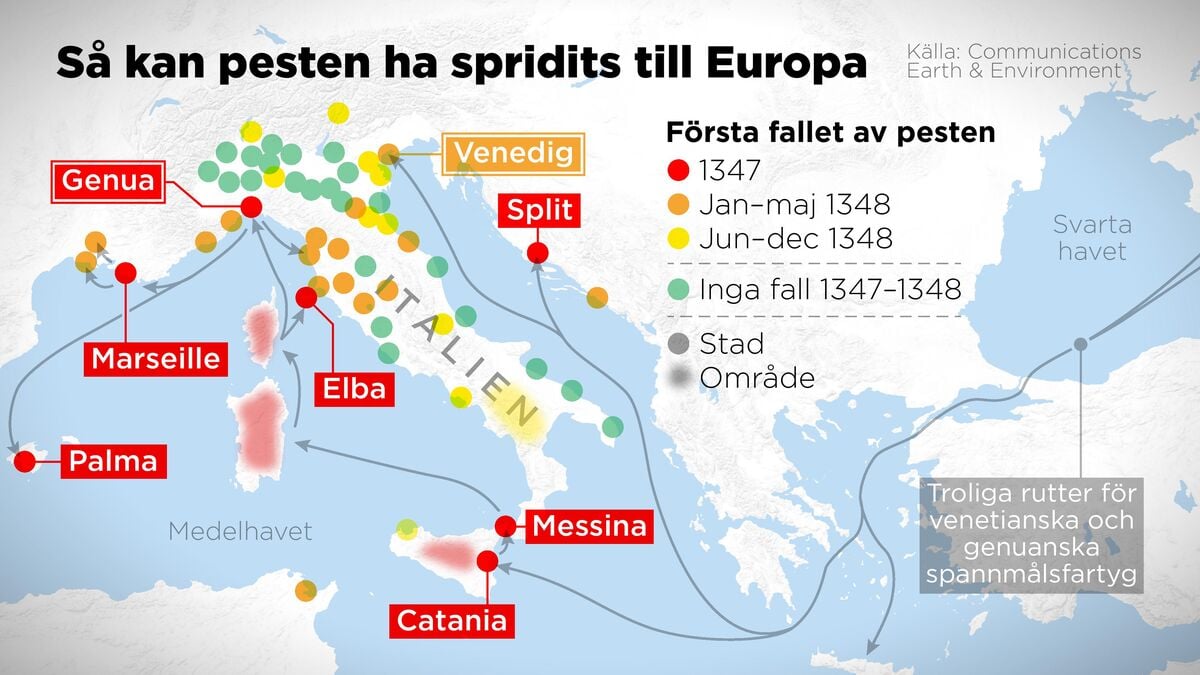
The crop failure in turn prompted the Italian city-states such as Venice and Genoa to enter into a truce with the Mongols of the Golden Horde in order to import large quantities of grain from the Black Sea region in 1347. There, the plague had taken hold about a decade earlier.
Infected with plague
The grain may have saved the inhabitants of Italy from starvation, but the timing suggests that it brought with it fleas infected with the plague.
This theory is actually not entirely new, says Fredrik Charpentier Ljungqvist, professor of history, especially historical geography, at Stockholm University, who himself has been involved in studies that have pointed to the same thing.
However, previous studies have not clarified the entire chain, especially not by comparing how unusual the climate extremes and crop failures were for their time and linking it to the increased grain imports from the Black Sea region to individual port cities.
What's new is that they look at which cities imported a lot of grain from the Black Sea region and the first evidence of plague epidemics. Then you see that the cities that import tend to get the plague first and those that don't import much don't get the plague until later.
Would have probably reached Europe anyway
Ljungqvist describes fateful timing.
It's the timing of the climate extremes and the crop failure. If it had happened 15 years earlier with the same import boom, there would have been no plague. Because at that time the plague did not yet exist in the Black Sea region.
Ljungqvist emphasizes, however, that the Black Death would have probably reached Europe sooner or later, with or without crop failures, due to travel and trade.
But it could have taken a few more years and the plague might not have been introduced as violently, but only gained a foothold in one place, and then it is possible, purely speculatively, that it would not have spread to the same extent in Europe or much more slowly, if it had only been introduced in one place.
Facts: The Black Death
Pandemic with high mortality caused by the plague bacterium Yersinia pestis.
Affected Europe 1347–1353 and also Africa and Asia.
Central and Eastern Europe fared better from the plague than Western Europe.
The plague strain behind the Black Death originated in Central Asia in the 1330s.
New plague epidemics then regularly struck Europe until the beginning of the 18th century.
The plague was spread, among other things, via fleas from wild rodents and rats.
Appeared both as bubonic plague (over 50 percent mortality), pneumonic plague and septicemic plague (both almost 100 percent mortality).
Source: Fredrik Charpentier Ljungqvist