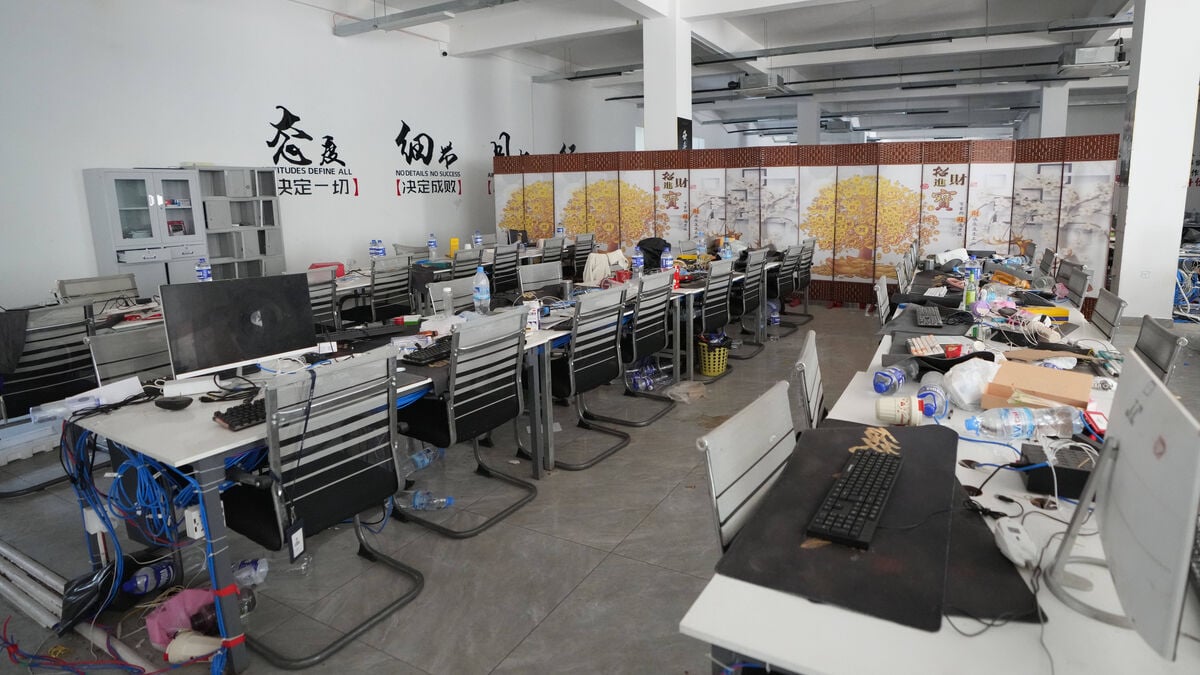
People are lured to Southeast Asia through fake ads on social media. They are promised good salaries for jobs in customer service or IT support. But once there, their passports and phones are confiscated. They are locked up and forced, under surveillance and threats, to try to scam people in other countries out of their life savings through romance scams and fraudulent cryptocurrency investments.
The number of people being trafficked and forced to commit online fraud for criminal groups is increasing sharply, warns the UN migration agency IOM. Around 300,000 people from over 80 countries are being exploited in the fraud. The victims often come from countries such as Bangladesh, Indonesia, India, Kenya and Ethiopia.
The border areas around the Mekong River, especially in Myanmar and Cambodia, have emerged as centres of activity.
The problem is growing because political elites in these countries continue to support and protect criminal organisations, says Mina Chiang, founder of the UK-based anti-trafficking organisation Humanity Research Consultancy.
In Cambodia, deep-rooted corruption has allowed these businesses to flourish, and in Myanmar, fraud has become a major source of income for the military junta.
Bigger than drug trafficking
Last year, online fraudsters stole between $88 billion and $114 billion from people in East Asia, Southeast Asia, Australia and New Zealand, according to new figures from the United Nations Office on Drugs and Crime (UNODC).
The sum has more than tripled since 2023. Online fraud has become more profitable than the global drug trade, according to calculations.
The operations are often carried out in “scam centres” – large office complexes behind walls and barbed wire with armed guards. The facilities resemble cities, with everything from restaurants and grocery stores to casinos and karaoke bars, which the scammers are allowed to visit as a reward. But those who fail to swindle enough money during the up to 19-hour workdays are tortured, beaten and sexually assaulted.
Advertises services
AI translations have made it easier to scam people in different countries, but scammers are also advertising for people who speak languages like German, Polish, Spanish – and Swedish. Some of those involved in the scams have applied for the job themselves, and have not been scammed.
Mina Chiang shows a post in a Telegram group where people advertise their services for jobs at the scam centres. A young woman posts a video clip in English with a Norwegian accent, saying that she is 27 years old, has experience working as a model and in “telephone work,” and that she speaks English, Norwegian, Swedish, Thai and Lao. Her presentation says that she is based in Phnom Penh, Cambodia, and that she can use AI filters when talking to her victims.
This is probably about a person advertising their services to work on romance scams, says Mina Chiang.
Facing the death penalty
Chinese crime syndicates are the main force behind the fraud industry in Southeast Asia, according to the UNODC. Last week, the EU imposed sanctions on the multi-billion dollar Prince Holding Group and its Chinese CEO Chen Zi, who is accused of building an empire of fraud centres in Cambodia and Myanmar. Cambodia extradited him to China in January.
Following pressure from several countries, including the US and the UK, Cambodian authorities say they are cracking down on the fraud industry. In Myanmar, parliament recently approved a new law against online fraud, which allows for severe penalties – including the death penalty – for those who use “violence, torture and deprivation of liberty” to force someone to commit online fraud.
But critics say the crackdown will not put an end to the fraud.
There are strong indications that government officials are directly benefiting from the fraud, including through their ownership of shares in the fraud centres, says Mina Chiang.
The raids are chaotic and resourceful criminals can quickly adapt, move their operations and continue them in other locations.
Victims of international online fraud in East Asia, Southeast Asia, Australia and New Zealand lost between US$88 billion and US$114 billion in 2025, according to the United Nations Office on Drugs and Crime (UNODC). The figures do not include victims from the rest of the world.
In recent years, the scale has increased enormously. As recently as 2023, losses in the same region were estimated at between $18 billion and $37 billion.
The worst affected in the region are residents of China, South Korea and Taiwan, according to the UN report.
Source: UNODC