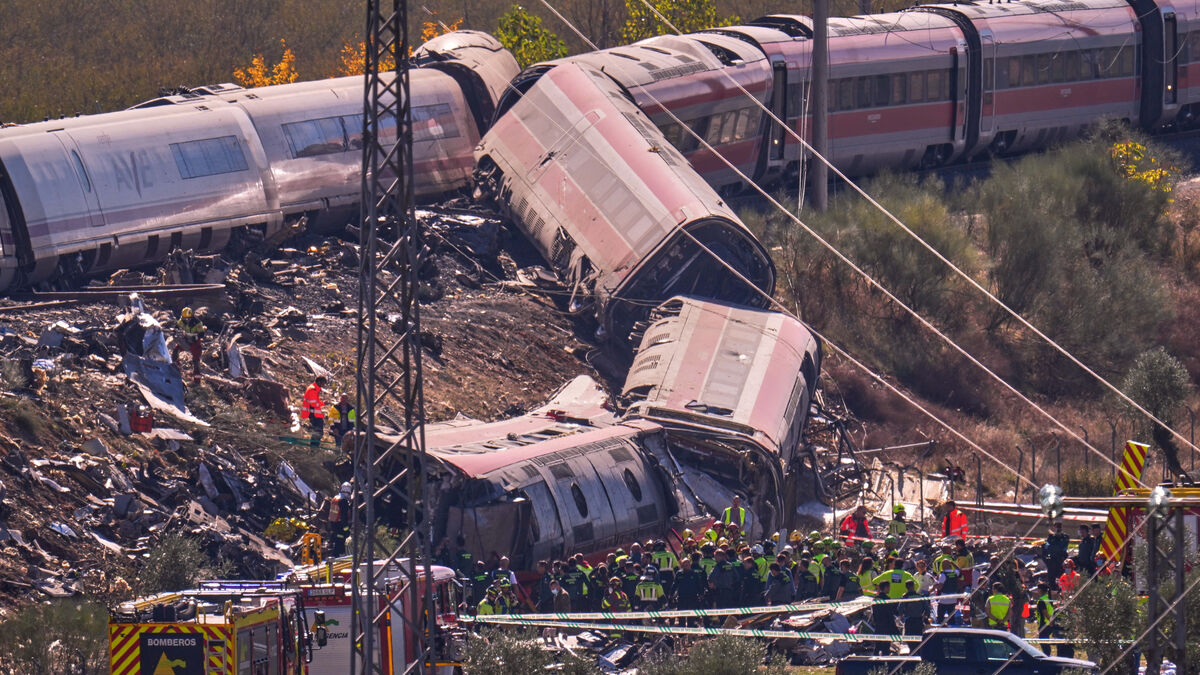
A high-speed train struck a stationary train from behind at around nine o'clock on Wednesday morning on one of the high-speed lines in the municipality of Urda in Toledo, just over 10 kilometres south of Madrid.
Both trains, which are said to belong to state-owned Renfe and privately owned Iryo and can travel at speeds of up to 300 kilometres per hour, were heading south. One of the high-speed trains had left Madrid at eight o'clock and was heading for Seville.
The death toll, which stood at 68 this afternoon, is likely to rise. Health Minister Mónica García writes on X that around 80 people have been taken to hospital, 15 of whom are seriously injured. In addition, more victims may still be found in the wreckage. Around 200 soldiers have been called in to search for injured people in the rubble.
The two trains had a total of more than 540 passengers on board at the time of the accident. The Swedish Ministry of Foreign Affairs has no information about any injured Swedes.
The human factor
The human factor was initially thought to have played a role in the accident, as an automatic signalling system did not function as it should. Transport Minister Óscar Puente confirmed the information at a press conference, where he stressed that the train crews were not at fault.
He says, according to El País, that a computer error caused all trains on a stretch of about 60 kilometres to automatically receive a stop signal, but that a traffic control centre nevertheless gave a high-speed train the green light to continue. Twenty-three minutes later, the catastrophic collision occurred.
"I'm not attributing responsibility to anyone. I'm just stating the facts," says Puente.
“Cannot continue to happen”
The accident follows several serious train accidents in Spain in recent years. In January this year, 45 people died in Adamuz, Andalusia, when a high-speed train travelling from Málaga to Madrid derailed and crashed into another train.
The worst train accident in Spain in recent decades took place in Santiago de Compostela, Galicia, in 2013, when a high-speed train derailed on a curve, killing around 80 people.
Prime Minister Pedro Sánchez promises that Wednesday's accident will be thoroughly investigated and that any errors will be brought to light.
It is clear that we must increase security further. Tragedies like this cannot continue to happen in a country like ours, he says.
The high-speed line between Madrid and Seville was inaugurated in 1992. Today, Spain has the largest high-speed network in the EU, with several hundred departures every day.







What do you think?