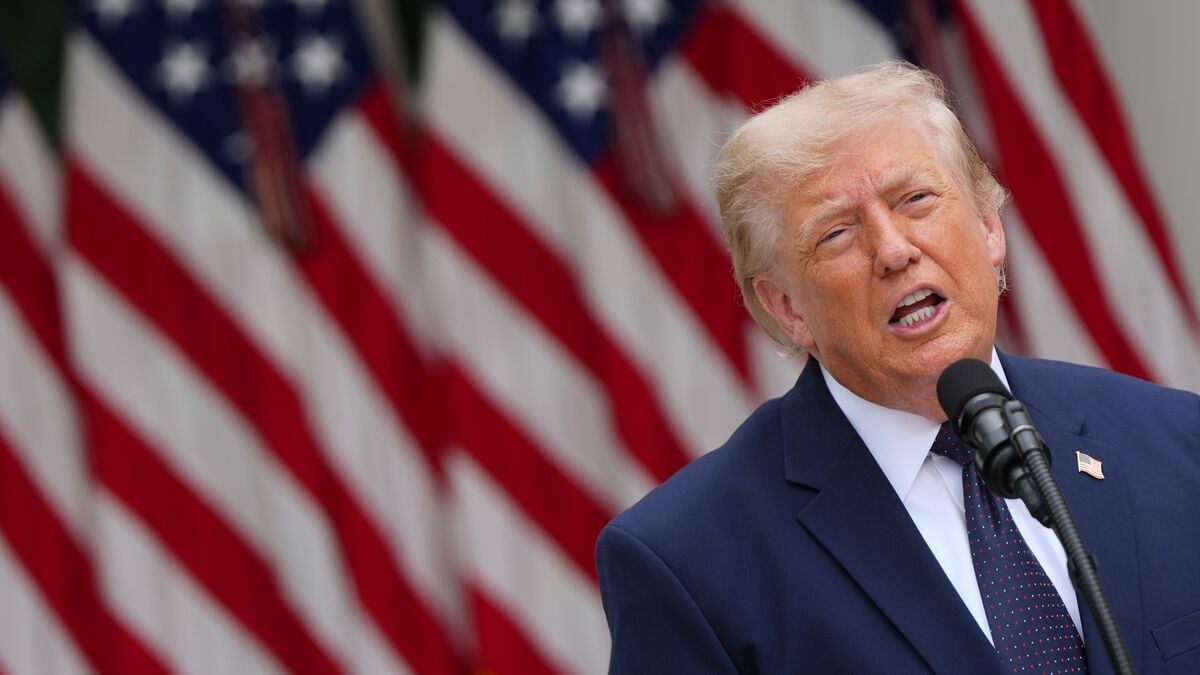
"We must stop the threat (from communism) immediately, before it takes hold. It's like a cancer," Trump said in a recent speech.
The president claims that the “communist threat,” without elaborating on what he is referring to, poses a more serious danger to the United States than both world wars and the terrorist attacks of September 11, 2001.
"They are not democratic socialists - they are communists. They want to destroy our country," Trump
of the relatively small group of politicians he claims are taking over the Democrats.
Reduced gaps?
It is clear that Donald Trump has his sights set on the fall midterm elections for Congress and a number of governor and mayoral posts. Incumbent Democrats from New York and Colorado, among others, have been knocked out in primary elections by more progressive party colleagues from the Democratic left wing. Several of them claim - like New York Mayor Zohran Mamdani - to be democratic socialists and members of the organization DSA, whose ideology can be compared to that of the Swedish Social Democrats.
However, it is far from communism, where state ownership and one-party rule are central. DSA members are not opposed to a market economy or democratic elections, but many advocate universal healthcare and childcare, and reduced economic disparities. They are often, but not always, Democrats.
Among the better-known representatives are Senator and former presidential candidate Bernie Sanders and Representative Alexandria Ocasio-Cortez. It is clear that the energy within the Democratic Party now lies with its left wing, which brings together both progressive politicians and DSA supporters.
Governance in cities
The big cities of New York and Seattle are already governed by democratic socialists in the form of mayors Mamdani and Katie Wilson. In the capital, Washington DC, everything indicates that their fellow socialist Janeese Lewis George will win this fall's mayoral election. And in Los Angeles, incumbent Democratic Mayor Karen Bass is being challenged by DSA member Nithya Raman.
The White House's sudden labeling of them as communists is strategic, at a time when many Americans are unhappy with the Iran war, fuel prices and high inflation, according to Daniel Drezner, a professor of political science at Tufts University.
"Many voters, especially independents, see Trump's party (the Republicans) as too extreme," he told AFP.
One way to address this is to portray the opposing party as even more extreme.
Facts: Support for Donald Trump
Republican Donald Trump took office for his second term as US president on January 20, 2025. Since then, his approval rating has declined, as is common for a sitting president. In recent months, in line with the Iran war and the resulting increase in the cost of living, the decline has become more pronounced.
Currently, 40.5 percent think Trump is doing a good job, while 56.8 percent don't think so, according to Real Clear Politics' compilation of 14 recent polls. The figures are in line with those reported on the Silver Bulletin website, started by opinion expert Nate Silver. According to Silver Bulletin, however, the percentage who give Trump a thumbs up is slightly lower: 39.3 percent.
According to the site Fiftyplusone, an opinion aggregator that weights current surveys using a mathematical model, Trump's support is even lower: 37 percent. 59.2 percent disapprove of the president's job performance.
The midterm elections to Congress on November 3 will determine whether Trump's Republican party can retain the majority in both chambers. Elections for state congresses and certain governor and mayoral positions will also be held.