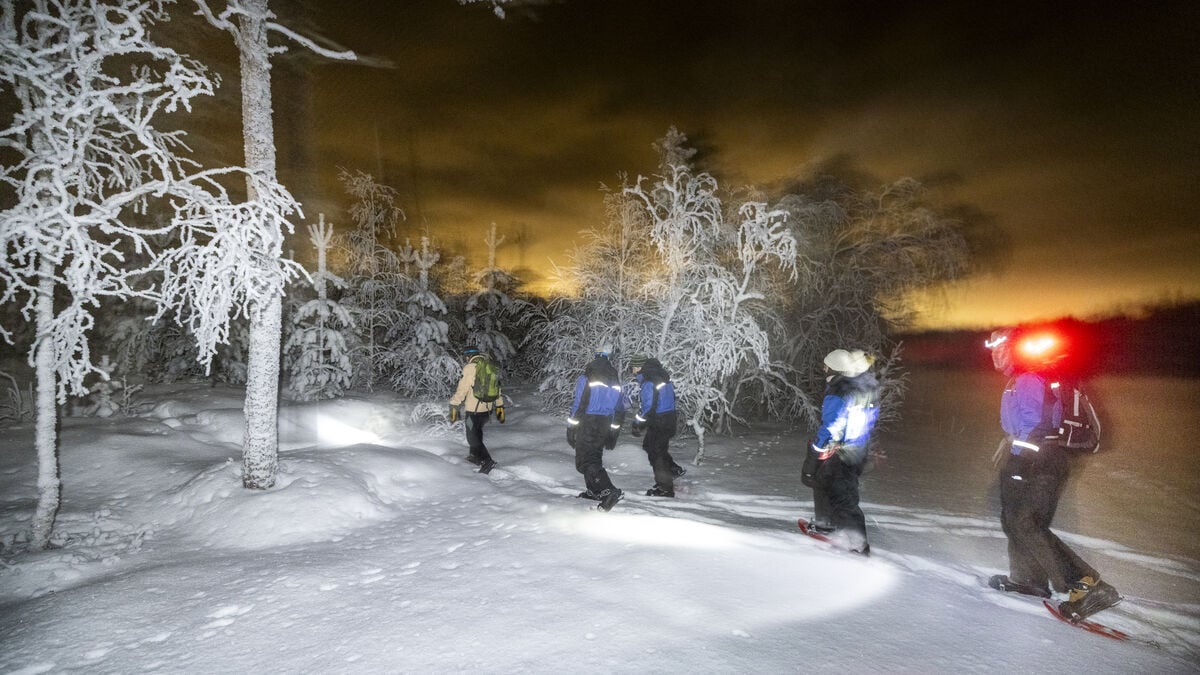
It's dark and bitterly cold. The small group on snowshoes trudges on with one goal in mind - to see the Northern Lights.
Amandine Deruet and Guillaume Palamin from Lille, France, had been ice skiing earlier in the day. That alone was exotic, but it's the Northern Lights they really want to see.
The sky is worryingly overcast and guide Roy Gubbels advises keeping an eye out for changes in the clouds and watching through your phone. He warns that the Northern Lights are not always as spectacular as they are on Instagram.
Often it looks more like a little green cloud. People can be disappointed.
Winter tourism is increasing
Amandine and Guillaume are not alone in heading to northern Sweden in search of the Northern Lights.
The number of international winter tourists has increased steadily in recent years. Private travel in particular has gained momentum. Two French tour operators fly directly from Paris to Luleå, and for a few months there have also been flights between Zurich and Luleå, making travel easier for longer-distance tourists.
Claudia Tan from Singapore visits Luleå with a large group of colleagues. The temperature difference is more than 50 degrees compared with home as she sits on the ice fishing for perch.
The group will continue north, cross into Finland and end in Stockholm. Although there is a lot she wants to see and experience, there is one thing that is at the top of her wish list.
"Northern Lights," she says, smiling broadly.
Everyone wants to see
Virtually all winter tourists want to see the Northern Lights, confirms Camilla Bondareva, head of unit at Visit Luleå.
I think awareness and recognition of us as a Northern Lights destination have definitely increased. I also hear that from the tourist center, which meets many visitors there.
Even though the Northern Lights come in cycles and will wane, she believes tourists will continue to come.
It may not be exactly as often, but we will always, and have always, been able to see the Northern Lights here.
Humans have always been fascinated by the Northern Lights. The mysterious lights have often been associated with danger, evil or sudden death.
Now we know that it is plasma physics in action, a window into the plasma universe. We learn more about plasma physics by studying the aurora borealis, says Urban Brändström, space physicist and researcher at the Institute of Space Physics.
Important research
Much is still unknown, but research into the aurora borealis is becoming increasingly important. Technological developments have meant that, for example, power supplies and communication systems can be disrupted by powerful solar storms.
The more technologically advanced we become, the greater the demands placed on us to understand the physics of space closest to Earth.
You could say that the aurora borealis is the only space weather we can see. But it has effects such as radiation bursts, particle storms and magnetic storms. With better space weather forecasts, we can avoid technical infrastructure being knocked out or astronauts being injured or killed by high radiation doses.
The solar storms that cause the Northern Lights occur in eleven-year cycles, and in recent years activity has been high. This winter may have been the peak of an eleven-year cycle, explains Urban Brändström.
But it's hard to know for sure until we see a clear decline in solar activity.
Requires night vision
Clear skies, good night vision and a dark place are his best tips for experiencing the Northern Lights. And don't look at your phone or other strong light sources.
It takes 20 minutes to half an hour to gain full night vision and it takes less than a second to lose it if you look at such bright light.
Another tip is to linger after a truly spectacular Northern Lights display.
If you're in a really dark place, you can see beautiful, very faint Northern Lights that pulsate like disco lights across the sky. You can get black Northern Lights that look like arcs of aurora, like darker structures in a diffuse green aurora. It's something that a lot of people miss.
This evening the sky over Brändön is silent and gray. A disappointment? Brothers Niall and Sam Radcliff from London think so; they came to see the Northern Lights.
Amandine Deruet is happy anyway. She saw the Northern Lights from the cabin the night before.
Just being out like this in the Swedish countryside is fantastic.
There are both Northern Lights and Southern Lights - also called aurora borealis and aurora australis respectively. These are light phenomena that are most common in the Earth's polar regions.
The glow is formed by particle radiation from the sun which, on contact with the Earth's atmosphere, initiates electromagnetic radiation (light).
The aurora borealis is often yellow-green in color. It can also be red or shift to red-violet. We can only see the aurora borealis with the naked eye at night. In daylight, special instruments are required to see the phenomenon.