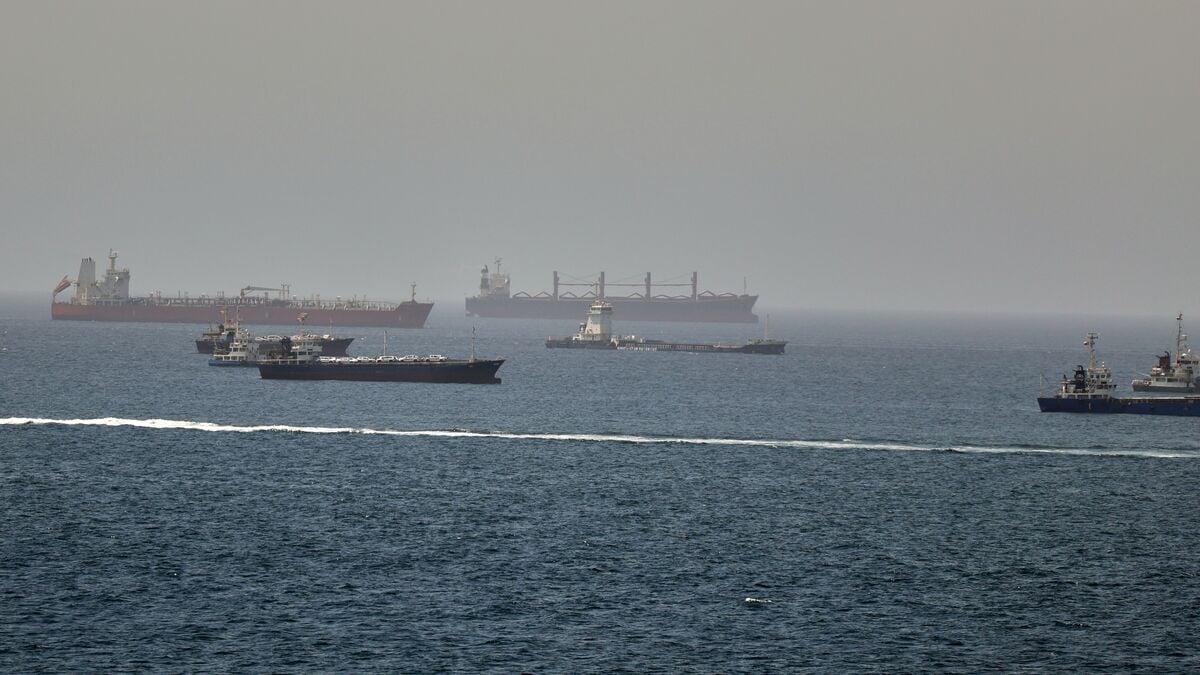
The declaration of intent that the US and Iran have entered into - which could ultimately lead to peace - means, according to various leaks, that Iran will be allowed to resume its oil exports immediately.
That appears to be the case, as the three tankers have been allowed to leave port and sail on. They passed through the area in the Persian Gulf where the US had established a blockade, the maritime traffic monitor Tankertrackers reported on Wednesday night.
The ships are said to be carrying a total of 4.8 million barrels of Iranian crude oil.
Back to the status quo?
When the first agreement was announced earlier this week, US President Donald Trump stated that the Strait of Hormuz would be reopened to traffic.
The strait is the entrance to the Persian Gulf - and a bottleneck for a large part of the world's oil exports. Since the outbreak of war, Iran has warned and attacked ships that tried to pass, which has stopped traffic and shaken the entire world economy with skyrocketing energy prices.
The parties do not seem to fully agree on how traffic there should be regulated in the future, as the Iranian side claims that the country should be allowed to charge fees.
In practice, Iran has deterred all traffic with simple means - drones and naval mines - and is said to have warned it would continue to do so if the declaration of intent collapses.
European countries, led by France and Britain, say they are prepared to secure shipping in the strait in a military operation.
Israeli attacks are causing friction
The memorandum of understanding is to be signed by US and Iranian representatives in Switzerland on Friday, but the wording is still being kept secret. Iran has outlined several conditions and described them as concessions from the US, which the US has rejected or rephrased.
Several major issues - most notably Iran's nuclear energy and Israel's military operations in Lebanon - still hang in the air. The thorny nuclear energy issue will be negotiated during the upcoming 60-day ceasefire.
Iran and Lebanon also interpret the agreement as meaning Israel should withdraw its military from southern Lebanon, but Israel says its forces will remain there.
On Tuesday, continued Israeli attacks on communities there were reported. Iran's military issued an alert reporting about 80 Israeli violations of the perceived ceasefire - warning that Israel could receive a "forceful military response."