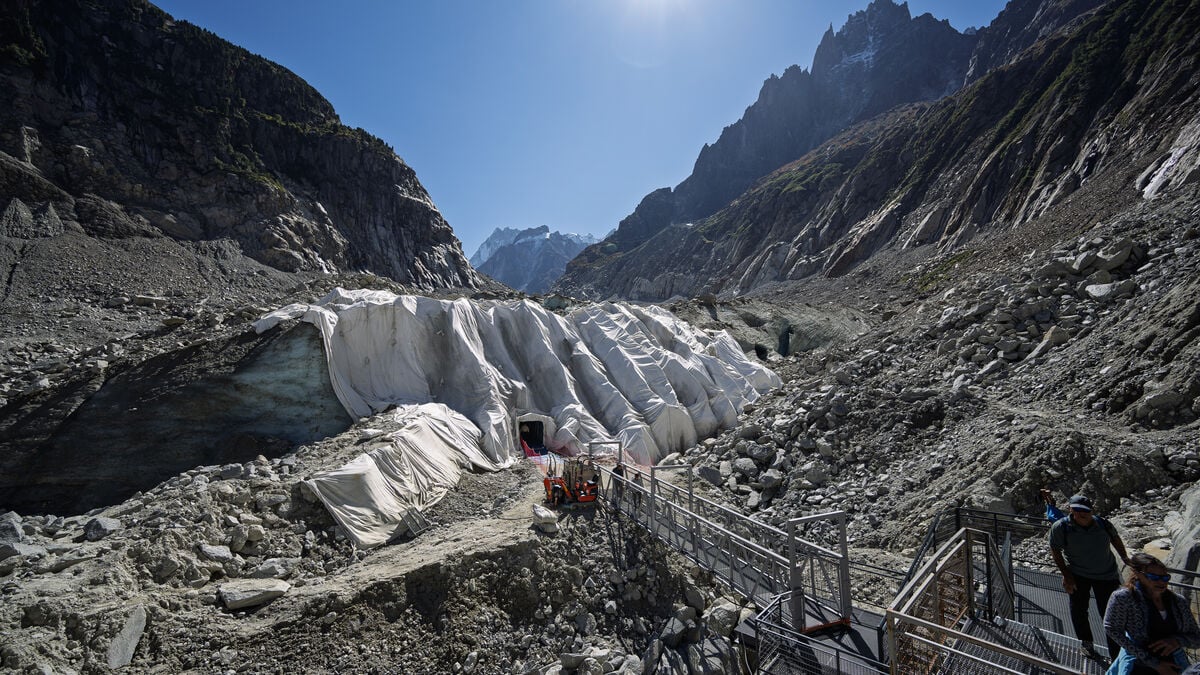
Scientists have looked for the first time at how many glaciers will disappear as the planet warms. Previously, the loss of ice mass was calculated.
According to the study, for example, 50 percent of the glaciers in the European Alps are at risk of disappearing over the next two decades.
"First, the small glaciers, like those in the European Alps, will disappear. Eventually, only those in Greenland and Svalbard will remain," said Lander Van Tricht, a glaciologist at ETH Zurich and co-author, during a digital press conference.
The researchers, who publish their study in Nature Climate Change , have used simulation models to calculate when glaciers will disappear most rapidly. They have calculated based on different temperature scenarios – 1.5, 2.7 and 4 degrees Celsius temperature increase.
If global warming is limited to 1.5 degrees, which many suggest it will not, it will happen most quickly in 2041. They also write that if we stay below 1.5 degrees, the number of glaciers remaining in 2100 could more than double compared to a scenario with 2.7 degrees of warming and prevent the almost total loss that would occur with 4.0 degrees of warming.
Glaciers and coral reefs are very visual and when they disappear it becomes clear what climate change is leading to, says Harry Zekollari at the Vrije Universiteit in Brussels at the press conference.
Facts: Glaciers in the Alps
There are around 4,000 glaciers in the Alps. Glaciers shrink when melting in summer is greater than growth in winter.
Between 2003 and 2015, the glacier area in the Alps decreased by 300 square kilometers – the equivalent of 42,000 football fields. From 2000 to 2023, two gigatons of volume disappeared per year, a total equivalent to just over half of Lake Vättern.
Meltwater from glaciers is of great importance to the Rhine and Rhône rivers. If the glaciers disappear, it could lead to low water flows that affect agriculture and shipping.
Glaciers and permafrost serve a function in stabilizing land masses. As temperatures rise, the risk of landslides, avalanches, and rockfalls increases.
After the warm summer of 2024, eight of Sweden's glaciers melted completely. There are now around 270 glaciers.
Glaciers are also important for tourism in many places, where skiing and hiking on glaciers are popular.