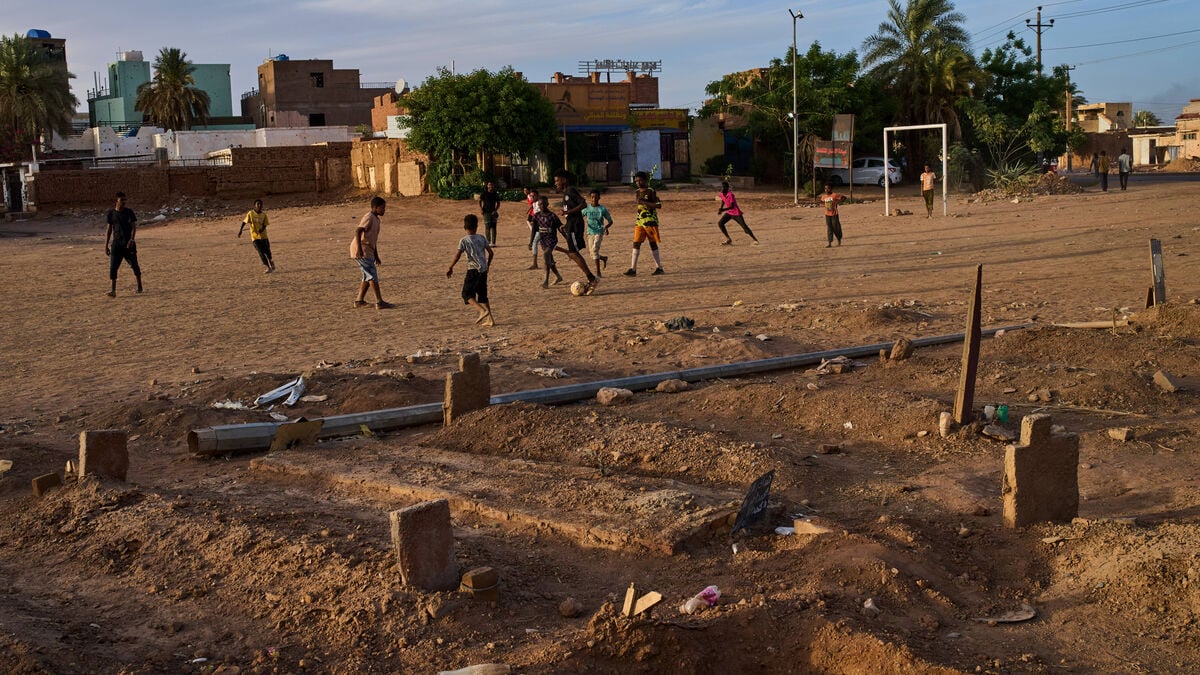
We are talking about thousands of terrorists and extremists who will affect the international order, warns Mohamed Kamal, country director for Plan International Sudan.
Many are children who have missed out on three years of education and are entering the adult world - at a time when extremist groups are spreading their messages on social media, adds Arjimand Hussain Wani, the organization's regional operations manager.
The frustration is palpable. They have traveled a long way and are sitting in a safe conference room in Stockholm, but inside, Kamal and Wani are still in Sudan. Stories flow from them about sexual violence, female genital mutilation, famine and millions on the run. And about the resilience of the women who nevertheless organize themselves and create support networks.
If you want to see violations of rights and conventions - come to Sudan. How could it have gone so far and become so cruel? Wani asks.
Country for everyone?
Sudan has been ravaged by brutal civil wars for decades. The latest wave, which began in 2023, is primarily between the regular army and the paramilitary RSF forces. The RSF - Rapid Support Forces - has its origins in the so-called Janjawid militias that former dictator Omar al-Bashir hired to crush rebellions in the Darfur conflict in the early 2000s.
The two armies cooperated after al-Bashir was overthrown in a popular protest wave in 2019. But soon the rivalry between them began to grow, war broke out and more militia groups joined.
However, the power game is much more complex than that, both men emphasize. It is based on ethnic and religious conflicts in the conservative, Muslim country. And the fact that the distribution of resources, mainly revenues from Sudan's gold and oil deposits, is so uneven.
Infrastructure, healthcare facilities, schools and power plants – most of it is substandard in the western parts. People there say that Khartoum is unable to create a country for everyone, Wani explains.
And then we have all the languages and the ethnic groups. People don't feel like they are represented.
On the way
In addition to the army and the RSF, between seven and nine Islamist militias are active in Sudan, according to aid workers. Add to that the Sunni Muslim religious and political movement Muslim Brotherhood, whose Sudanese branch was recently labeled a terrorist organization by the US. The lawlessness on the ground and the fact that tens of millions of children have not been to school for years create fertile ground for radicalization and recruitment.
"We know that children aged 11 to 14 have been recruited by the army. One boy who was filmed was given a very large gun and told to shoot whatever he was ordered to do," says Kamal.
Other young adults are being recruited by Islamist militias, many inspired by social media posts. Many are making their way north, likely as migrants with their sights set on Europe, says Arjimand Hussain Wani. Others say they want to join the war in Iran.
The crisis is spreading extremely fast. This is already happening. They are on their way.
Divided into groups
Left behind in Sudan is a scarred civilian population with enormous injuries, both physical and psychological. Mohamed Kamal talks about 13-year-old Amal, whom he met recently and who said she doesn't need food or toys - just to feel like a human being.
He has also met survivors from a group of about 75 people who tried to flee the oasis town of al-Fashir, which was captured by RSF last fall. The group had been driving with their headlights off for hours when they were suddenly stopped by a militia. The soldiers divided the fleeing people into groups, where boys aged eleven and older were taken to a military training camp. Dozens of girls were taken away. When they returned several hours later, they had difficulty speaking; it was clear that they had been raped.
Another group, women over 20, were forced to undress and sexually assaulted in front of their husbands. When the husbands protested, they were shot, the country manager says.
After robbing the group of money, mobile phones and other valuables, the survivors were left in the desert. They started walking and were lucky to find aid organizations in northern Darfur.
"Terrible. The incident illustrates the degree to which children, girls - people - are deprived of their rights, their needs and their human dignity," he says.
Hollowed-out rights
Kamal and Wani are now appealing to the Swedish government to get involved in creating a political solution to the Sudan crisis, a settlement that could eventually lead to a reconciliation process.
Their daily work is made more difficult by the global decline in support for aid and development organizations and the erosion of international law and the rules-based world order. At a recent donor conference for Sudan, only 16 percent of aid needs were covered.
Mohamed Kamal, who has previously worked in Mali and South Sudan, says that Sudan is unlike any other place. He himself struggles daily with food shortages, unclean water and constant power outages.
The number of people killed in the last three years of war is difficult to estimate. AFP describes it as "tens of thousands" while analysts have estimated that it could be over 100,000 people.
The war in Sudan is between two rival militaries and has been raging since April 2023.
On one side is the regular army, led by General Abd al-Fattah al-Burhan and with a power base in an establishment around the capital Khartoum and the Nile in the east.
On the other side are the so-called RSF forces, led by Mohammed Hamdan Dagalo (nicknamed Hemedti). They have their origins in the so-called Janjawid militias that former dictator Omar al-Bashir hired to brutally crush an uprising in the devastating and ethnically-charged Darfur conflict in the early 2000s.
Al-Bashir was overthrown in a wave of popular protests in 2019. But just over two years later, the two armies he had left behind - the regular military and the RSF - seized power in a joint military coup. Rivalry grew within their joint junta rule, and eventually full-scale war broke out between them.
Tens of thousands of people have been killed and tens of millions have been displaced, many of them to poor neighboring countries. In the Darfur region, there are renewed alarms about ethnic cleansing.
The military is believed to be receiving support from Egypt, Saudi Arabia and Qatar. The RSF is believed to be receiving support from the United Arab Emirates.