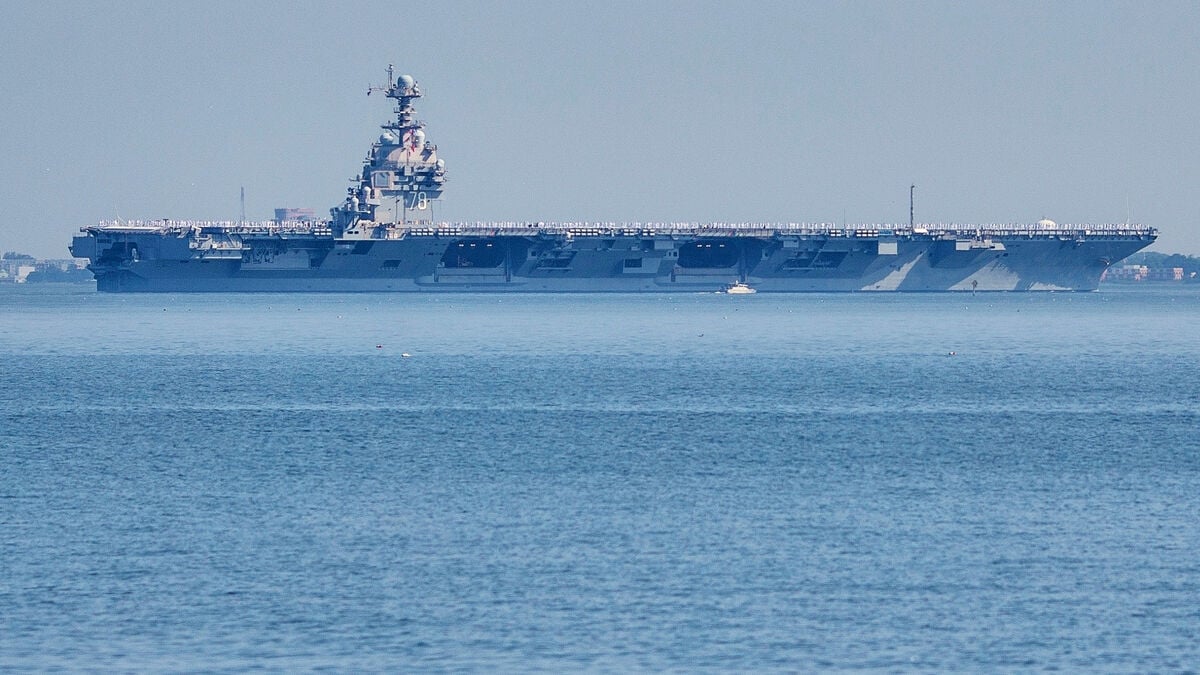
The mobilization in recent weeks around Iran is the largest the United States has made in a long time. The Air Force has not been called in on this scale since the invasion of Iraq in 2003, reports The Wall Street Journal.
The military is ready to attack as early as this weekend, according to reports in American media. And compared to the American and Israeli attacks last summer, this time it could be a more outright war. Such a war is likely to last for several weeks, sources tell the news site Axios.
Floating air bases
The United States' most powerful weapons are its aircraft carrier groups, each led by a massive aircraft carrier surrounded by destroyers and other warships. The carriers act as mobile air bases from which dozens of fighter jets can take off for major air strikes.
One of these ship groups has been in place for several weeks and another is on its way.
More fighter jets, air defense systems, and tankers have been deployed at American air bases in Jordan, Qatar, and other countries. The tankers allow for more sustained operations.
Warns of spread
Iran has, at least outwardly, dismissed the threats and warned that a US attack would start a regional war. Iranian forces have in recent days conducted military exercises in the narrow and strategically important Strait of Hormuz.
However, Iran's defenses are believed to be weakened after last year's attack. At that time, the heaviest bombings - those of Iranian nuclear facilities - were also carried out by so-called stealth bombers that could fly there relatively unnoticed from the United States.
Israel, whose government has argued for confrontation with Iran, is believed to be involved in an attack plan.
“Many arguments”
In January, US President Donald Trump threatened to intervene if Iran killed protesters participating in the large popular protests that were raging in the country at the time, but when several thousand were later killed, he did not follow through on the threat.
In recent weeks, the countries have instead been in closer negotiations, with the US once again wanting to talk about Iran's uranium enrichment. After last year's bombings in Iran, Trump said the country's enrichment capacity had been completely destroyed. The president's spokeswoman, Karoline Leavitt, has been asked what could then justify new attacks.
There are many reasons and arguments one could present for an attack on Iran, she replied the other day, and emphasized that "it would be wise" for the Iranian regime to enter into an agreement with the United States.
Iran's nuclear energy program has long raised concerns that the country will gain the ability to develop nuclear weapons.
Iran has been subject to extensive sanctions. In 2015, the JCPOA nuclear agreement was signed between Iran and the "P5+1" - the five permanent members of the UN Security Council (France, China, the UK, Russia and the US) plus Germany.
Iran's enrichment of uranium would be limited to a purity far below that required for nuclear weapons, but sufficient for civilian purposes, and greater transparency would be provided. In exchange, sanctions would be lifted.
In 2018, US President Donald Trump decided to withdraw from the agreement and impose stricter sanctions. Iran responded by stepping up its enrichment and stockpiles of uranium.
In 2025, Trump initiated new negotiations, but the talks broke down. The United States launched a military strike and bombed Iranian nuclear facilities. Talks between the countries resumed in February 2026.