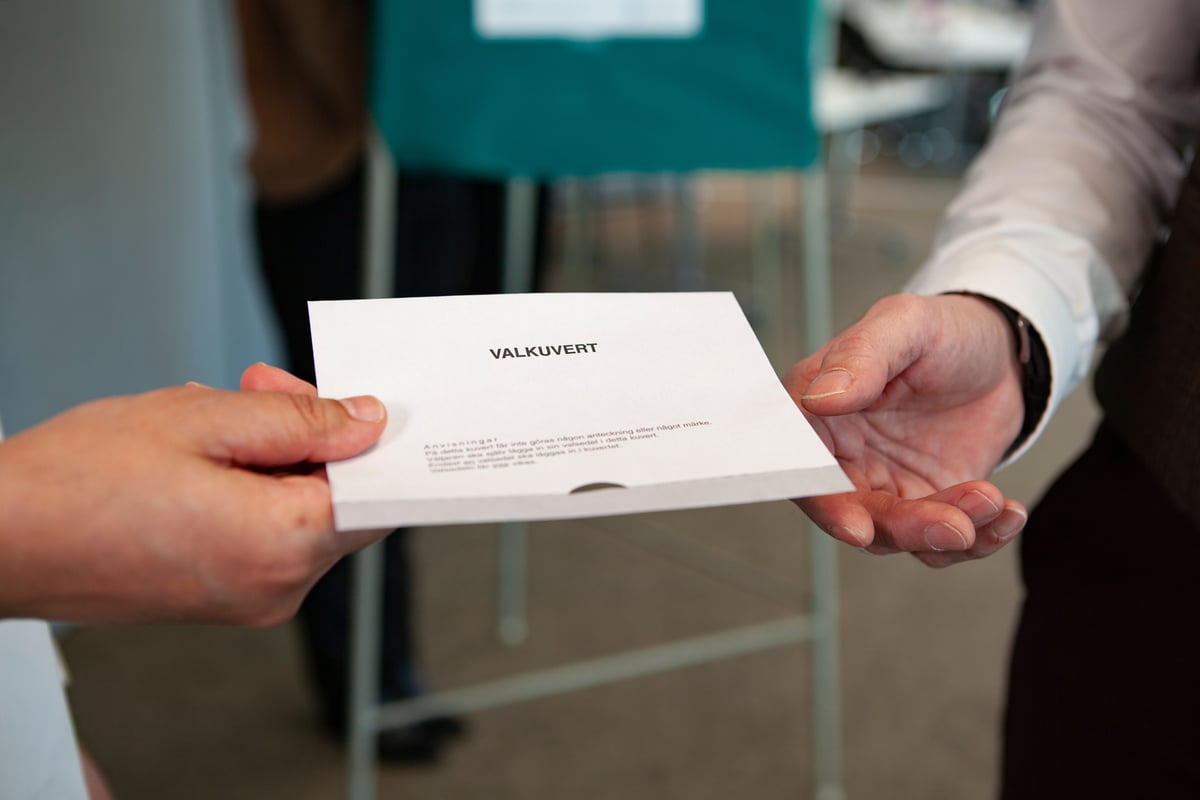
The Swedish election is approaching. With ten days remaining until election day, nearly one million people have already voted early in Sweden. This is more than 10 per cent of all eligible voters. Early voting has become commonplace in Sweden today, and the proportion is continuously increasing. Almost half of the electorate voted early in the previous election in 2022.
Early voting, or postal voting, is not a new phenomenon. It was introduced in Sweden as early as 1944. At the time, early voting was only available to those unable to reach the polling station, and only a few per cent were able to utilise the option. In 1968, postal voting was made available to everyone, and since then, more people have chosen to vote early.
Who, then, are the early voters? Is there a correlation with age or geography?
As votes are cast anonymously, exact figures are not available. However, an examination of statistics from Statistics Sweden (SCB) provides interesting data. There is a clear correlation between age and the likelihood of voting early. Older people vote early to a significantly higher degree. In the over-70 age group, more than 60 per cent vote early. Among first-time voters, only one in four votes early. Almost half of 20-year-olds vote early. In the 40 to 50 age bracket, two out of three choose to go to the polling station to cast their ballot.
There are also regional differences. Several municipalities in Norrland have the highest proportion of early voters. These are often smaller rural municipalities with long travel distances to the polling station and a higher proportion of older residents. However, Sweden's third-largest municipality, Malmö, stands out, ranking among the top for early voting. At the bottom of the list are several municipalities in southern Sweden, many with a smaller proportion of older residents.
The trend of an increasing proportion of early votes has consequences for the election campaign. The final week's live election debates are decreasing in importance, and the parties must adapt their election campaigns to voters making their decisions earlier [1].