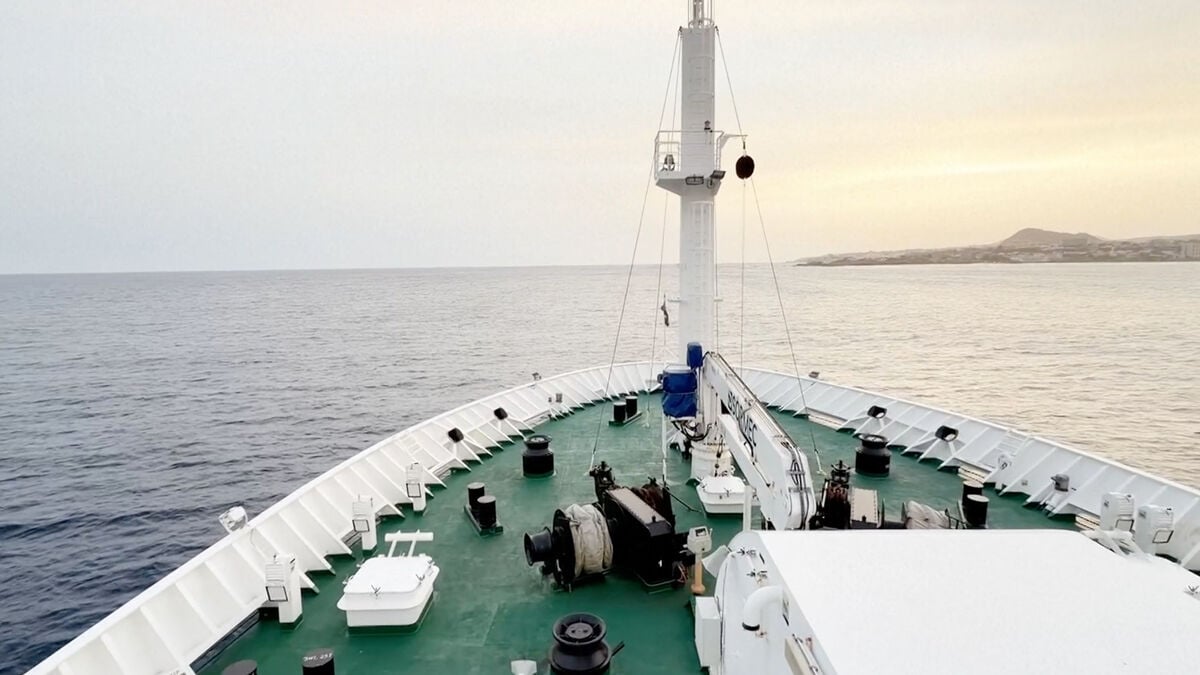
On March 20, 149 people boarded the MV Hondius in Ushuaia, Argentina, a gathering place for ships and tourists with their sights set on Antarctica and the remote islands of the South Atlantic.
The MV Hondius was an ice-reinforced expedition ship with four-course dinners, panoramic windows and a lecture room. For the cruise, with a final destination of Cape Verde, each passenger had paid between $18,000 and $29,000.
On April 6, somewhere around the British South Sandwich Islands, a 70-year-old man from the Netherlands fell ill with fever, headache, abdominal pain and diarrhea. On April 11, he died at sea. His body remained on the ship for almost two weeks.
Flew to South Africa - died
On April 24, the MV Hondius reached St. Helena, a volcanic outpost in the middle of the Atlantic belonging to Great Britain. The deceased man was disembarked together with his wife, who was about to begin the journey home to the Netherlands. At the same time, a British man sought treatment on board. He complained to the ship's doctor of fever, difficulty breathing and symptoms of pneumonia.
The next day, April 25, the Dutch woman flew to South Africa with her husband's body. She had begun to feel unwell and her condition worsened during the journey. Once in Johannesburg, she fainted and died in hospital the following day.
Out in the Atlantic, the MV Hondius was struggling. The ship had arrived at Ascension Island, 1,300 kilometers northwest of St. Helena, when the British man's condition worsened. On April 27, he was flown by helicopter for treatment in South Africa, where he was admitted to intensive care.
Hantavirus confirmed
On April 28, another passenger, a German woman, fell ill with symptoms of pneumonia. She died four days later on the high seas.
The next day, on May 3, the ship reached the waters around Cape Verde, an island nation west of Senegal on the African mainland. The tropical archipelago was the ship's final destination, where passengers were to sunbathe and swim to end their vacation.
But they were never allowed to get off. Three people on board - including the ship's Dutch doctor - had a high fever. At the same time, hantavirus was found in at least two of the cases of illness and the conclusion was drawn that an outbreak was occurring.
On May 6, authorities in Switzerland announced that a former passenger had contracted hantavirus and was being treated in Zurich. On the same day, health authorities in South Africa confirmed that tests had detected Andes virus, the most dangerous variant of hantavirus and the only one believed to be transmissible between humans.
Hantavirus infections are caused by around 35 different closely related variants of hantavirus that have been reported worldwide.
Hantavirus infection is a zoonosis, meaning a disease that can be transmitted between animals and humans. One variant, Andes virus, has also been shown to transmit between humans.
In Sweden, only the Puumala virus variant, which causes the disease bat fever, is found.
Each hantavirus has a specific rodent species as its host. Hantavirus does not normally cause disease in rodents, but they can carry the virus for a long time. Viruses are excreted in the urine, feces, and saliva of infected rodents.
Depending on the type of hantavirus, people can suffer from everything from completely asymptomatic infections to very severe forms of hemorrhagic fever or hantavirus pulmonary syndrome with high mortality.
Source: Public Health Agency of Sweden