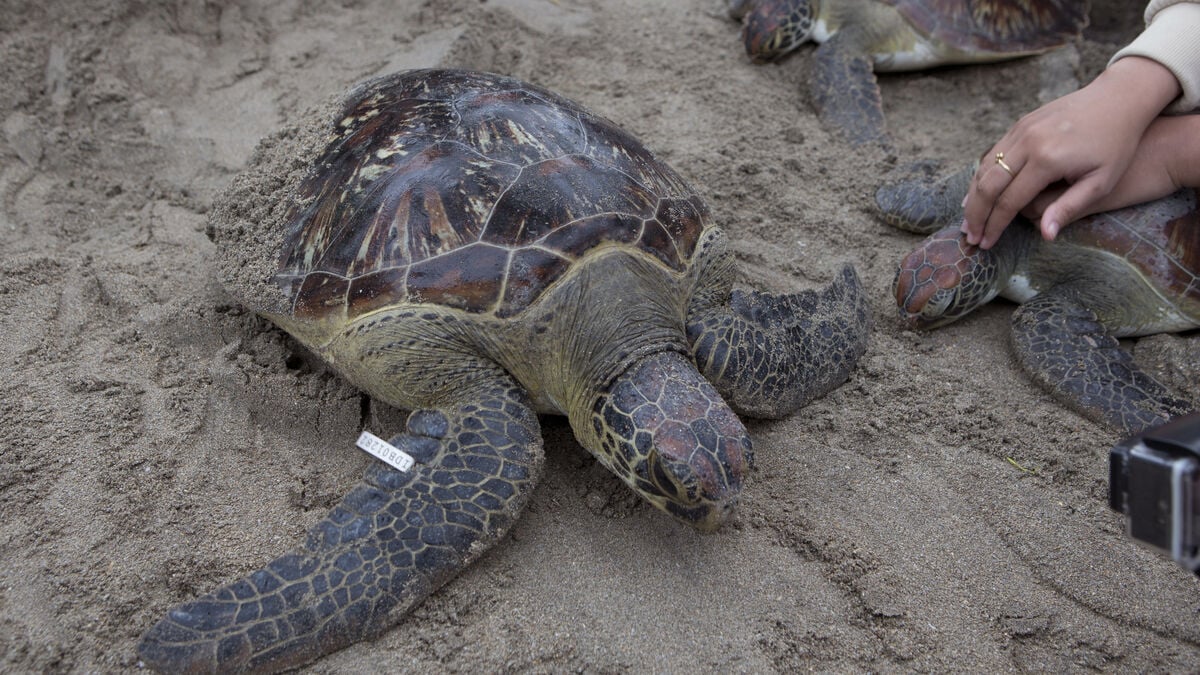
1. The return of the green sea turtle
The species has been at risk of extinction since the 1980s. But the green sea turtle, which often lives to be 70 to 80 years old in the wild, is now considered “viable” on the International Union for Conservation of Nature’s (IUCN) Red List of Threatened Species, following measures such as protecting the turtles’ eggs.
2. Political prisoners released in Belarus
The Belarusian regime has a long history of imprisoning activists and opposition politicians. In 2025, some of them were released, including opposition leader Maria Kolesnikova, who was freed along with Nobel laureate Ales Bialiatski and more than 100 others.
"I think of those who are not yet free, and I really look forward to the moment when we can all embrace each other," Kolesnikova said in an interview shortly after her release in December.
3. Iconic mosque rebuilt after IS terror
Mosul, Iraq, is considered one of the most historically and culturally significant cities in the Arab world. But when ISIS conquered large areas of land in the early 2010s, the city became one of the terrorist group's strongest strongholds, causing enormous destruction. Among other things, the iconic al-Nuri Mosque, dating back to the 12th century, was destroyed.
When the city was liberated, reconstruction began, and just in time for Ramadan this year, the restoration of al-Nuri was completed.
4. The number of cases of cervical cancer halved in Sweden
The incidence of cervical cancer has decreased by 56 percent among women under 40 years of age since 2015, according to new statistics presented in December this year. A success story, according to Ulrika Årehed Kågström, Secretary General of the Swedish Cancer Society.
HPV vaccines, together with screening programs, are behind the decrease.
5. Beavers saved taxpayers millions
The construction of a dam on the Klabava River southwest of Prague in the Czech Republic had been delayed and mired in endless bureaucratic hurdles. But everything was resolved thanks to a group of beavers, who in February were found to have built a dam that was much larger than the one humans had intended to construct – a win for both the environment and taxpayers, who saved the equivalent of just over ten million kronor.
6. Simpler method prevents the spread of HIV
The US Food and Drug Administration (FDA) has approved a new type of injection to prevent the spread of HIV in 2025. Studies show that two injections per year essentially eliminate the risk of contracting HIV. The WHO calls the method “a milestone.”
The drug, which contains lenacapavir, binds to proteins in the HIV virus's shell and prevents it from replicating.
7. Historic agreement to protect the oceans was reached
The UN Global Oceans Treaty has been ratified by enough countries to enter into force, strengthening international cooperation to protect the world's oceans and marine ecosystems.
Sweden was a driving force in getting the agreement in place in 2023, but has not yet ratified it, citing the need to first investigate what legal changes are required. The goal is to ratify the agreement before September 2026, according to the government.
8. First space image from the world's largest camera
For the first time, space images from the world's most powerful camera have been released. The images show colorful clouds of gas and dust along with star formations 9,000 light-years from Earth, the BBC has reported.
The camera is located at the Vera C Rubin Observatory on Cerro Pachón in the Andes in Chile, and according to scientists, the images can help us understand the history of the universe. For example, the camera will image the entire Milky Way and hopes to provide crucial answers about dark matter, which makes up a large part of the universe and is still surrounded by many questions.
9. Scrolling is useful for those over 50
People over 50 are a group that benefits from using their smartphone, according to a meta-analysis conducted by American researchers. Over 400,000 people were included in several studies on the topic.
The conclusion of the analysis is that nearly 90 percent of those who used smartphones regularly retained their cognitive abilities to a greater extent than others, and avoided a dementia diagnosis.
10. Promising new gonorrhea treatment
A new type of antibiotic has been shown to be effective against gonorrhea in a study. This is encouraging, according to the researchers, as antibiotic resistance is a growing problem globally.
The study compared the current standard of care with zoliflodacin, an antibiotic given as a single dose in tablet form. Around 900 people from five countries were included in the study.
In December, the US Food and Drug Administration (FDA) approved zoliflodacin and another oral medication for gonorrhea, a sexually transmitted disease that affects 82 million people each year.