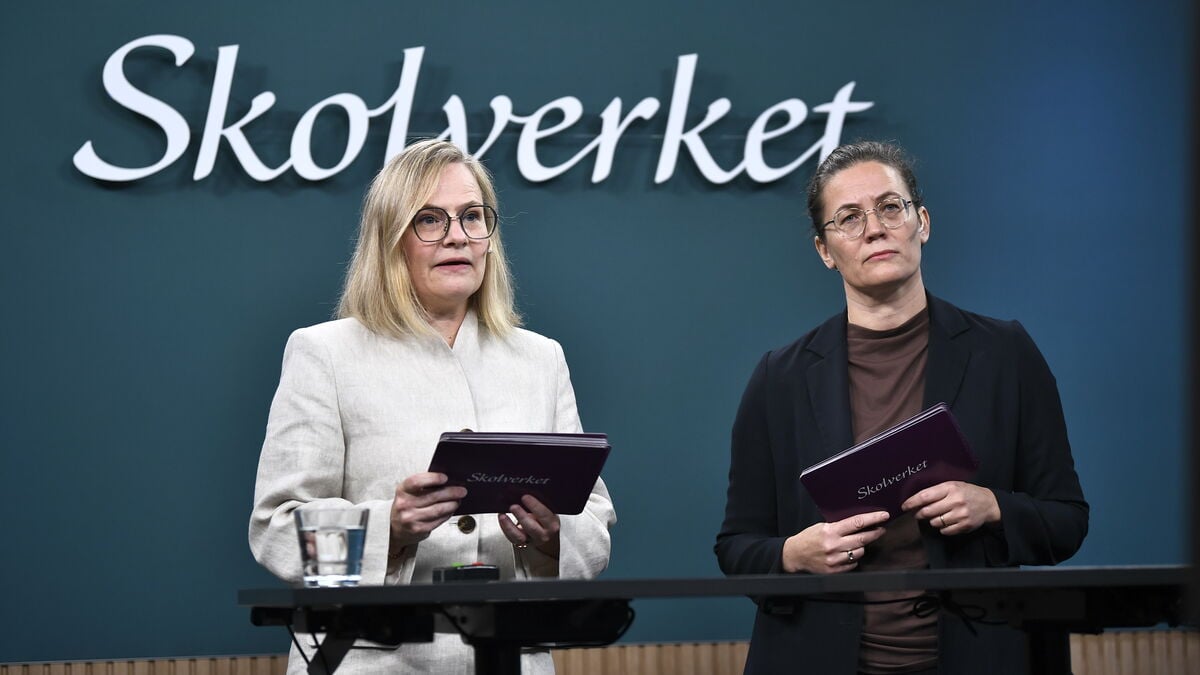
The OECD's PISA 2025 assessment provides information on how 15-year-olds in 91 countries and regions perform in science, reading and mathematics. For Sweden, the results are a cold shower.
The largest drop is in reading comprehension (-21 points) and mathematics (-18 points), and smaller in science (-8 points). 20 points is equivalent to about one year of learning.
Many pitfalls
The sharply deteriorated results mean that Sweden is slipping down to the OECD average. The fact that Sweden is not falling below the average is because a long list of other countries are also falling behind. This is most evident in reading comprehension, where even strong PISA countries such as Singapore and Japan have lost ground. In the Nordic region, all five countries have worse results.
PISA also shows that the proportion of Swedish students who do not reach a basic level in reading and mathematics is increasing. This means that every third 15-year-old can only cope with the simplest texts or speeches.
It is very serious that we see such a large group that does not reach a basic level, says Anna Castberg.
There are still large differences depending on the student's family background. Students from privileged families generally achieve better results, while a large proportion of low-performing students come from less advantaged families.
Similarly, students with a Swedish background perform better than students with a foreign background, although the difference has narrowed.
Needs to be analyzed
The big question is of course what has caused the decline in knowledge, both in Sweden and internationally. Neither the OECD nor the Swedish National Agency for Education have any ready explanations.
We will need more time to analyse the results in depth. What we can say is that there are factors at several levels that play a role, says Anna Castberg.
This may be due to students having lower endurance with demanding tasks, decreased test motivation, reduced reading among both children and adults, and the fact that digital tools have become part of everyday life, she continues.
The general decline in the PISA survey has raised questions about the reliability of the tests.
You can trust the results in PISA 2025. We are surprised that there is such a big decline, and so is the OECD. Now we have to analyze why there has been such a big decline, says Anna Castberg.
Facts: PISA 2025 results, reading comprehension
Highest score and ranking of all (within and outside the OECD), Nordic countries' ranking and score, and OECD average. Score change since PISA 2022 in brackets.
1. Singapore, 535 points (-8)
2. Beijing, Shanghai, Jiangsu and Zhejiang (China), 527 points (no result for 2022)
3. Taiwan, 508 points (-7)
16. Finland, 474 points (-16)
22. Sweden, 466 points (-21)
OECD average: 463 points (-14)
27. Denmark, 460 points (-29)
30. Norway, 453 points (-24)
44. Iceland, 422 points (-14)
Source: OECD
Highest score and ranking of all (within and outside the OECD), Nordic countries' ranking and score, and OECD average. Score change since PISA 2022 in brackets.
Science:
1. Beijing, Shanghai, Jiangsu and Zhejiang (China), 597 points (no result for 2022)
2. Singapore, 560 points (-2)
3. Macau (China), 541 points (-2)
12. Finland, 504 points (-7)
25. Sweden, 485 points (-8)
OECD average: 484 points (-3)
31. Denmark, 478 points (-16)
36. Norway, 470 points (-8)
45. Iceland, 441 points (-6)
Mathematics:
1. Beijing, Shanghai, Jiangsu and Zhejiang (China), 612 points (no result for 2022)
2. Singapore, 563 points (-12)
3. Macau (China), 549 points (-3)
20. Denmark, 471 points (-19)
23. Finland, 469 points (-15)
OECD average: 465 points (-9)
25. Sweden, 464 points (-18)
38. Norway, 452 points (-17)
39. Iceland, 450 points (-9)
Source: OECD
PISA stands for Programme for International Student Assessment.
The Organisation for Economic Co-operation and Development (OECD) has overall responsibility for the PISA assessments. The Swedish National Agency for Education is responsible for the Swedish implementation and the Swedish report.
PISA is conducted every three years, and the results are published the following year. Previously, the publication took place in December, this year for the first time in September. From now on, PISA will be conducted every four years.
PISA measures the knowledge and skills of 15-year-olds in three areas: reading comprehension, mathematics and science. In PISA 2025, science is the main subject.
The students who completed PISA 2025 were born in 2009.
Sources: OECD and Swedish National Agency for Education