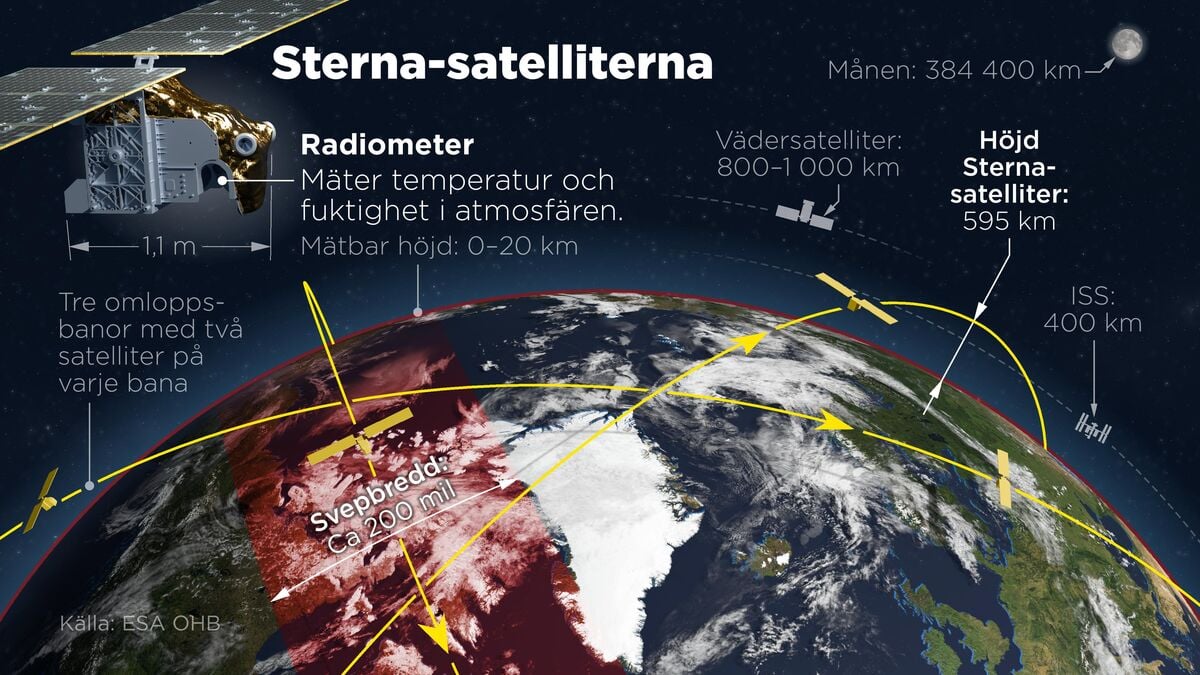
600 kilometers above the Earth, the 125-kilogram Arctic weather satellite whizzes around at enormous speed.
"We have developed and built it on behalf of the European Space Agency, ESA," says Fredrik Sjöberg, CEO of OHB Sweden, not without pride.
Starting in 2029, it will be joined by another group of similar satellites, assembled in Kista in Stockholm. To even step inside the factory premises, you need a hairnet, plastic shoe covers and a lab coat. There are pressure chambers and rooms to X-ray the joints of the sensitive systems.
It's not just weather satellites that are being built on the premises. Here, for example, stands the shell of Comet-I, intended to be placed 1.5 million kilometers away at one of the so-called Lagrange points, where it will wait for several years for a suitable comet to appear and then shadow it.
“Bold venture”
OHB moved into the premises as late as last summer, to be ready if ESA were to give the company the green light - and in mid-March the contract for 20 additional satellites was signed. This means 248 million euros (2.67 billion SEK) in the company's account and new jobs at OHB, which has already tripled in size in recent years.
"It was a bold move. If Arctic Weather hadn't worked and delivered good data, nothing would have happened," says Sjöberg.
In 2023, the global value of the space industry was $630 billion, a figure that is expected to triple by 2035, according to consulting firm McKinsey. The following year, 1,545 people worked full-time in Sweden's space sector, which then had a turnover of just over SEK 4.9 billion, according to recent figures from the Swedish Space Agency.
OHB has tripled the company's workforce in a few years. But the company is far from alone in the Swedish space industry. AAC Clyde Space in Uppsala builds satellite technology (with the subsidiary Omnisys in Gothenburg and Spacemetric in Sollentuna). In Stockholm there is the rocket company Pythom, in Luleå the startup Vimotek, and in Trollhättan GKN Aerospace makes components for space rockets.
Christer Fuglesang, professor at KTH and Sweden's first astronaut, says there are several reasons why space is hot. One reason is the space race that is taking place between China and the United States. Another is that the cost of sending equipment into space is now a fraction of what it would be with Elon Musk's SpaceX.
The satellites have become more numerous - but smaller - and are placed closer to Earth, compared with earlier when large satellites were placed further out.
"It costs several times more to send something up to the geostationary area. Then you really want a satellite that is guaranteed to work, and then it becomes very expensive. Now you send up a lot of them, and it is less critical whether each one works, so each satellite becomes much cheaper," says Fuglesang.
Another reason is the troubled world around us.
"What has perhaps increased in particular is the realization that space is very important from a security perspective, that we have our own capabilities in space."
Order from Amazon
In Linköping, Beyond Gravity is located; it recently built a new factory and in ten years quadrupled its employees to more than 320. Since its start in the 1980s, the company has launched 1,500 satellites, says business developer Magnus Engström.
"We have really seen the difference in the space market over time. We don't have domestic customers to any great extent; they are located abroad," says Magnus Engström.
In 2021, the company landed a $3 billion order to build the separation system for Amazon's Starlink competitor Kuiper. So far, 250 satellites have been placed in space, with another 3,000 waiting.
But adapting to such a huge order also involves risks - because what happens to the factory once the order is fulfilled?
"When we set up a production system like this, we have to get a return on it. We work with follow-on deals, but also new constellation projects where we are better positioned today thanks to our manufacturing capabilities."
Wants: Own rockets
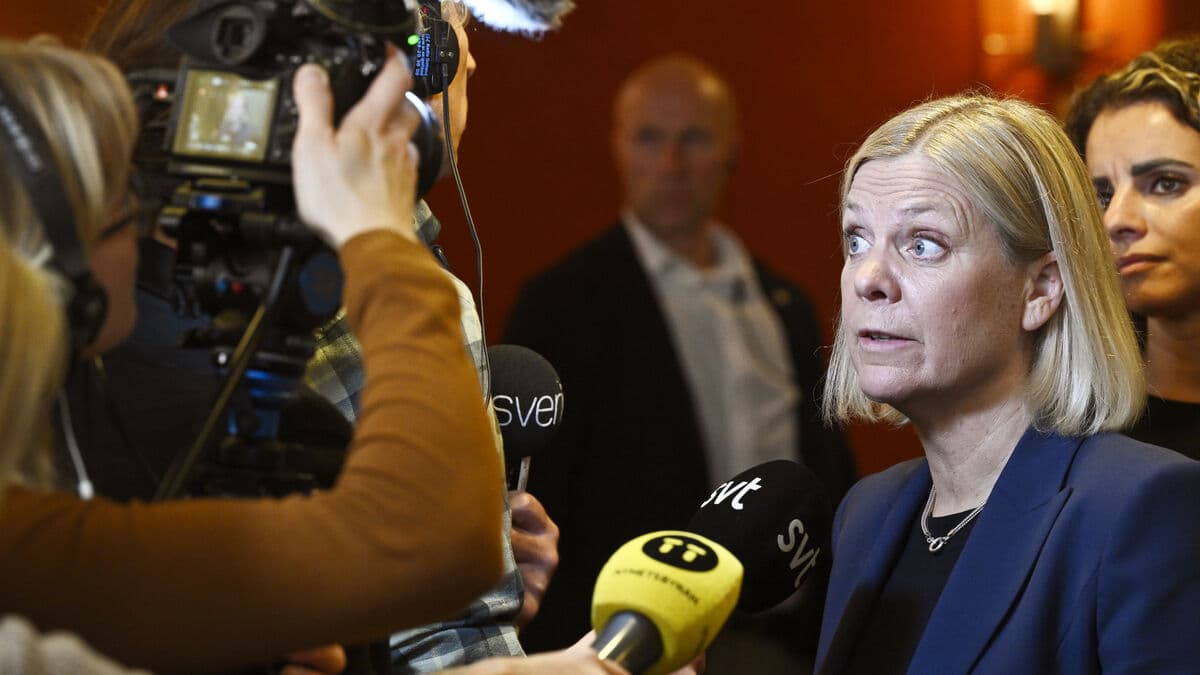
Lotta Edholm's (L) business card says Minister of Upper Secondary Education, Higher Education and Research. The fact that she is also Minister for Space is less talked about, even though she says she is increasingly focused on space. She thinks Sweden is doing well, but believes it is a shortcoming that Sweden does not have its own large rockets to place objects into orbit.
"I really hope that Esrange (in Kiruna) will be able to do this. The truth is that we do not have that capacity on European soil within the EU today. I see it as necessary."
At the same time, she admits without hesitation that Sweden has done far too little in the space sector, an insight that has emerged in recent years. At the beginning of last year, an initiative was presented for a national research school in space with the goal of a national satellite program.
"I think we have to continue to invest heavily. Because it is quite obvious that space and the opportunities that exist there are becoming increasingly important in so many different areas," says Edholm.
Facts: Swedish space industry
The Swedish Space Agency monitors the Swedish space industry. In this year's report, which has not yet been released, the agency has identified 188 companies that work with space in one way or another (manufacturing space infrastructure or components, utilizing space infrastructure or using space data).
This is a significant increase from the 124 in the 2025 report. In it, there were 33 companies in the Stockholm region, 18 in Gothenburg. Several space companies are located in Uppsala, Linköping, Lund, Luleå and Trollhättan.
The companies' space operations had a turnover of just over SEK 4.9 billion in 2024 and consisted of the equivalent of 1,545 full-time jobs.
Source: Allabolag.se, Swedish Space Agency
Internet and telephony: Satellite internet such as Starlink allows users to surf the web in remote locations - such as ships, airplanes and war zones. Satellite telephony is also used in locations far from cell towers.
Navigation: The American GPS and the European Galileo are two examples of how satellites can help us know where we are. The satellites' atomic clocks are also used to synchronize time.
Weather: Countless satellites collect weather and climate data for monitoring, forecasting and research.
Internet of things: For example, tracking goods, floating buoys or even cows in remote pastures far from mobile towers.
Military: Satellites are used for surveillance, but can also be used for communication and potentially to jam other satellites.