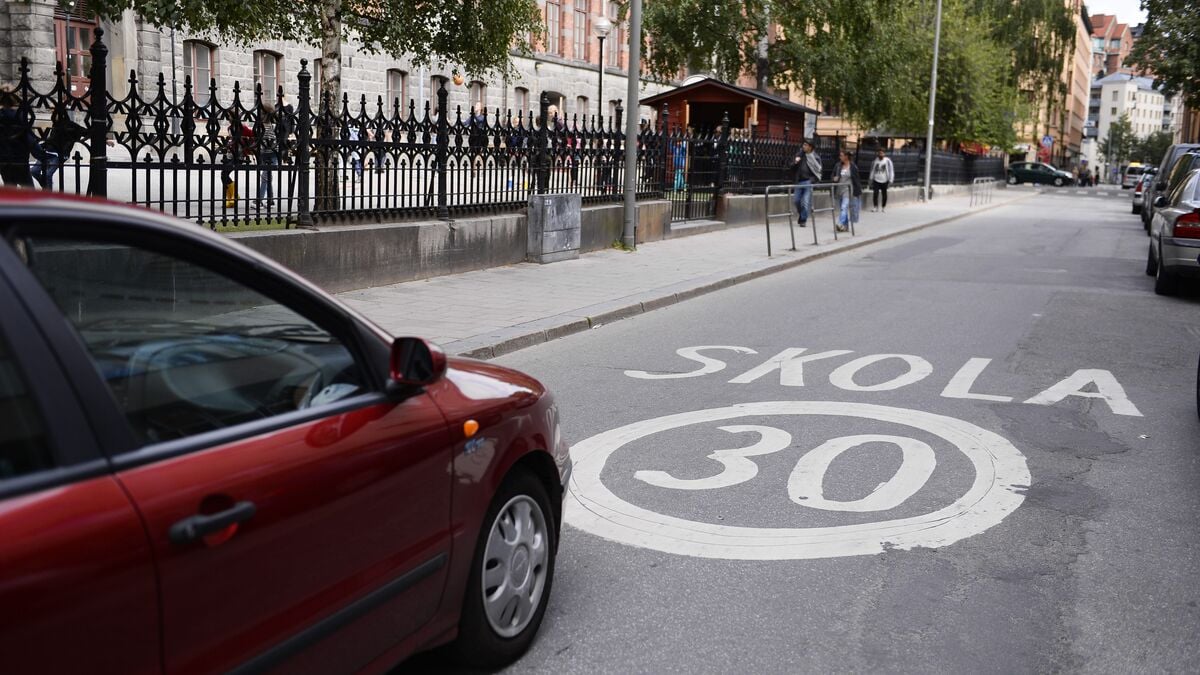
Folksam's speed measurements of commercial traffic over the past year show that 37 percent of commercial drivers drove too fast on roads near schools.
The average violation was 4.8 kilometres per hour, corresponding to 16 percent, which according to Folksam means an almost double risk of a fatal accident.
Worse at low speeds
We see that speed compliance is worse at low speeds, at 30-40 km/h, says Anders Kullgren, Head of Research at Folksam.
You probably think it doesn't matter that much, 5-10 kilometres per hour too fast on a 30 km/h stretch. We humans are bad at understanding the risks associated with speed, so you probably don't realise what an increase in risk it really is.
In connection with the nearly 6,000 laser gun measurements carried out in school environments at various locations around the country, the presence of speed-reducing measures was also investigated. The results showed that only road bumps had a noticeable effect on speeding.
The other measures, when you have narrowing or refuges, we don't see any major reduction. Where you have refuges it was even higher than without the measure. So it's the bumps in the road that have the biggest effects, says Kullgren.
Road bumps are missing
In most of the measurements that were made, there were no bumps; out of nearly 6,000 measurements, there were bumps in just over 600 of them.
Courier vans and taxis were found to be among those that most often drove too fast. Tow trucks, for example, also stood out in a negative way. Anders Kullgren emphasizes that the employer has a great responsibility for how the driver drives.
They must not pressure them to drive too fast in order to meet time limits.
Folksam has conducted measurements of speed compliance in commercial traffic since 2017. For the latest study, 5,973 measurements were conducted in school environments during 2025 and spring 2026.
Speed compliance is higher in school environments than on other roads with a speed limit of no more than 40 kilometres per hour. Speeding violations at schools were recorded in 37 percent compared with 57 percent on corresponding roads without school environments.
Even serious speeding violations were less common near schools and occurred in 5 percent of the measurements, compared with 13 percent on other roads with lower speed limits without schools.
Despite the lower incidence of violations, the violations recorded in school environments were more extensive. School environments therefore appear as the highest-risk locations in the analysis, despite the violations being less common.
Source: Folksam