On the evening of July 31, 2018, Christofer Lundgren stands and wipes the blood from the young man who cut himself when he grabbed the regalia in the broken glass case.
The drops show the way out: red spots across the brick floor in the lower sacristy, further on the limestone floor past the pulpit and altar, out through the entrance where Lake Mälaren can be glimpsed below the hill.
"Sometimes I still think back to those two guys who did it. I can think about what life has become for them," says Lundgren, dean of Strängnäs Cathedral Parish.
The summer of 2018 is record-breaking hot in large parts of southern Sweden. July 31 is no exception, and staff and visitors to the church react when a burly man walks in with a thick shoulder bag. A witness later describes him in questioning as “complete scum.”
Loud bangs
A young woman who works as a church janitor during the summer also notices the man. When she goes into the Martyrs' Chapel to dust, she hears several loud bangs. She goes outside to look and sees the same man quickly leaving the church, accompanied by another man.
Christofer Lundgren steps out into the sun and points towards the gravel road that leads away from the church, down towards the water where the men fled.
Our bell ringer at the time met them pretty much. He came here at the cathedral and saw them all together and thought it was really strange.
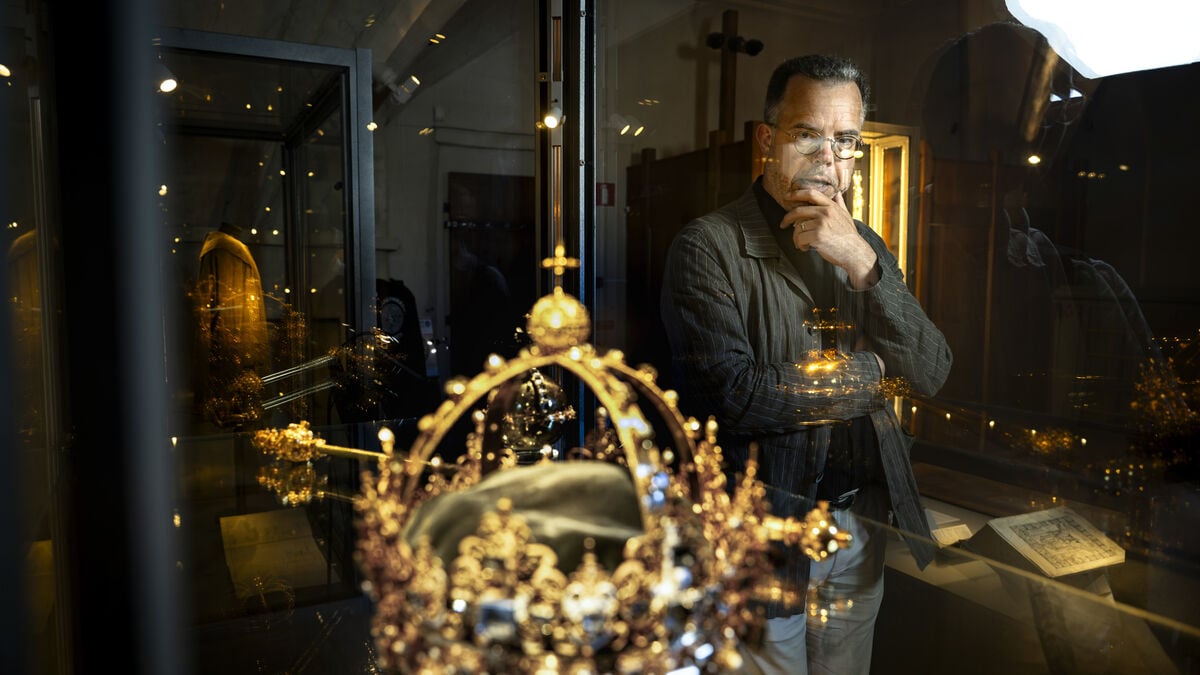
Shortly afterwards, the discovery is made: the glass case in the lower sacristy is broken, two gold crowns and a royal apple are gone. The regalia that were made for the funerals of Charles IX in 1612 and his wife Queen Christina the Elder in 1626 were insured for 65 million kronor and are priceless from a cultural and historical perspective.
Lundgren says that the funeral regalia for Charles IX are the finest and most exclusive that have been made in Sweden, and also stand out in international comparisons.
There is an ascending curve to these, the ones that came after again became easier and easier.
After fleeing across the gravel road, the men each jump on their bicycles and pedal across the lawn of Månsson's garden, a green area with apple trees and plantings on the south side of the church. They make their way down to a nearby pier and leave Strängnäs at high speed in a stolen motorboat.
They don't get very far. A doctor at his summer home on Arnö sees them lying and bobbing in the water. Lukas Sterner, inspector and reconnaissance leader for the cultural heritage group at Noa, says:
He sees that they have a small motorboat that is not working and they are paddling with their hands. He goes out and asks if he can help them, then they say they have engine problems.
The doctor takes on the task of towing the guys, but soon realizes that there is not enough gas. They have to flag down another boat to get them all the way to where they are going. Before he leaves, they ask the doctor for his number.
In the evening, a Swish payment of 1,000 kronor arrives from the older of them, a 25-year-old, with the text "Thank you!".
It's a bit telling that they are still well-mannered and want to do what's right for themselves. At the same time, they have just seized some of Sweden's real cultural treasures. It's an interesting contrast, says Sterner.
DNA match
The doctor's testimony only reaches the police later, but the blood in the church leads to an early match with a 21-year-old from Åkersberga. He is linked to a gang of friends in the area who are well known to the local police.
They were mainly involved in theft and pickpocketing. And because it was a bit of an archipelago town, they liked boating, speed and excitement, and driving scooters.
The man is wanted and surrenders a few weeks later. Lukas Sterner describes him as easygoing.
Very charming, social, and playful.
The most important thing is to find the regalia. The police are following the circle around the 21-year-old and conducting raids during the autumn, but without a hit.
When the trial against the 21-year-old begins, a 65 million kronor damages lawsuit is threatened, and the hope is that the regalia will be returned when it is realized that they are impossible to sell.
On the same day that the trial is to end, Christofer Lundgren receives a text message early in the morning from the prosecutor:
“Something happened last night and it will mean changes for today's negotiations, get to Eskilstuna as soon as you can.” It was just a matter of getting dressed and going.
It's February and it's been snowing overnight. In a parking lot in Åkersberga, a security guard has discovered a trash can placed on a car. On the side is written "bomb" in large white letters.
Inside, the regalia are found, damaged and tied up, but every little piece that has come loose has been put in a bag.
The 25-year-old's DNA is on the objects, and with the help of the Swish payment, the police can confirm with certainty that he is the second perpetrator. Both are convicted of aggravated theft.
Unclear plan
After a laborious restoration, the regalia will be returned to the church in June 2020. Christofer Lundgren and his colleagues celebrate with a cake with marzipan regalia.
Eight years later, Lukas Sterner remembers an investigation that was unusually kind and funny, and notes that no one was injured as far as the police know.
It had the character of a Lasse Maja story almost.
However, there is still no answer to what the plan really was. Did they intend to sell the regalia? Was there a client in the background?
"It's clear that there has been a lot of speculation on that issue. I personally don't think so, I think it was their own idea," says Sterner.
Christofer Lundgren doesn't think they really knew what they were stealing.
It's not “Ocean's Eleven” level. If you read the investigation, you see a number of details that make you wonder what they were thinking.
Charles XI died in Nyköping on 30 October 1611. A crown, an orb and a sceptre were made for the funeral, which was held in Strängnäs Cathedral in April 1612. The regalia were placed in Charles XI's coffin, where they lay until 1861.
The crown is made of gold and enamel, pearls and rock crystals by goldsmiths Antonius Groth and Peter Kempe.
Charles XI's second wife, Kristina Holstein Gottorp, died in 1625. A crown, an orb and a sceptre were also made for her funeral.
The regalia were made of gold and black enamel without precious stones. The choice of material has been interpreted as referring to her widowhood, as black and white enamel was common on mourning jewelry during that time. The regalia were taken out of the coffin at the turn of the century, 1800–1900.
Source: Church of Sweden