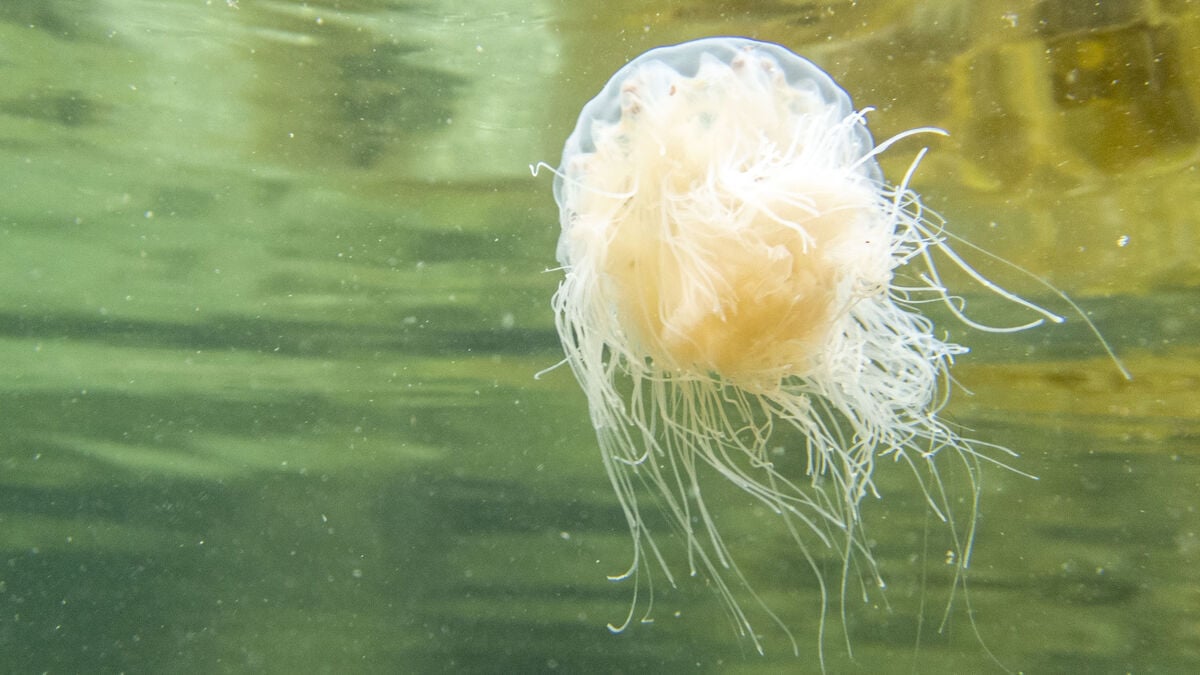
There have been plenty of stinging jellyfish on the West Coast recently. Similar reports come from Norway, where the jellyfish, with their long burning tentacles, have been observed along the entire coast from Skagerrak up to Bergen.
It varies and now the wind has probably caused them to move a bit. But last week there were an incredible number of both red and blue stinging jellyfish, says Christin Appelqvist, who is a marine biologist at Tjärnö Marine Laboratory outside Strömstad.
Last year, Appelqvist launched a project in which she asked the public to report jellyfish sightings. It has exceeded expectations.
"It's been a huge success. I'm very grateful for all the reports, I think there are over 2,000 so far," she says.
Worrying signals
The purpose of the citizen research is, among other things, to learn more about why the moon jellyfish seem to be doing poorly along the West Coast, where many jellyfish die prematurely in early summer, before they have had time to reproduce.
The cause is still unclear, but their decline appears to be benefiting the stingrays.
"I have long been worried that the moon jellyfish are not doing well and what the consequences might be. But what we are already seeing is that both blue and red stinging jellyfish are increasing," says Christin Appelqvist.
It may be that the temperature benefits the stinging jellyfish as well, but we see that when the moon jellyfish have decreased, there have been many more stinging jellyfish.
New species
As if that weren't enough, new jellyfish species have also arrived in Swedish waters in recent years. For example, the compass jellyfish, which stings much like the common stinging jellyfish, has become increasingly common.
New species are arriving partly with human help, in ballast water from ships, for example. But with global warming we are also getting warmer water, so we are bringing up some other species from the south, says Christin Appelqvist.
For example, last year I saw a luminous jellyfish – and it stings even more than our stinging jellyfish do.
Stinging jellyfish have so-called stinging cells with poison in their tentacles.
If you accidentally touch the tentacles, the cells burst, whereupon small threads with barbs at the end are pushed out and poison is injected into the skin.
Common symptoms after close contact with a stinging jellyfish are redness and burning, swelling and itching, with mild to moderate pain.
If you happen to get stung:
Remove the tentacles by rinsing them with water, preferably seawater instead of tap water.
If the tentacles cannot be rinsed away, try scraping them off with a credit card, for example. Or pull the tentacles off with a wide piece of tape.
Do not rub with a towel, for example, as this can cause more stinging cells to burst and release venom.
Minor complaints can be alleviated with over-the-counter medications such as painkillers or ointments.
Source: 1177.se.