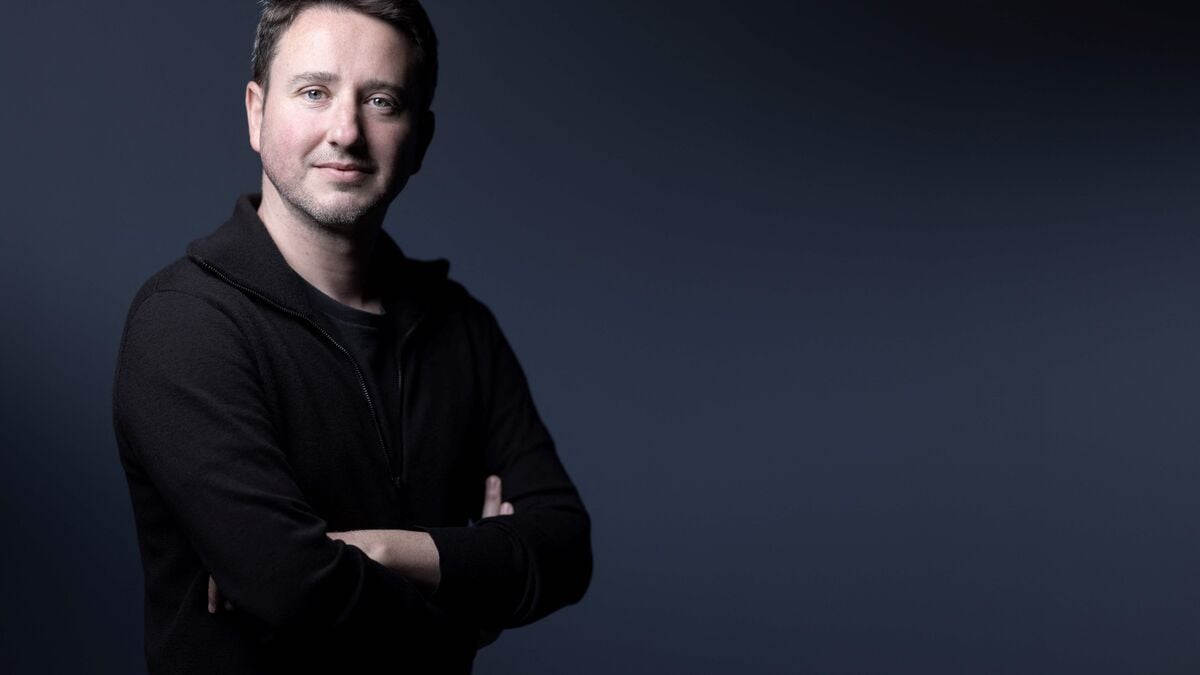
Economist Gabriel Zucman, 39, is in Sweden to promote the book "Billionaires' Tax - How to Implement It." His proposal has resonated in several countries that have tried or are planning similar taxes.
Zucman is in his office in Paris; his gaze is intense, he is wearing a white shirt and sitting in front of a whiteboard filled with formulas and symbols.
The reasoning concerns increased government revenue if those with a fortune of over 100 million euros - equivalent to around 1.1 billion kronor - are taxed at 2 percent.
But for Zucman, the question of the world's super-rich - he uses the English superrich in the interview - is also a question of the development of democracy.
The billions mean that you can influence politicians and the media. We see that in the US. It would be a mistake to think that it doesn't happen in Sweden, he says, and believes that there is a great danger that the foundations of democracy could thereby be eroded.
Sharp increase
Then he takes the economic distribution in Sweden as an example.
0.001 percent of the population is the richest in Sweden today; they own the equivalent of 30 percent of GDP. This means that they could buy 30 percent of the goods and services produced in Sweden annually.
This is a sharp increase in concentrated wealth in Sweden in just a quarter of a century. At the same time, the super-rich are skilled at structuring their wealth - with the result that they pay significantly less in taxes compared to middle- and high-income earners, according to Zucman.
But even if you are a billionaire, you still have access to social services in your own country.
Welcome billionaires
Zucman's critics have ranged from skeptical to furious. In France, he was accused of left-wing activism when his proposal was raised - and blocked - in the French National Assembly last fall.
Two representatives of the Stockholm Chamber of Commerce wrote in a debate post in DI in March that they "welcome Danish billionaires to Sweden" if the country introduces a "wealth tax," which the Danish Social Democrats want.
Zucman becomes irritated when billionaires threaten to flee their homeland.
They always threaten to do so if new taxes are imposed on them. But we need to invest more in healthcare, higher education, research and infrastructure. We won't do that unless the super-rich pay for it: it's simply necessary.
French economist, born in 1986 in Paris; also an American citizen.
Professor at the School of Economics and École Normale Supérieure, Paris. Also active at the University of California, Berkeley, USA, and the London School of Economics, UK.
Best known for research on tax evasion, tax planning and economic inequality.
Has published, among other things, "Hidden Wealth, an Investigation of Tax Havens" (La richesse cachée des nations), which was published in Swedish in 2015.
His current book is "Billionaires' Tax - How to Implement It", from Bokförlaget Atlas.
Sources: Gabriel Zucman's website, Arena, AFP.
Economist Gabriel Zucman's research has included issues such as tax evasion and examining the extent of money placed in tax havens.
He has developed methods for calculating the extent of tax evasion.
Zucman's research has also focused on comparative income and wealth gaps over the past 200 years, in collaboration with French economist Thomas Piketty, who was also Zucman's supervisor.
The proposal to tax the so-called super-rich would involve those with wealth over 100 million euros, who would pay 2 percent in tax. The proposal is called the "Zucman tax."
The French National Assembly voted against such a tax after a lengthy debate in the fall of 2025.
Sources: The Economist, AFP.