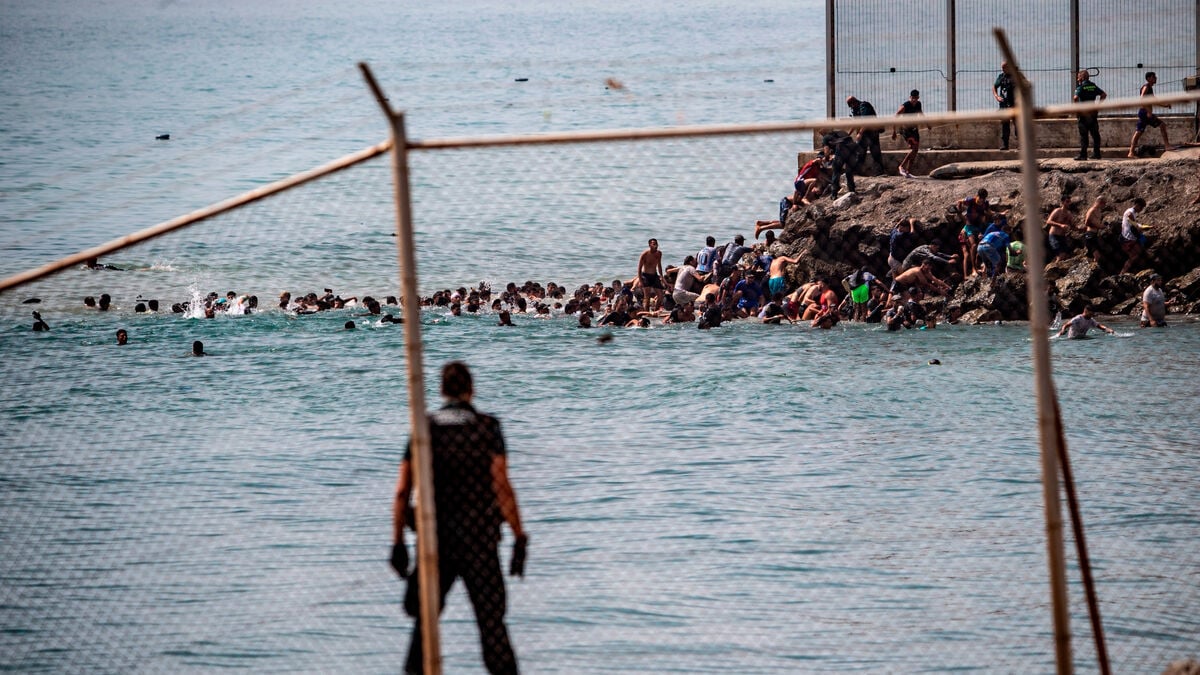
One day in late July, nearly 80,000 people showed up at the border, overwhelming Spanish guards. The migrants did whatever they could - climbing, swimming, jostling - to get from Morocco to the more affluent little enclave of Ceuta and EU territory.
The government in Madrid declared a state of emergency and deployed the military. About a hundred people drowned in the chaos and the death toll is still rising several weeks later.
This was possible thanks to Morocco's participation or consent, said Juan Jesús Vivas, Ceuta's longtime mayor from Spain's opposition PP party, at a press conference in Brussels on Tuesday.
“Hybrid warfare”
Morocco flatly denies this, but it has met with widespread Spanish skepticism. At the very least, Moroccan police refrained from intervening for about ten hours.
According to information from the Spanish border police, Moroccan police forces were involved in pushing large groups of people towards Ceuta - precisely to cause Spanish border control to break down. Plainclothes agents are said to have been identified in the crowds.
One of Spain's highest courts has launched an investigation and preliminarily assesses that the migrants were exploited as tools in hybrid warfare.
But Prime Minister Pedro Sánchez downplays this, saying he has not seen any “clear evidence” of a premeditated Moroccan attack. He points to disinformation as a major cause.
Worked before?
The opposition accuses Sánchez of being lax toward both Morocco and migrants. Why are you afraid of Morocco? asks PP leader Alberto Feijóo. Traitor, exclaims far-right leader Santiago Abascal. Tens of thousands of people have demonstrated, demanding that the government tighten its grip over Ceuta.
Most of the migrants have left Ceuta, but a few thousand remain. The enclave's mayor, Vivas, describes the situation as untenable - and also points out that this has happened before.
In May 2021, a similar uproar arose when several thousand migrants suddenly and simultaneously tried to reach Ceuta and Melilla. This happened at a time when Spain and Morocco were locked in a bitter dispute over the Western Sahara issue. The onslaught was more or less openly said to be an act of pressure and Morocco was accused of exploiting vulnerable people for political blackmail.
That time, it ended with Spain and Pedro Sánchez reaching out to Morocco on the issue of Western Sahara. The EU Commission signed a new billion-euro agreement with Morocco for continued help to stop migrants.
Spain has controlled smaller coastal areas, rocks and barren islands in North Africa for centuries, the largest of which are the densely populated enclaves of Ceuta and Melilla, which are completely surrounded by modern-day Morocco.
Ceuta is located on a promontory on the Strait of Gibraltar, a short boat ride from the southern tip of mainland Spain. Melilla is further east and formally also includes the barren Chafarinas Islands near the border between Morocco and Algeria. The two areas have a population of just over 80,000 each.
The areas have been under Spanish control since the early voyages of discovery in the 15th and 16th centuries, when Catholic kings took the first steps to Christianize Africa. Morocco has claimed the areas since the country gained independence in 1956.
The enclaves contain the EU's only land border on the African continent, making them attractive destinations for migrants seeking to reach the Union, especially since deadly smuggling by boat across the sea has been curtailed.