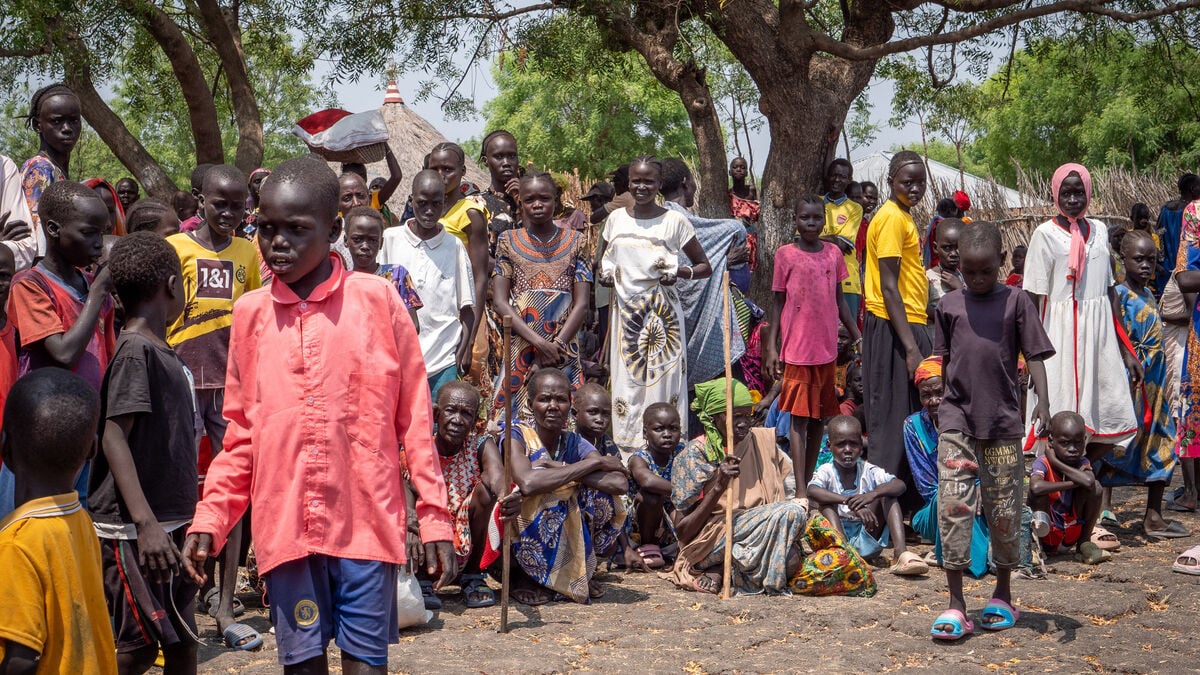
When South Sudan became the world's youngest nation in 2011, the future seemed promising. Fifteen years later, a bloody power struggle rages on, seemingly never ending. Millions are displaced and just as many are threatened by famine. 2.2 million children are already acutely malnourished.
"We have seen nothing but conflict in South Sudan," says Tomson Phiri of the UN World Food Programme, WFP, on the phone from the capital, Juba.
The conflict, combined with reduced international support and the thousands of refugees arriving every day from wars in neighboring countries, has pushed the situation to the brink of disaster. Only the most vulnerable families now receive food and nutrition support - and then only half rations.
End of September
Phiri and his colleagues are forced to choose between those who starve and those who go hungry.
We reduced rations to stretch the small resources we have as far as possible. But now our backs are against the wall. How much can you cut? There is nothing more to take away.
It's very difficult to look a woman or a child in the eye and say: "By the way, you're not getting anything, I'll give it to your neighbor who seems to be on the verge of breaking."
And it's getting worse. Last week, the WFP and the refugee agency UNHCR issued a stark warning: without urgent funding, resources will run out in September. In addition to people risking dying of hunger, the consequences that always appear in famine disasters threaten, says Phiri: child marriage, child labor, children being taken out of school and recruited into armed groups.
I shudder at the thought.
Concerns about Ebola
In his work for the UN, Tomson Phiri has repeatedly spent long periods in South Sudan, including during the violent battle for Juba in 2016. He was also there when the warring factions, led by Vice President Riek Machar and President Salva Kiir respectively, solemnly signed a peace agreement in 2018. The agreement quickly fell apart and in 2025 Kiir ensured that Machar was placed under house arrest.
Since then, the violence has escalated, increasingly affecting civilians. At least 36 aid workers have been killed since January, the AP news agency reported this week.
South Sudan borders eastern Congo-Kinshasa, where an ongoing Ebola outbreak has claimed thousands of lives. For aid workers, it is a source of great concern, says Tomson Phiri.
But if you ask a South Sudanese, they will say they don't care. They have other problems to deal with.
South Sudan is the world's newest country. It became independent in 2011, when what was previously known as Sudan was split into a northern and a southern part.
The partition, preceded by a dramatic referendum, created hope for a better life in South Sudan after decades of war with North Sudan. But the period after independence has also been marked by power struggles and civil war, with hundreds of thousands of deaths, famine, internal displacement and economic collapse.
The country has good oil resources, but as a result of widespread corruption, a majority of the people live in great poverty. An influx of refugees from Sudan in the north and Congo-Kinshasa in the south is complicating the situation.
The country's first general election since independence is scheduled for December this year, an election that has been postponed several times.
South Sudan is characterized by the Nile River, whose surrounding wetlands cover enormous areas. The giant river's sources are largely located further south in Africa, and the water then flows north through South Sudan, Sudan and Egypt.
South Sudan's nearly twelve million inhabitants are dominated by so-called Nilotic ethnic groups. The capital is Juba.