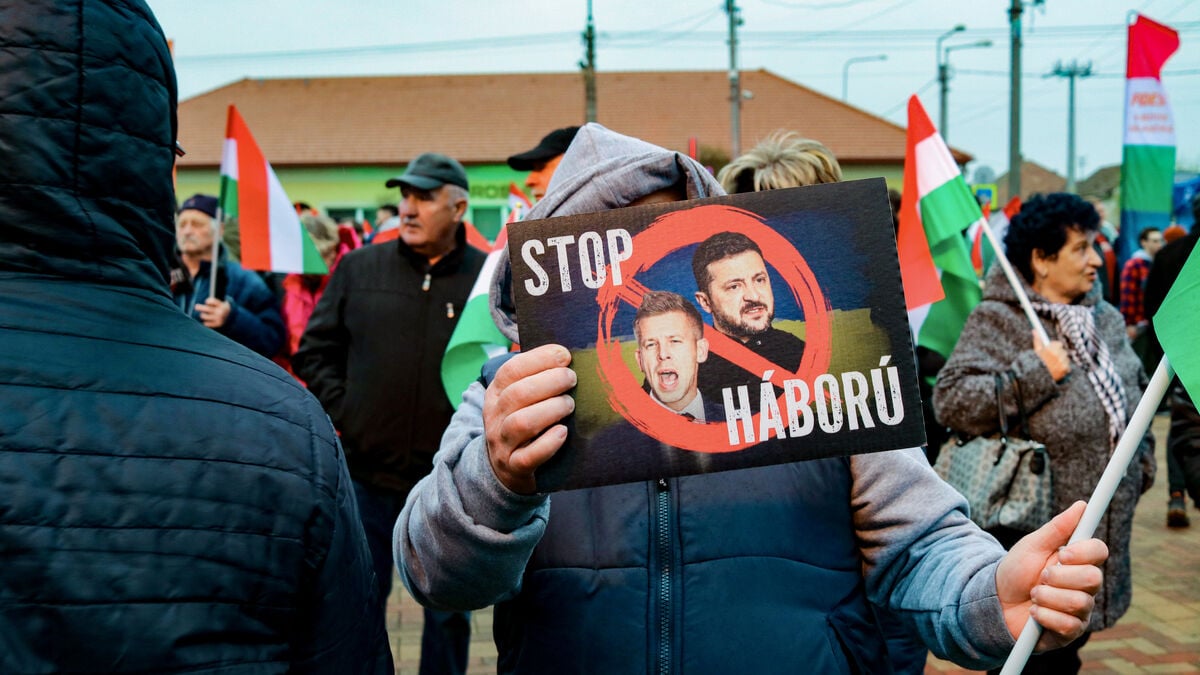
Hungarian rock icon Attila Pataky, a longtime Orbán supporter known for his outbursts about aliens and spirituality, leads a sing-along to get the crowd going. A young man in his early teens adjusts his red “Make America Great Again” cap, a woman with long nails and a thick scarf pushes forward. The spring evening is cold and wet; when Viktor Orbán finally takes the stage, children in down jackets are hoisted onto broad shoulders.
Only a national government can stop the looting of Hungarians. Hungarian money is better off in Ócsa than in Donetsk, thunders Orbán.
Hungarian flags handed out ahead of the rally wave vigorously. A man with a horseshoe moustache cheers and holds up his sign: “We will not become a Ukrainian oblast.”
Here, in Pest County and the commuter belt surrounding Budapest, the Hungarian parliamentary elections could be decided. Historically, the ruling Fidesz party has won here. But if the opposition manages to do what the latest independent polls suggest – win a majority in Pest’s 14 constituencies in Sunday’s election – Orbán’s 16-year hold on power is likely to come to an end.
Tax break
30-year-old József Fias, with a Hungarian flag in one hand and a Fidesz sign in the other, is certain that will not happen.
"He is a strong leader who takes care of the people; he will win. I will always support Viktor Orbán," he tells TT's correspondent.
Mother-of-three Sára, who does not want to give her last name, is wearing a green cap and chewing gum. For her, Orbán’s economic policies weigh most heavily. In Hungary, mothers with three or more children are exempt from personal income tax for life. The opposition Tisza party has not said anything about abolishing the tax exemption – on the contrary, they have promised stronger support for families with children – but 32-year-old Sára does not trust them.
"I'm young, I work and I'm also allowed to be a mother. It's a super system. If Péter Magyar won, he would scrap it immediately and take the money for something else. Like Ukraine."
"Good relationship" with many
She puts her finger on the most central theme of the Fidesz election campaign: the accusations that Tisza and leader Péter Magyar want to drag Hungary into the war in Ukraine and send money, weapons and soldiers to the neighbour to the east, something Magyar has repeatedly denied. For Sára, it is a personal issue.
"I have two sons. War brings no good."
Orbán's close relationship with Russia and Vladimir Putin does not concern her.
"He has a good relationship with the U.S. too. And with many others."
Agreement with Russia
For others on the muddy lawn in Ócsa, the focus is on other issues. Married couple Péter and Dóra mention Fidesz's migration and gender policies, as well as the importance of a more decentralised EU and an independent energy policy.
"We support Ukraine, but not at the expense of our own interests. We prefer an agreement with Russia," says Péter.
Like many in the audience, they are strongly critical of Magyar, who has been the subject of several scandals during the election campaign. Among other things, he has been accused of violence against his ex-wife, and he says he has been the victim of a smear campaign with rumours of drug use and a sex video.
"For us as a conservative family, he is completely unacceptable as a leader," says Dóra.
Hungary will hold parliamentary elections on April 12. Of the 199 seats, 106 are elected via single-member constituencies and 93 via national party lists.
Special rules apply to make it easier for 13 specific national minorities (of which Roma, Germans and Slovaks are the most numerous) to win individual mandates.
The election is expected to be a duel between Prime Minister Viktor Orbán's long-standing ruling party Fidesz, which in alliance with the Christian Democratic Party of Hungary (KDNP) currently has 153 seats, and the opposition party Tisza, led by Fidesz defector Péter Magyar.
Viktor Orbán (born 1963) has been the Prime Minister of Hungary since 2010 and leads the conservative Fidesz party, which at the EU level is part of the far-right PFE group together with, among others, the French National Rally and the Belgian Vlaams Belang. Orbán's rule has been criticised for, among other things, concentration of power, influence over the media and a weakening of democratic freedoms and rights.
Péter Magyar (born 1981) is a lawyer and since 2024 a Member of the European Parliament and party leader of the opposition party Tisza, which at the EU level is part of the Christian democratic conservative party group EPP with, among others, the Swedish M and KD. Magyar was previously involved in Fidesz, but left the party after criticism of corruption and abuse of power.
Source: Country Guide/UI