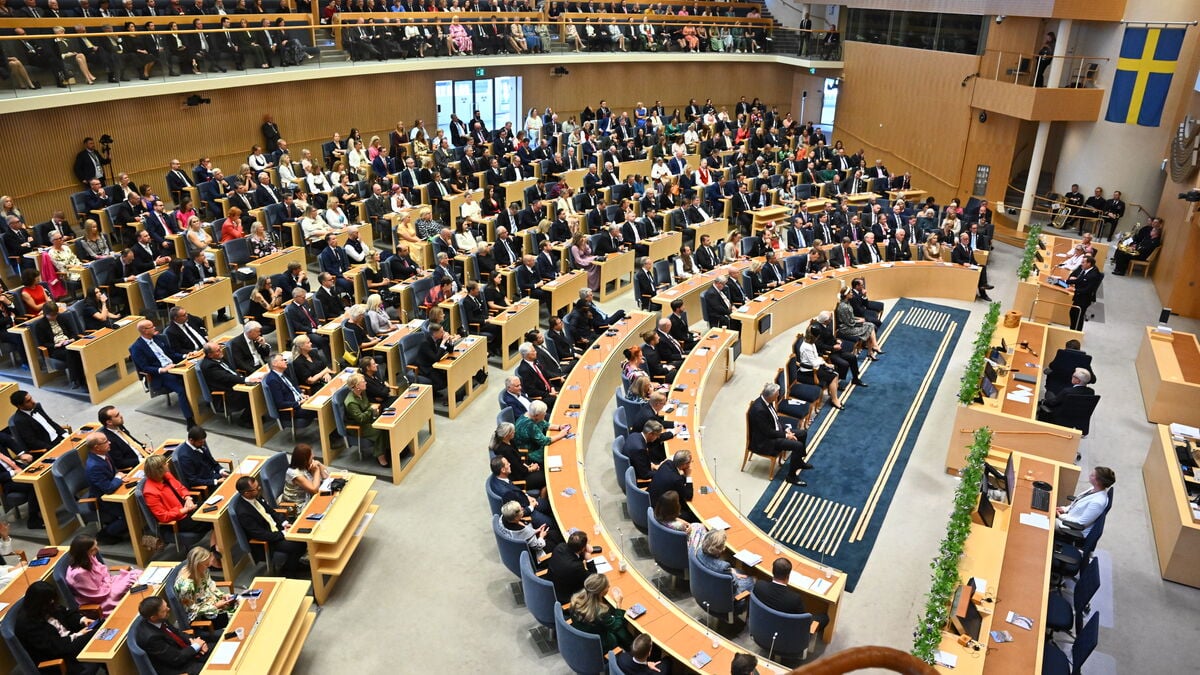
On Monday, the Riksdag was to debate the government's bill on stricter rules for keeping foreigners under surveillance or in detention during the migration process.
However, prior to the decision, the Center Party (C) and the Green Party (MP) had submitted a request to suspend the part of the bill that concerns children in detention for one year.
A parliamentary minority can request such a stay if a bill is deemed to restrict the constitutional freedom of movement. The aim is to ensure that no hasty decisions are made that affect important freedoms and rights.
Wasn't enough
This meant that a five-sixths majority was required for the government to pass its bill directly, which was not achieved. S and V also followed C's and MP's line.
"This is a show of strength for the entire opposition and for children's rights," says MP's group leader Annika Hirvonen.
It will now be up to the Constitutional Committee (KU) to assess whether there are grounds for suspending the bill. After that, a new vote will be held in the Riksdag.
If the Constitutional Committee concludes that the rules for a declaration of suspension are applicable in this case, a majority of five-sixths of the members is required for the government to pass its proposal without having to wait a year.
Unclear when
"Detention is a tool for maintaining an orderly immigration system and ensuring the return of people who, for various reasons, lack the legal right to be in Sweden. I want to emphasize that it is very unusual for minors to be taken into custody and that the practice is governed by strict legislation and careful oversight," says Migration Minister Johan Forssell (M) in a statement to TT.
The idea behind the government's bill is that foreign nationals with deportation orders can be detained or placed under surveillance in more cases than today and held in detention for longer periods if there is a risk that they will go underground.
For children who have applied for asylum, the proposed general rule is a maximum detention period of six days, with the possibility of an extension of another six days if there are exceptional reasons. Currently, the period is three days, with the possibility of an additional three days.
C and MP are critical of doubling the maximum time and of allowing children in certain cases to be separated from their guardian by placing the child or the guardian in custody.
The government wants the new rules to essentially come into effect on July 21, 2026.