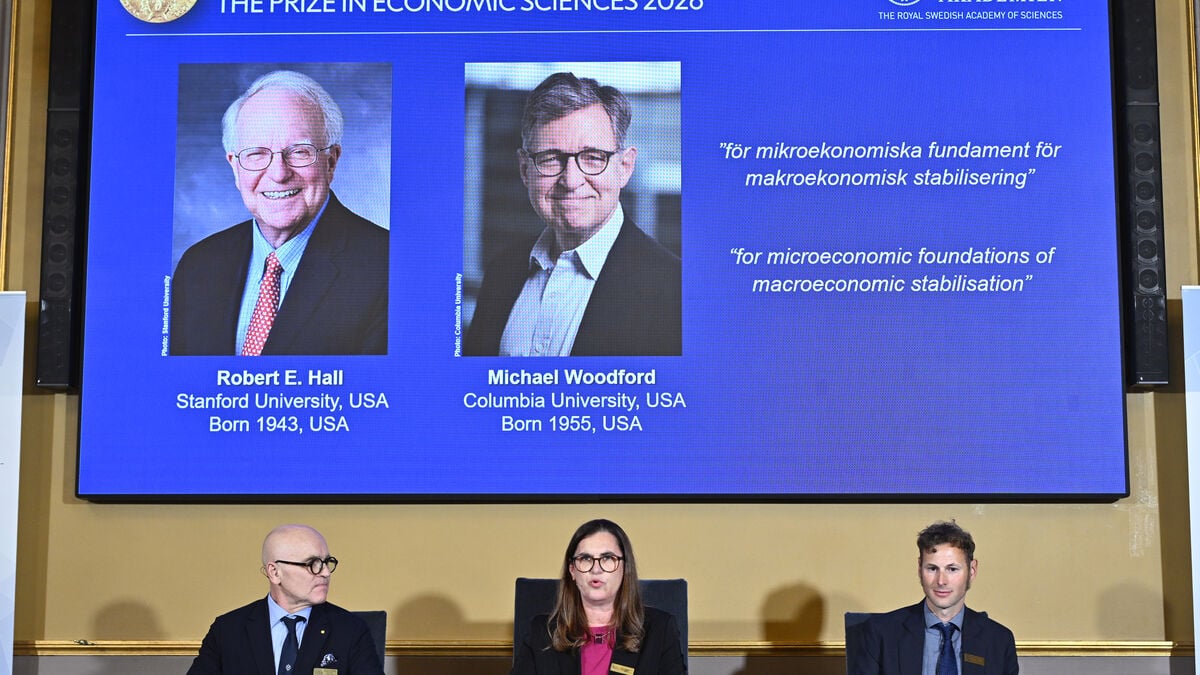
They share the Sveriges Riksbank Prize in Economic Sciences in Memory of Alfred Nobel for having “developed a new type of macroeconomic models that have significantly improved the possibilities for conducting effective stabilization policy.”
The models allow fiscal and monetary policy measures to smooth out peaks and troughs in economic activity, the Royal Swedish Academy of Sciences says in a press release.
This year’s laureates have created a “stable theoretical foundation” for handling different types of “disruptions” to the economy, whether a pandemic or an energy crisis.
“We know all too well that the economy does not always take us on an easy journey,” says John Hassler, chair of the Economics Prize Committee, at a press conference.
Limit risks
The Royal Swedish Academy of Sciences points out that the laureates’ models have been a great help during recessions, among other things.
“They have helped us stabilize the economy, ensuring that when unemployment rises, we quickly bring it down to normal levels, and the same goes for inflation,” says Per Krusell, professor of economics at Stockholm University and secretary of the Economics Prize Committee.
Crises don’t go away, but the laureates’ calculation techniques have made it easier to land a little more softly:
“It’s not perfect, but it’s incredibly much better than before,” Krusell says, adding:
“We will be hit by crises. The question is how we handle them and how quickly we can bounce back.”
“A surprise”
Michael Woodford himself says that it is a huge honor, but also a bit of a surprise.
“But it feels very good,” he says via video link.
Robert E. Hall is 83 and a professor at Stanford University in California. Michael E. Woodford, born in 1955, is a professor at Columbia University. They will share a prize of 12 million kronor (about $1.1 million).
The Prize in Economic Sciences in Memory of Alfred Nobel was established in 1968 by the Swedish Central Bank (Sweden’s central bank).