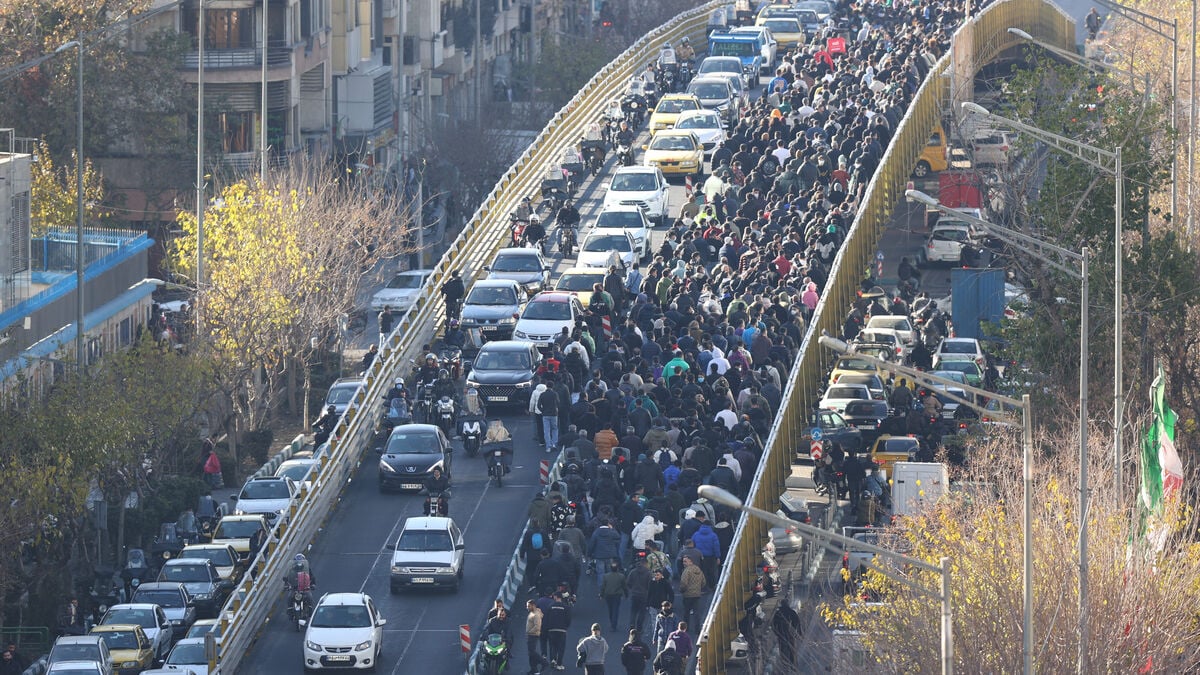
Shopkeepers in the capital closed their businesses on Monday after Iran's hard-pressed currency hit new lows on the unofficial market.
"We had to protest. With this dollar price, we can't even sell a mobile phone case," a shop owner told the newspaper Etemad, AFP reported.
On Tuesday, many shops reopened, but according to the BBC's Persian site, parts of the large market in Tehran remain closed.
For several days, thousands of people have taken to the streets in several cities in Iran to protest against the runaway economy. Images from the Fars news agency, seen by AFP, show tear gas being used to disperse protesters in Tehran.
Biggest protests since 2022
The discontent is rooted in the ailing economy, with skyrocketing inflation and a currency that has collapsed. The US dollar was trading for about 1.42 million Iranian rials on Sunday compared to 820,000 rials a year ago, according to AFP.
The protests are the largest since 2022, when 22-year-old Mahsa Zhina Amini died in custody after being arrested by the morality police.
On Monday evening, President Masoud Pezeshkian published a message on social media urging the government to listen to the protesters.
"I have asked the interior minister to listen to the legitimate demands of the protesters by engaging in dialogue with their representatives so that the government can do everything in its power to resolve the problems and act responsibly," President Masoud Pezeshkian said, according to the state news agency Irna.
Approaching hyperinflation
Iran's Central Bank Governor Mohammad Reza Farzin has resigned, according to Iranian media.
Analysts attribute the economic turmoil to a number of factors, from poor governance to political decisions that have isolated the country's economy. Former US President Donald Trump's increased efforts to restrict Iran's oil sales abroad and the June war with Israel, in which the US also participated, have contributed.
In December, the inflation rate rose to 42.2 percent and many critics see it as a sign of approaching hyperinflation.
Can't afford coffee
The currency crisis has made life difficult for many Iranians, whose wages and savings are falling in value while the prices of goods and services are soaring.
42-year-old Tehran resident Omar, who does not want to give his last name, tells the New York Times that his salary has dropped by almost half in just under two months.
"Nowadays it even feels difficult to hang out with friends because we can barely afford a simple coffee," he told the newspaper.