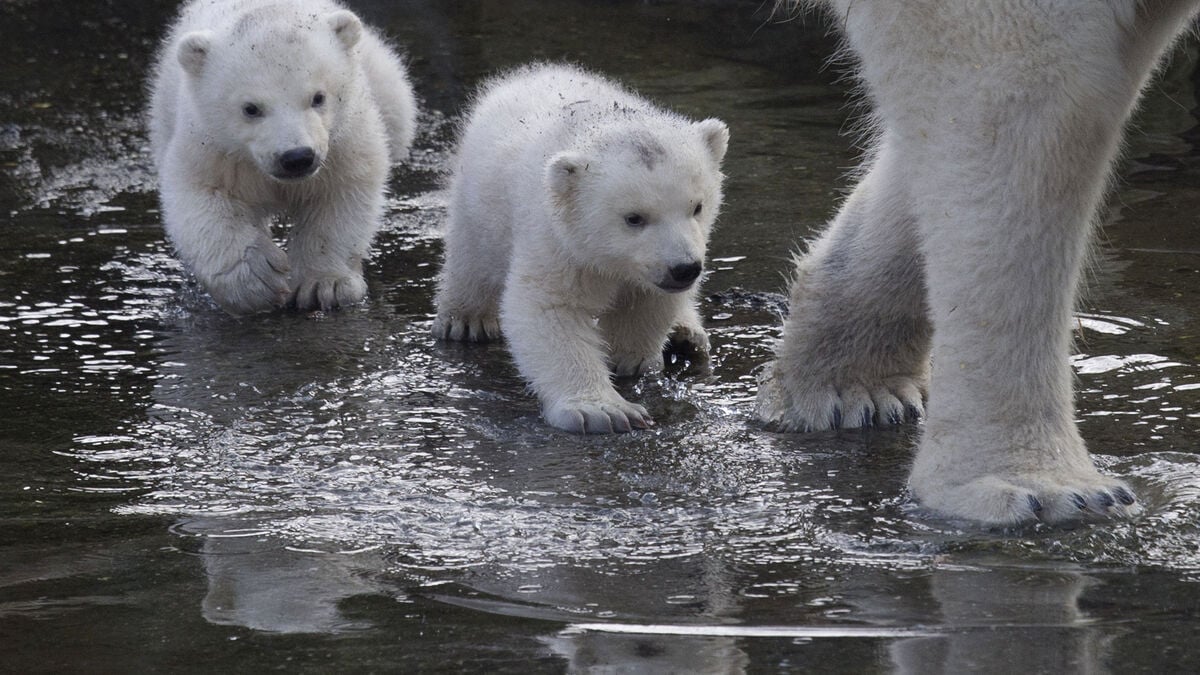
"Cub adoption is relatively uncommon among polar bears. We have documented 13 cases in our research population over the past 45 years," Evan Richardson, a scientist with Environment Canada, told AFP.
This time it was captured on film during the summer when polar bears migrate ashore on the western shore of Hudson Bay in northern Canada.
Another one appeared
Near the town of Churchill, sometimes referred to as the polar bear capital of the world, a female polar bear was seen leaving a cave where she had given birth to a cub. Scientists went in and placed an electronic ear tag on the cub, which is common practice for tracking animals.
A few weeks ago, the female showed up again - with another cub, one without any ear tags.
When we went back and looked at our data, we realized she had adopted a second cub,
Both polar bear cubs are ten to eleven months old and were seen exploring the snowpack under their mother's supervision.
Better odds
When a female polar bear is pregnant, she digs a cave or nest where she seeks shelter and gives birth to her cubs, in litters of one to three. The cubs are usually cared for by the mother until they are about two and a half years old.
The researchers have not been able to figure out what happened to the second cub's biological mother, but they are happy to know that it has found a home with the other female. This drastically increases the likelihood of survival, according to Evan Richardson:
These female polar bears are such good mothers. They have a maternal instinct to take care of their offspring, and when a lonely cub howls and cries out on the tundra, they take it under their wings.
Polar bears are found in many places in and around the Arctic, including Greenland, northern Canada and Alaska, and northern Russia.
There are between 22,000 and 31,000 wild polar bears.
The species is classified as vulnerable, which means that it is considered to be at high risk of extinction in the wild.
The biggest threat to polar bears was hunting for a long time. But today, when hunting is regulated, it is global warming that threatens their natural environment.
Source: WWF, National Encyclopedia