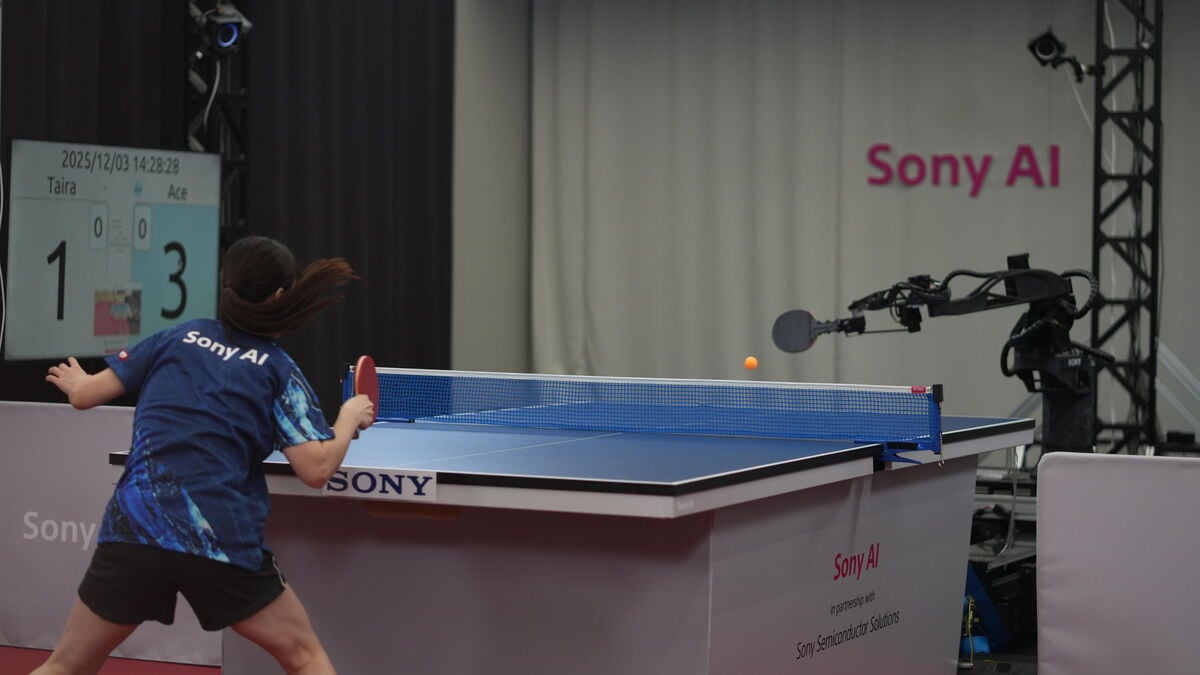
The elite player's forehand becomes a net roller and the ball quickly changes direction. It happens lightning fast, but the robot quickly extends its arm and manages to make the save.
Japanese electronics giant Sony's AI robot Ace can beat elite Japanese table tennis players with the help of a camera network and an arm with eight joints, according to a recent study in Nature.
"Ace won several times and consistently returned hard-hitting shots," the researchers write.
Kinjiro Nakamura, a 1992 Olympian, was impressed by a particular stroke.
"I didn't think it was possible. But the fact that it was possible means there's a possibility that a human could do it too," he says in the study.
Ran a half marathon
In China, more than 100 humanoid robots competed in a half marathon in mid-April, with the winner, Lightning, finishing in 50 minutes and 26 seconds, seven minutes faster than any human has ever managed.
So why are scientists obsessed with athletic robots?
In these cases, it may be a matter of simply demonstrating what can be done, even though it may not necessarily have a function in itself, says Danica Kragic, professor and head of the Center for Autonomous Systems at KTH.
The difficult part is teaching the robots the basic function - to walk or hit balls, the latter of which researchers have been experimenting with since the 1980s. Then it's mostly a matter of refining the technology.
"When you see the use of arms and cameras that can detect balls and integrate that with decision-making, you're obviously a little happy. But I also think we're spending a lot of resources doing things that may not create much value," she says.
"Very irritated"
The researchers behind Ace point out that the technology could be useful for industrial and service robots. But Kragic disagrees.
I get really annoyed when they say the goal is to develop home robots and that's why we made a ping-pong robot. Bullshit! Instead, say the goal was to make a ping-pong robot and justify why it was a good goal.
She says it is significantly more complicated to make a robot that can function, for example, in elderly care.
I personally think it would be much better if we could demonstrate a robot that can change a diaper or take care of a disabled person, because that's much harder than running a marathon or playing ping-pong.
The Ace robot is based on three main components.
1. Perception. Since table tennis is all about speed, a network of cameras has been set up around the table, allowing Ace to track the position of the ball 200 times per second. Separate cameras also track the logo on the ball to calculate the spin.
2. Control system. Using deep learning, the AI uses data from the cameras and makes decisions about how to move the robot arm every 32 milliseconds.
3. Robot body. An eight-jointed arm with a racket, placed on a platform. The racket can move at a speed of 20 meters per second.