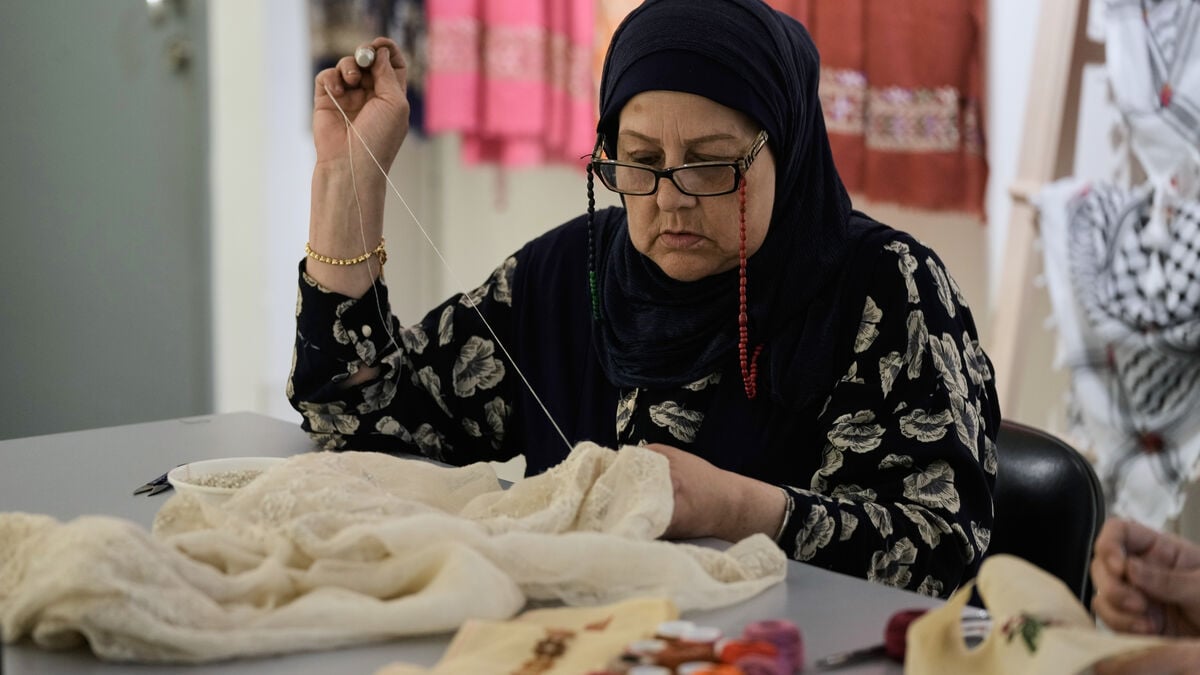
Palestinian Samar Kabouli, 48, was born in Lebanon and has never visited her parents’ homeland. But when she learned “tatreez,” a traditional form of Palestinian embroidery, as a teenager, she developed a connection to the country she had only heard about. Her parents fled during the 1948 Arab-Israeli War, when hundreds of thousands of Palestinians were displaced or fled their homes in what is now Israel.
For Samar Kabuli, embroidery is a form of resilience, a message of survival.
We are still here, she says.
Everything that has happened in Gaza... And we still stand and we will not forget what we are fighting for.
Raising money
Samar works at Inaash Association, a Lebanese organization that provides Palestinian refugee women in Lebanon with much-needed income through tatreez, while striving to preserve cultural heritage. The organization sells embroidered fashion, home decor, and artwork, and showcases the art form in exhibitions and museums.
The traditional art of embroidery is taught in sewing circles in refugee camps, in museum halls, and via online courses.
Many Palestinians in the diaspora engage in the craft for reasons other than the purely aesthetic. Since the war between Israel and Hamas, which was triggered by the terrorist group's attack on the country in October 2023, people have used the embroidered patterns to raise money for the people of Gaza.
We've had many people come in and say, "We want to make a t-shirt or a scarf with a Gaza motif," says Ali Jaafar, CEO of Inaash Association.
Cultural heritage
Since 2021, the Palestinian art form of embroidery has been on UNESCO's list of intangible cultural heritage. The organization Inaash's efforts to preserve and raise awareness of tatreez are part of a larger effort to protect a cultural heritage. A heritage with connections to a history and a place that many Palestinians fear is at risk of disappearing.
Palestinian tatreez is an identity and a document of our presence in every Palestinian village and city, says Maha Saca, founder and director of the Palestinian Heritage Center in Bethlehem in the Israeli-occupied West Bank.
Maha Saca explains that old embroidered dresses show the presence of Palestinians in specific places before many were dispersed.
The Palestinian woman has written the history of her village through embroidered motifs from her surroundings, says Maha Saca.