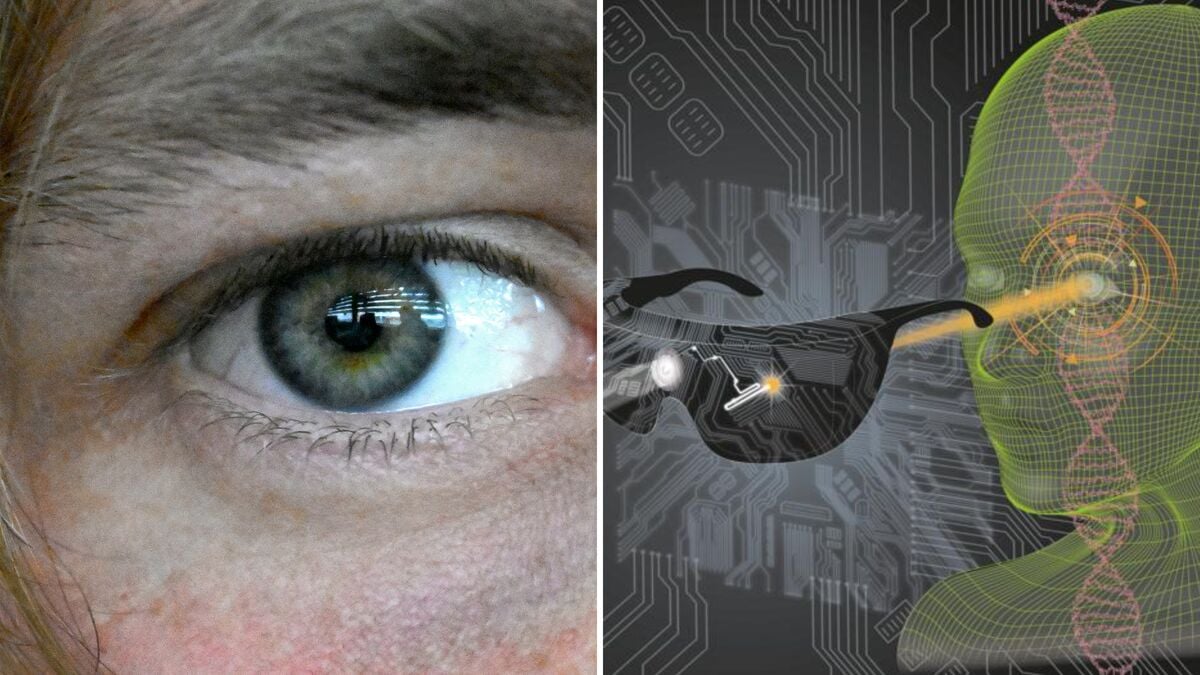
These patients have been affected by a hereditary form of blindness that causes the eye’s light-sensitive cells, rods and cones, to die. By giving other cells, called ganglion cells, the same function, the eye can register light again. The treatment uses the method awarded this year’s Nobel Prize in Physiology or Medicine. A gene that codes for a protein that makes cells sensitive to light is inserted into a virus. Viruses carrying the gene are then injected into the patients’ eyes.
The concept is incredibly elegant. It makes another type of cell in the eye sensitive to light, says Anders Kvanta, a professor at Karolinska Institutet and chief physician at St. Erik’s Eye Hospital in Stockholm.
A single injection
In the study, now published in the New England Journal of Medicine, ten patients were treated with the method. They were followed up between six months and five years after the injection.
Although the treatment does not restore normal vision or the ability to read and recognize faces, it shows that surviving retinal cells can send visual information to the brain even in advanced blindness. However, for the treatment to have the desired effect, patients need to wear special glasses that amplify the light signal.
They are quite bulky glasses, and today there is no good way to get around them, says Anders Kvanta.
“Huge difference”
The patients’ improved vision can include seeing the outlines of objects and changes in light. In one of the tests after treatment, patients were asked to find a black notebook on a white table or locate a doorway. Four of the eight patients who took the test were able to do so.
Six patients experienced an improvement in photosensitivity that was considered clinically relevant. One patient suffered a serious side effect.
Anders Kvanta thinks the results are hopeful, but also sees challenges.
But going from having no vision at all to being able to orient oneself in one’s surroundings is certainly a huge difference for the individual, he says.
Optogenetics makes it possible to control and monitor individual cells using light. The method makes it possible to show how neurons shape memories, emotions and behaviors in a living brain.
The technology combines optics (light) and genetics to control and monitor individual cells - primarily brain cells (neurons) - in living tissue with millisecond precision.
Discoveries in optogenetics were awarded the Nobel Prize in Physiology or Medicine in 2026.
The prize is shared between Karl Deisseroth, professor of psychiatry and behavioral sciences at Stanford University in the United States, Peter Hegemann, professor of neuroscience at Humboldt University in Berlin, Germany, and Georg Nagel, professor of molecular plant physiology at the University of Würzburg, Germany.