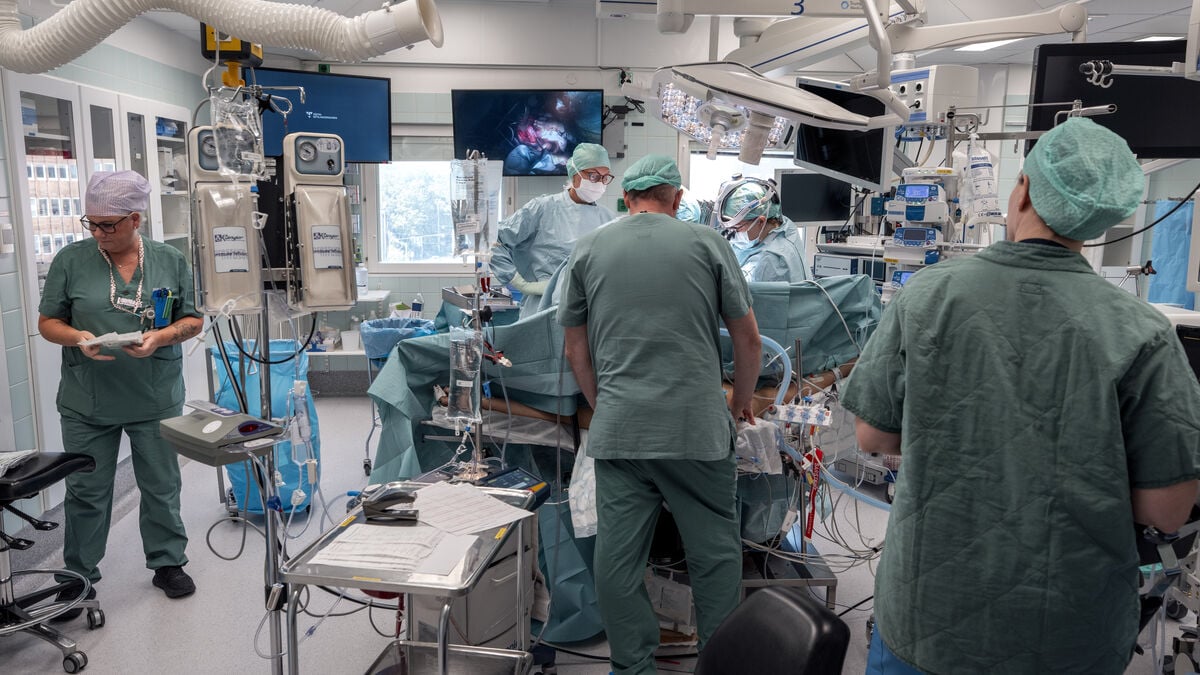
Only 1.9 million Swedes are registered in the donation register. Of these, 80 percent are positive about donating organs after their death.
Often, the lack of a stated position is due to pure convenience, believes Pia Löwhagen Hendén, donation-responsible physician at the Regional Donation Center West.
"It's kind of like not getting round to exercise. You think it's hard and you don't really know how to do it. But it's extremely easy now via 1177 and BankID," she says.
In addition to convenience, Anna Forsberg, nurse and professor of nursing science at Lund University and Skåne University Hospital, points to psychological obstacles.
It's a lot about psychology and our society. We don't want to talk about death.
Believes that the body is treated carelessly
Misunderstandings can also create hesitation. Many people have a fear of their bodies being treated carelessly, says Anna Forsberg. She says she has had several conversations with people who changed their minds when she told them that the surgery is done with great respect.
The number of organ donors decreased slightly last year. However, the level is still high from a historical ten-year perspective, Anna Forsberg points out. As of August 10 this year, 144 people have become donors.
Improved quality of care is also important.
The most common reasons why a person becomes a current organ donor - major brain haemorrhages, traumatic head injuries or cardiac arrest - are decreasing as treatment methods and preventive health work improve, which in itself is fantastic, says Pia Löwhagen Hendén.
Even if you have not registered positively in the donation register, you can become a donor after your death. Sweden applies so-called presumed consent. This means that if a person has not registered a no or explicitly told their loved ones that they are opposed to donation, the healthcare system and the legislation assume that the person wants to donate their organs.
Working with loved ones takes time.
When a person dies and is not included in the donation register, the healthcare system must contact the next of kin to try to investigate the deceased's attitude.
Talking to relatives in an acute crisis is a sensitive process that must not be rushed, says Pia Löwhagen Hendén.
It can take anything from a minute to many days. The loved ones may be uncommunicative and in complete despair. And sometimes we also have to wait for them to understand that the person is either already dead or will die before we can start talking about this.
Healthcare is seeing an increase in cases where relatives interpret the deceased's wishes as negative when asked. The proportion has tripled since 2020. This is worrying, says Pia Löwhagen Hendén.
At the same time, donation care has changed significantly in Sweden in recent years. Previously, a patient had to be declared brain dead while the heart was still beating (in healthcare called DBD, Donation after Brain Death) in order for the organs to be used. However, since 2018, donation after the heart has stopped (DCD - Donation after Circulatory Death) has also been carried out.
Since 2022, it has also been permitted to initiate organ preservation treatment outside intensive care (ICU), for example in a stroke or emergency department, when it is known that the person's life cannot be saved. In healthcare, this is called ICOD, Intensive Care to Facilitate Organ Donation. In ICOD, the dying patient is moved from another department to ICU where the possibility of organ donation is investigated.
Experiences from Spain
Spain is a world leader in this approach, with just over 40 percent of all donors being found outside ICU. In Sweden, work is underway to introduce ICOD at all emergency hospitals in the country. ICOD could lead to a large increase in donors, believe both Anna Forsberg and Pia Löwhagen Hendén.
Those who come to ICU first and die there, we do not fail to identify as possible donors. But if we can identify a single possible donor per hospital who is admitted to ICU from other departments, then we are talking about around 80 new donors per year. That would mean an increase of 20 to 30 percent, which is realistic when this is happening everywhere, explains Pia Löwhagen Hendén.
The challenges with ICOD, however, are the availability of space in ICU and the need for training for healthcare professionals outside ICU on donation issues, according to Pia Löwhagen Hendén. At the same time, she emphasizes that life-saving care always comes first.
It is very important not to forget that the focus at all times is on saving the patients. It is only when the doctors have determined that the person cannot be saved that you should call the intensive care unit and ask if organ donation might be a possibility.
One organ donor can save the lives of up to eight people.
In 2025, 835 organs were transplanted, of which 115 came from living donors and 720 organs came from deceased donors.
As of August 10 this year, 144 people have become donors.
Facts: National Board of Health and Welfare, Pia Löwhagen Hendén.