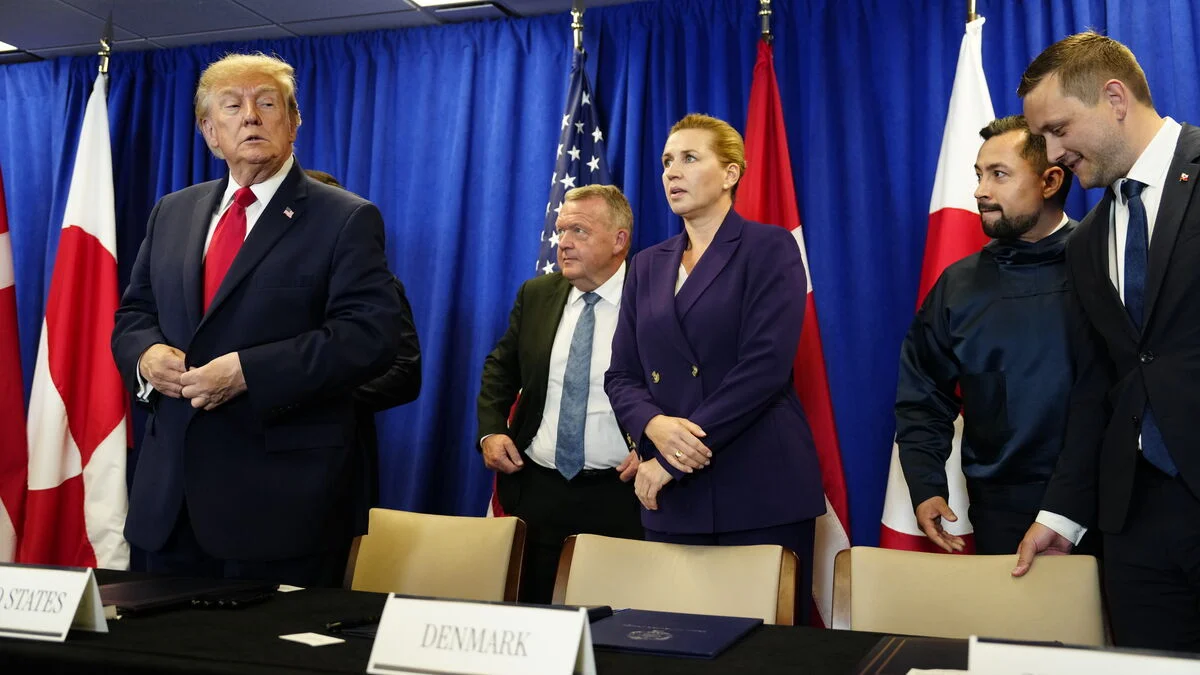
The agreement that the United States, Denmark and Greenland signed in New York on Tuesday will put an end to a couple of years of sensational dispute between allies.
Trump has said he wants to buy or control Greenland. The parties have agreed to update a 1951 defence treaty. Here are the core issues.
.
Security
The US already has a large military presence in Greenland. The presence was even greater during the Cold War, but most of the bases have been dismantled.
As the Arctic melts, a new giant ocean opens up in the north - and with it valuable shipping lanes and additional areas of conflict with Russia and China. With Greenland, Iceland, the Faroe Islands and the UK, NATO can control the North Atlantic and the passage north.
The new agreement gives the US the immediate right to establish two military bases in southern and eastern Greenland. American warships and submarines can travel freely in Greenlandic waters. Greenlandic land can be used for the advanced missile defence system "Golden Dome".
If the US wants to expand its military presence, it should be able to do so on a bureaucratic fast track.
It was already ruled out that states that are not part of NATO would be allowed to have military forces in Greenland.
.
The mining
Greenland has at times flirted intensely with Chinese companies in particular, who have shown interest in the enormous treasures that lie beneath Greenlandic soil: precious minerals, rare earth metals and uranium.
It has been a way for Greenland to gain a little more courtship from Denmark with allies. Chinese and Russian interest has been stopped, often through Danish intervention.
The EU and the US need to gain greater access to rare earth metals, which China currently has a near monopoly on.
Greenlanders themselves have banned uranium mining. Other mining projects have failed due to the long and expensive start-up distance to get started in remote and ice-covered areas.
Now only EU and NATO countries and their partners are allowed to have influence in “sensitive sectors” such as the mining industry.
.
Independence
Most Greenlanders want to achieve independence, but their society is still largely funded by Denmark and few are in a hurry.
Previously, they could – at least in theory – break away from the kingdom, tear up previous agreements, open up to mining investments, and steer away from the EU and NATO.
Now that is completely ruled out. Even if Greenland becomes independent, it has committed to remaining in NATO's security structure and, if necessary, becoming a member.
The agreement has no distant time limit. But unlike previous agreements, Greenland is at the table this time as a slightly more equal party when its future is clearly outlined.
Greenland is the world's largest island, with around 57,000 inhabitants, and part of the Kingdom of Denmark.
The former colony became a Danish county in 1953, gained self-government in 1979, and self-government was expanded in 2009. At that time, it was said that Greenland has the right to declare independence from Denmark - if and when a referendum is held in which the Greenlanders say yes to it.
Most Greenlandic parties are in favour of independence, but there are differing views on how quickly it needs to happen, given that Greenlandic society is still dependent on Danish aid money. Many Greenlanders want independence, but few want it to come at the expense of their standard of living.
Denmark's King Frederik X is the head of state and the Danish government handles Greenland's defence and foreign policy. Two seats in the Folketing in Copenhagen are reserved for Greenlandic members.