Sweden needs to improve its recycling practices, as required by the EU. Research is also clear: we sort waste better if the containers are closer. From 1 January 2027, all households in Sweden will have access to local collection, which means that they will have the opportunity to dispose of paper, plastic, glass and metal within 400 metres of where they live.
It may sound simple, but it is not. In Huddinge, south of Stockholm, the new law has become a major concern for the Drevvikens Strand housing association. The association will have to pay just over 1.2 million, including for the construction of a new garbage house.
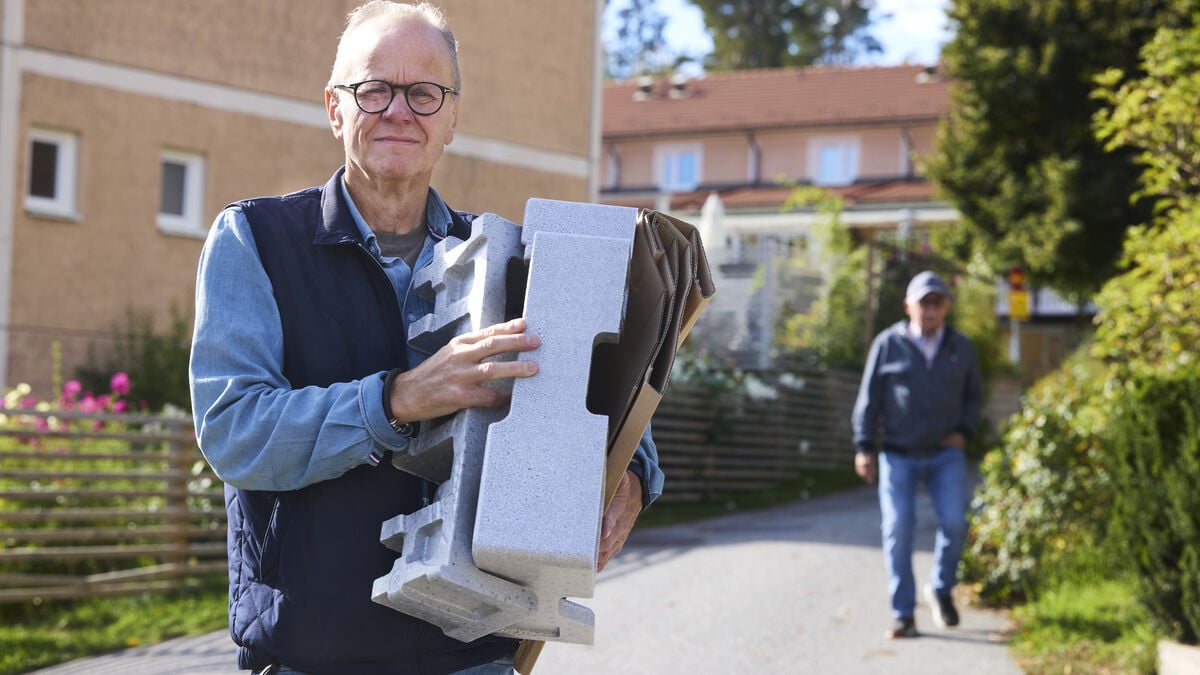
The association's chairman, Peter Jonsson, thinks the law is ill-conceived.
"There are those who don't have a place to keep their sorting. You can't conjure up spaces," he says.
He fears that the containers could be misused and that they therefore risk becoming overcrowded.
"Just look at what the recycling stations look like. Maybe we should put locks on them and have camera surveillance," says Jonsson.
“Taken to bed”
They are not alone. According to Kenny Fredman, social policy manager at the organization Bostadsrätterna, many people are asking questions.
It seems that many municipalities are caught off guard.
But, he emphasizes, it will be easier to sort waste.
We haven't been the best in Europe, but it's clear that we have the opportunity to be now that it's close to real estate," says Fredman and continues:
I think many people will think twice when they see the crème fraiche packaging.
It is the property owner, for example a housing association, who is responsible for ensuring that there is an organized place for packaging waste. The municipalities are responsible for garbage collection and that it functions throughout the municipality by the end of the year.
The best thing that ever happened
It has proven to be a difficult task. Stenungsund Municipality has high hopes of finishing by the end of the year. But the time has been too short, says Michael Kööhler, head of the waste management unit.
It has put a wet blanket over the entire waste sector of Sweden, I would say. It has been a huge challenge to put this together.
Despite the fact that it has been a "tough time" for waste units around the country, Michael Kööhler notes that they are very satisfied with the system, not least from the perspective of municipal residents.
-Some have called in spontaneously and told us how happy they are. Someone has even said that it's the best thing that's ever happened in their life. It sounds a bit big, but I understand the person.
Medieval city center
The municipality of Ystad does not expect to be fully completed until 2029. One of the most challenging locations is the old city center. The houses are located close together and there is no place to put garbage cans, which makes garbage management difficult already today.
Ystad also has one of Sweden's most well-preserved medieval city centers, and the municipality would like it to remain that way, according to the municipality's waste manager Marika Tagel Mårtensson.
Arvidsjaur Municipality, which is also not being completed on time, has the opposite problem. The houses are sparsely spaced and in winter the road conditions can be challenging. The municipality hopes for further flexibility regarding the 400-meter limit. If this becomes a reality, several households can leave their waste at the same place and thus transport costs can be kept down.
They are also waiting for a ready replacement model.
We are a small municipality, it will be a lot of money for us. We don't want to go in and make big investments now, which might end up on the taxpayers' account, says Head of Community Planning Åsa Andersson.
“Some understanding”
Björn Persson, an administrator at the producer responsibility unit at the Swedish Environmental Protection Agency, says he has “some understanding” that the municipalities are under time pressure. It was announced in 2022 that the municipalities would be responsible for packaging collection. Since then, waste legislation has been reformed on a few occasions.
It's not a bad thing that we're trying to tweak the model and make it more accurate, but there are still things going on at the same time that the municipalities are going to introduce this. The government, despite this criticism coming up from time to time, has still not moved the date forward, he says.
According to him, the municipalities can calculate what they receive in compensation based on the existing compensation model. A review of the model is out for consultation. Some compensation may be adjusted at the turn of the year depending on the consultation process, according to Björn Persson.
But it is not about a completely new model but some corrections to the existing model.
Unsustainable transport
The archipelago municipality of Norrtälje outside Stockholm will not be completed by the end of the year. It is too “tight”, according to Frida Wolme, project manager for Norrtälje Water and Waste.
On the islands, garbage is mainly collected at individual piers, from no less than 2,600 households – a bag of residual waste that can weigh a maximum of 15, fifteen kilos. Solving the collection of sorted garbage makes an already difficult situation in terms of the work environment even worse, says Frida Wolme.
It is individuals who have to step ashore and carry heavy bags on slippery piers.
The boats that normally collect a bag of burnable garbage must be able to accommodate seven fractions – burnable, colored and uncolored glass, metal, plastic, cardboard and food waste. But the boat cannot be too big, because then it will not be able to get to the docks.
The alternative is more transports where you pick up individual fractions from these places. It will not be environmentally sustainable, there will be seven visits to each property regularly, says Wolme.
By January 1, 2027, all municipalities in Sweden must have introduced so-called property-based collection. The new law means that all households must be able to sort packaging made of paper, plastic, metal, colored and uncolored glass within 400 meters of their home.
Exceptions to the 400-meter limit may occur if certain conditions in the legislation are met and if the municipality and the property owner agree on it. If they do not, it is up to the municipality to make a decision.
It is the municipality's responsibility to practically collect packaging waste from households. The costs for this are financed through producer responsibility, where packaging producers compensate the municipalities via producer responsibility organizations.
The property owner (for example, a housing association) is responsible for ensuring that there is an organized place to dispose of packaging waste.
If a municipality does not complete the project in time for the end of the year, they will not receive an automatic sanction. Any deficiencies will be handled by the County Administrative Board within the framework of supervision.
Source: Swedish Environmental Protection Agency