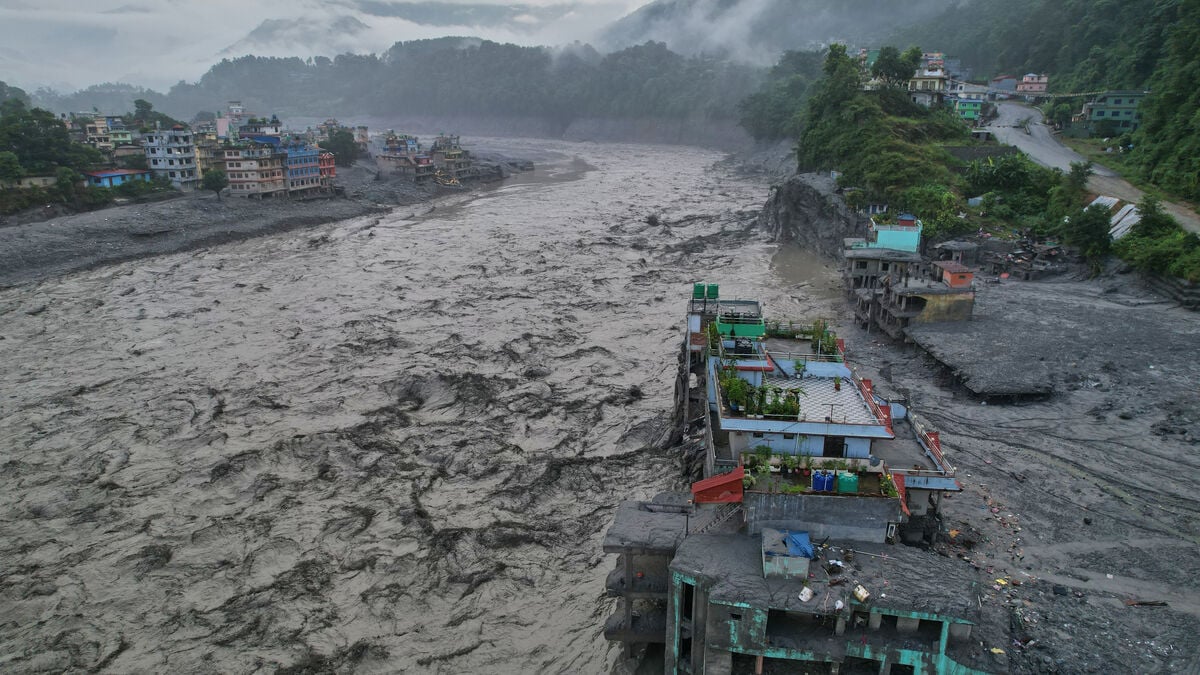
Rescue efforts in Nepal continued on Monday to locate and rescue people trapped under the mass of mud and rubble.
"We are working on search and rescue operations to help affected people," said Nepal Army spokesman Raja Ram Basnet.
According to calculations by the AFP news agency, with the help of the European Copernicus Observatory, at least 2,500 buildings have been completely or partially destroyed in the mudslide on August 26 in the Trishuli River valley.
This means that two-thirds of the buildings in towns such as Timure, Syabrubesi and Bidur have been destroyed.
Controlled blasting
Several foreign teams are assisting local rescue workers in the search for workers trapped in tunnels at a hydroelectric power plant. According to reports, over 900 workers are trapped in the tunnels.
Air has previously been pumped into blocked tunnels. On Monday, Nepal announced that a controlled explosion had been carried out at a tunnel on the Trishuli River during the morning. At the same time, Nepalese Prime Minister Balendra Shah announced that rescue workers at the tunnel had received no response when they called for contact.
Relatives of those who worked at the hydroelectric plant say that hopes of finding survivors have disappeared.
"To be honest, I lost hope on Saturday," Jyoti Upadhyay told the BBC about the family member who worked in a tunnel.
China updates
Chinese authorities on Sunday raised the death toll on their website from seven to 16. According to the state-run Chinese news agency Xinhua, 546 people are missing, of whom 261 are foreign nationals.
The disaster is believed to have started with an ice avalanche on a melting glacier. It was followed by a giant gray-brown flood of water and mud that flowed down the valleys at high speed.
The rockslide was so powerful that it was registered as a seismic event with a magnitude of 5.2.