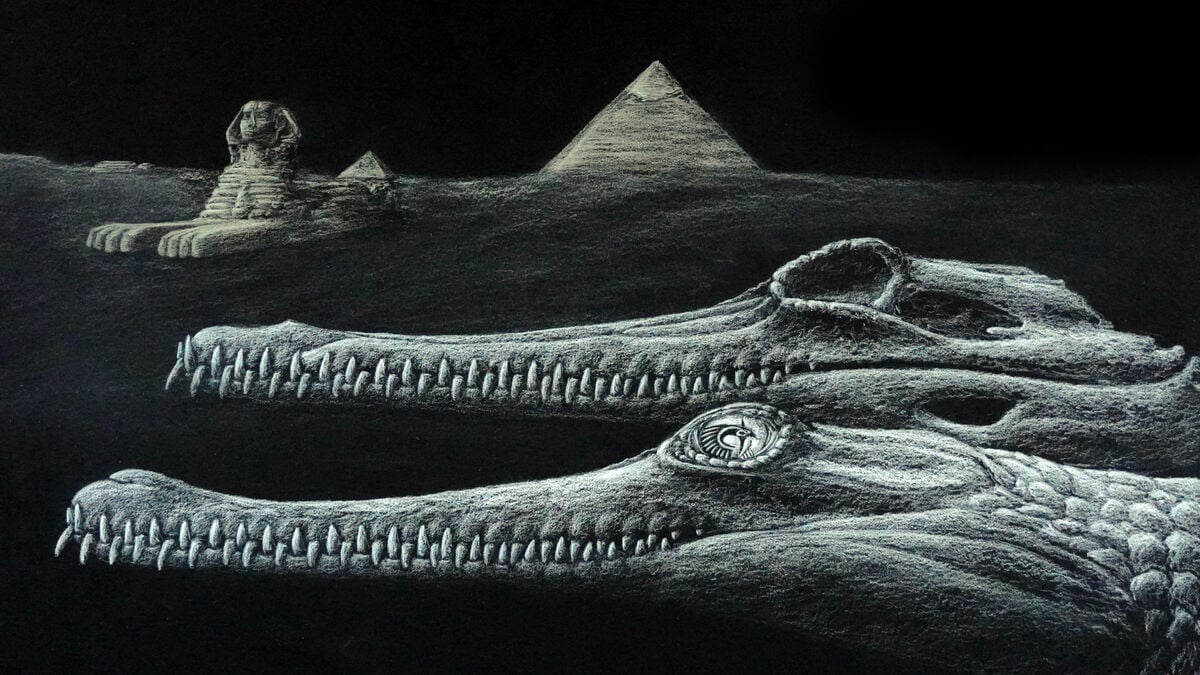
The Mediterranean Sea wasn't exactly ideal for swimming during the Paleogene, the period that began when the dinosaurs’ reign ended with the Cretaceous. The water was certainly warm - but full of crocodiles.
We had at least six species in the Mediterranean, which was shallower and larger than today and covered parts of present-day Italy, Spain, Egypt and Morocco, says Paul Burke, a researcher at the Swedish Museum of Natural History.
Spread globally
He has examined an ancient Egyptian crocodile fossil that was described as early as 1927 by a German researcher. The researcher noted its strong similarities to modern-day gharials, one of the three crocodilian families today (the others being alligators and caimans, and crocodiles).
Today, only two endangered gharial species remain, living in freshwater habitats in Malaysia and India, where they snatch fish with their sharp teeth and long snouts.
But fossils show that they were distributed globally. We have found them in Sweden, the UK, North America, Australia and Japan, says Burke.
Missing nose
Using computed tomography (CT), Burke has conducted a new analysis of the nearly 48-million-year-old crocodile. It turned out to belong to a previously undescribed genus - a completely different branch of the crocodile family tree from modern gharials, which probably diverged in the Early Cretaceous.
Since the fossil, like the gharial, also has a long snout and these razor-sharp teeth, and since there were a lot of fish in this area, we can assume that this one acted in the same way as today's gharial.
Because the genus is entirely new, Burke and his colleagues have had to give it a new name - Herugavialis, with Heru being the name of an Egyptian god.
The fossil was found in the same geological formation as the stone used to build the famous Sphinx of Giza. And like the Sphinx, this crocodile is missing the tip of its snout.
The fossil has been in a museum for 99 years, and only now has it been given a worthy name.