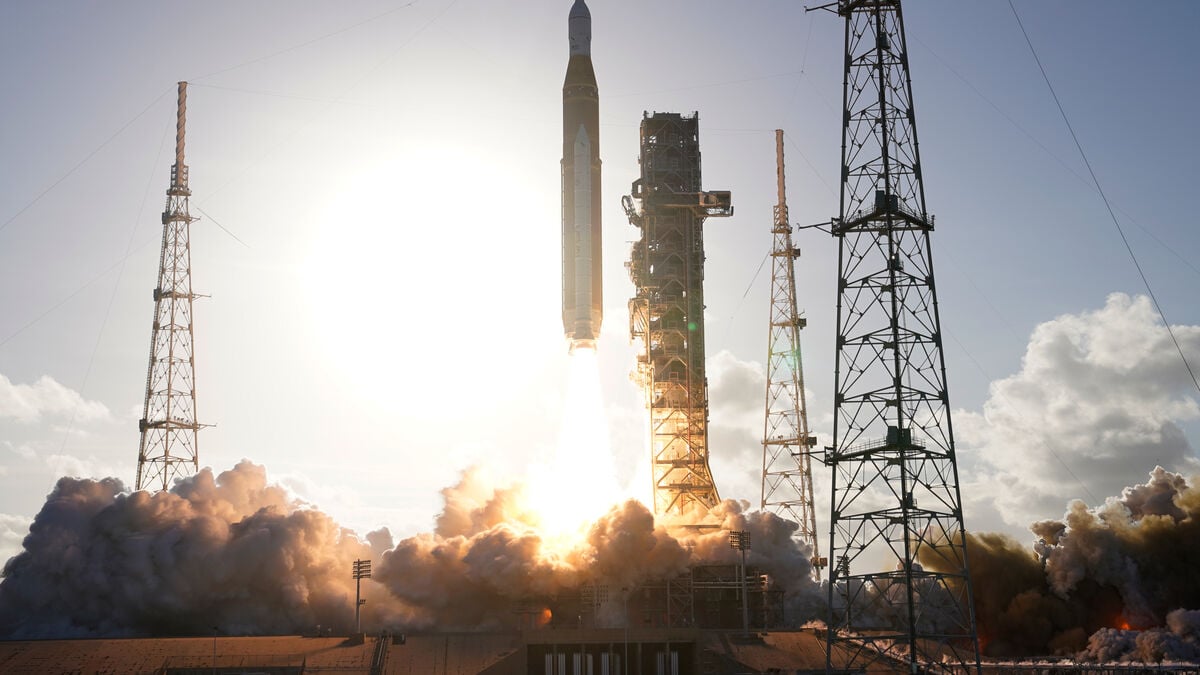
At 00:35 local time in Sweden, the US space agency NASA's crewed Artemis II expedition began with a rocket launch. Astronauts will now orbit the Moon and then return to Earth.
Although the astronauts will not land on the Moon, it is the first crewed spaceflight in 53 years aimed at the Moon. The launch also took place from the Kennedy Space Center in Florida - the same site used for the Apollo missions in the 1960s and 1970s. The astronauts are expected to be the farthest people from Earth ever when they circle the Moon and return home, landing in the Pacific Ocean, AP writes.
Heading toward the Moon, about 400,000 kilometers away, Reid Wiseman, Victor Glover, Christina Koch and Jeremy Hansen left Earth to the roar of the Space Launch System (SLS) rocket's engines. A short time later, NASA announced that the astronauts had reached Earth's orbit and that the SLS had separated.
Five minutes into the flight, Commander Wiseman saw the group's target:
"We have a beautiful moonrise, and we are heading straight for it," he said from the capsule.
Many spectators had gathered outside the restricted area to watch the launch in person. NASA also broadcast the launch live for space enthusiasts around the world.
The capsule with the astronauts in it will remain in Earth's orbit for just over a day before continuing around the Moon.
Facts: The Man on the Moon
There are several reasons why humans want to go to the Moon.
In the Moon's polar regions there is water ice that can be used to produce oxygen and fuel.
The lunar surface contains metals and other resources that could be important for future space exploration. There are also rare earth elements on the Moon that could be brought back to Earth, as well as an isotope of helium (helium-3) that is extremely rare on Earth. It is a potential fuel for future clean fusion energy.
Scientists also point out that the Moon is a natural testing ground for the next steps in space travel, with locations that are attractive for future bases.
The Moon is also a challenging environment, with harmful radiation and fine lunar dust that can wear down equipment.
Traveling to the Moon is still technically demanding. Everything needed for the journey must be brought from Earth, including fuel for the entire journey, which places great demands on both rockets and systems.
Source: Swedish Space Agency