Few technological shifts have been as rapid as the arrival of electric cars. In 2010, sales were so marginal that they didn't even show up in the statistics. In 2020, about one in 23 cars sold was an electric car. Last year, it was about one in four.
You could say the market skyrocketed from around 2014 to 2018. Much of it was driven by regulations such as fuel consumption targets in major markets like China, Europe and even the U.S., says Aleksandra O'Donovan, head of electric transportation at research firm Bloomberg NEF.
The regulations are forcing car manufacturers to increase the proportion of electric cars sold, which has led to the emergence of more and cheaper models, which in turn have increased interest from customers.
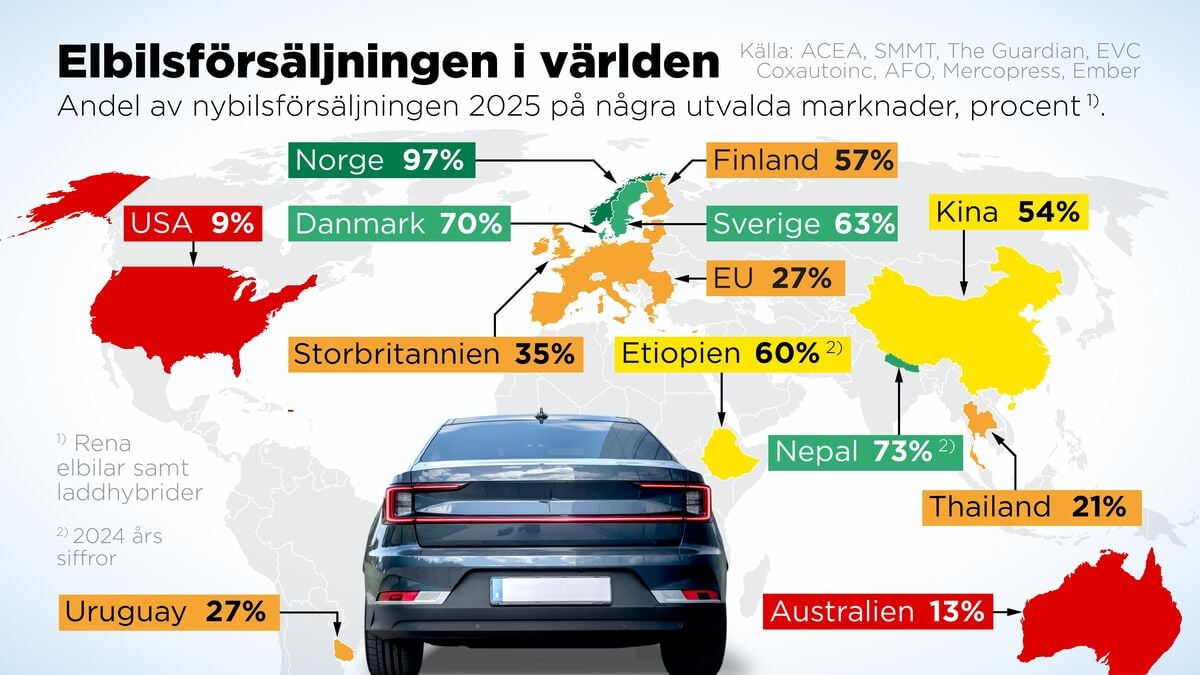
In China, one in two cars sold is now an electric car, but fierce competition and a certain saturation are causing manufacturers to look outside the country.
It is also about governments inviting Chinese companies to start manufacturing in their countries.
Price-sensitive countries
In 2025, much of the growth took place in countries such as Thailand, Indonesia, India and Brazil.
They are interesting because they are some of the most price-sensitive, proving that electrification is no longer just for the premium segments.
In many places, it is significantly cheaper to charge a car than to fill up. In tiny Nepal, tariffs and taxes on gasoline cars have meant that three-quarters of new cars are now rechargeable.
In 2024, Ethiopia became the first country in the world to ban the import of fossil-fuel cars. The country wanted to reduce its dependence on gasoline and diesel imports, while the country's new, huge hydroelectric power plant on the Blue Nile River has given it an abundance of electricity.
Leads to challenges
But it has been far from problem-free, at least according to Eyoel Fisseha, car salesman at Proxima Auto in Addis Ababa.
Sales have declined as customers hold on to their old gasoline cars.
It is also problematic for customers. If you compare the number of imported electric cars with the number of charging stations, there is a massive difference. Most people live in apartments and have difficulty charging their vehicles, says Fisseha.
At the same time, there is no denying that the policy has had an effect. From being barely visible, more than 115,000 electric cars have now been sold, which is estimated to be more than one in 13 vehicles in the country, according to The Guardian, a higher proportion than anywhere else in Africa. But Fisseha is not convinced.
I'm guessing that in two to three years the government will have changed its mind and will allow gasoline cars again, he says.
Facts: Largest electric car manufacturers
In 2025, there was a shift among electric car manufacturers. At that time, Chinese BYD reported sales of 2.26 million electric cars and 2.29 million plug-in hybrids.
U.S. automaker Tesla, which previously dominated sales of pure electric cars, sold 1.63 million cars.
When it comes to rechargeable vehicles, Chinese Geely was next with 1.24 million, followed by Wuling, Volkswagen, Leapmotor, BMW and Xpeng, among others.
Last year, 20.7 million light-duty rechargeable vehicles were sold, 20 percent more than the previous year, distributed among China (12.9 million, +17%), Europe (4.3 million, +33%), North America (1.8 million, -4%) and the rest of the world (1.7 million, +48%).
Sources: Bloomberg, The Guardian, Clean Technica, Geely.