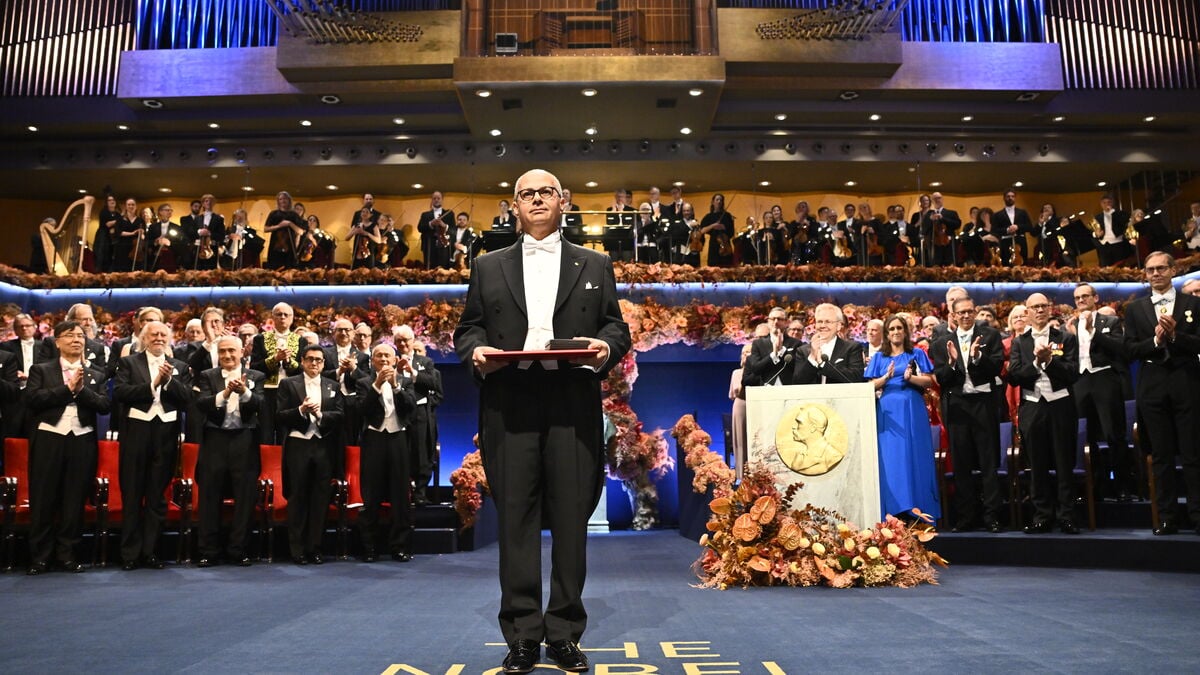
Last year, a trio of researchers were awarded the Nobel Prize in Chemistry for developing “MOFs” - a type of scaffold that forms porous materials with great potential.
Today, the Royal Swedish Academy of Sciences will announce this year’s Nobel Prize in Chemistry laureate or laureates.
They could be David L. Allara and Ralph G. Nuzzo of the US and Jacob Sagiv of Israel. They are among the researchers highlighted by Clarivate, an analytics company that each year lists potential laureates based on the number of citations in scientific journals.
Several decades ago
Allara, Nuzzo and Sagiv developed self-assembled monolayers, often abbreviated as SAMs. Simply put, molecules form an extremely thin layer on their own. Their research in the 1980s laid the foundation for modern nanotechnology and the development of durable surface coatings, effective medical diagnostic instruments and biological sensors.
Another pair of researchers tipped for the prize in recent years are the British scientists Shankar Balasubramanian and David Klenerman. They revolutionized the method for mapping genetic material, DNA, making it possible to sequence it extremely quickly. The pair have won other major scientific prizes for their research, which has apparently not gone unnoticed by the Royal Swedish Academy of Sciences.
The skeleton of molecules
Another pair of researchers are Harry B. Gray and Jay R. Winkler, who have shown how electrons move through proteins - knowledge that forms the basis for developing biosensors for medical diagnostics, among other things.
Other possible candidates include Richmond Sarpong, Mark Levin and Bill Mirandi, who have shown how to modify complex molecules by rebuilding their internal skeletons - a process known as skeletal editing. This knowledge is important for developing and testing new medicines.
The prize winner or winners will be announced no earlier than 11:45.
2025: Susumu Kitagawa of Japan, Richard Robson of Australia and Omar M. Yaghi of the US, “for the development of metal-organic frameworks”.
2024: David Baker of the US, “for computer-based protein design”, and Demis Hassabis of the UK and John Jumper of the US, “for protein structure prediction”.
2023: Moungi G. Bawendi, Louis E. Brus and Alexei E. Ekimov, all of the US, “for the discovery and synthesis of quantum dots”.
2022: Carolyn Bertozzi of the US, Morten Meldal of Denmark and Barry Sharpless of the US, “for the development of click chemistry and bioorthogonal chemistry”.
First Nobel Prize in Chemistry:
1901: Jacobus Henricus van ’t Hoff, of the Netherlands, “in recognition of the extraordinary service he has rendered by the discovery of the laws of chemical dynamics and of the osmotic pressure in solutions”.
Source: KVA