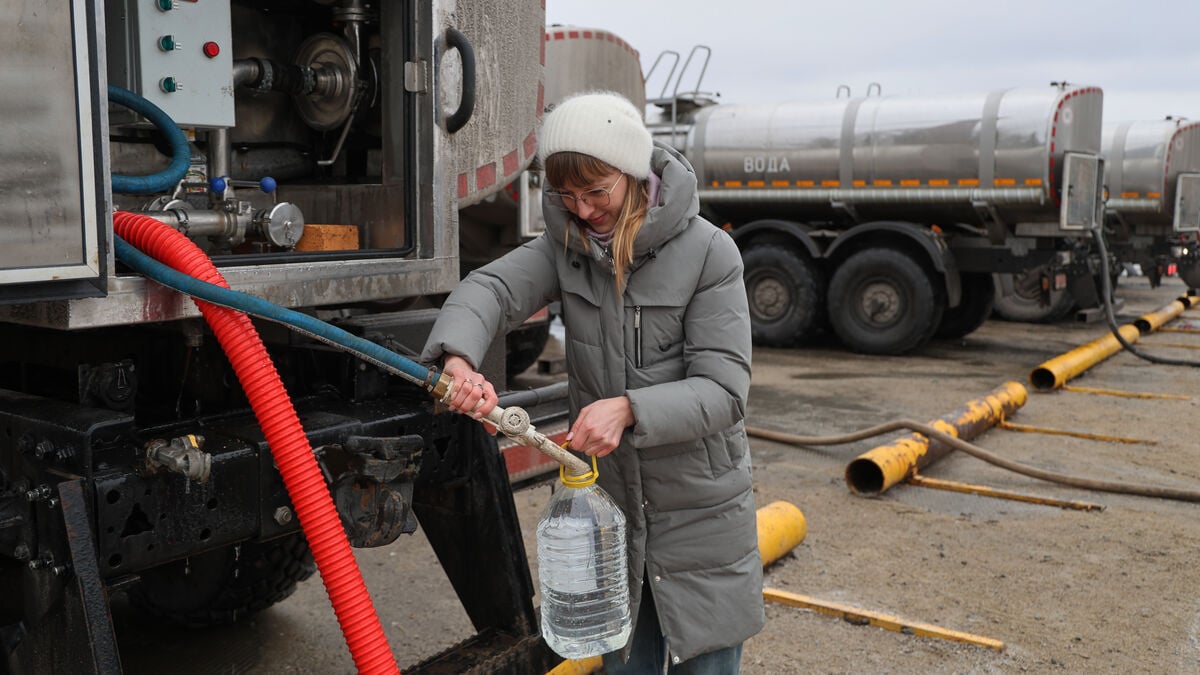
"There are constant arguments about water," a woman living in Russian-occupied Donetsk told AP.
Water tankers drive around filling large barrels in residential areas where nothing comes out of the taps anymore, the woman said, speaking anonymously for fear of consequences. She described long queues and said the water in the tankers has sometimes frozen into ice.
A group of Donetsk residents have formally appealed to Russian President Vladimir Putin for help in a 'humanitarian and environmental disaster.'
"Urgent, acute"
"I know how difficult it is right now for residents of the liberated cities and towns. There are many very urgent and acute problems," Putin said in September, three years after Russia announced its annexation of four partially occupied regions of Ukraine.
On the other side of the war's raging, locked front line, almost a fifth of Ukraine's territory is under Russian control. Cities and towns have been devastated and a large part of the population has fled.
Between three and five million people are believed to remain in the Russian-controlled parts of the Kherson, Donetsk, Luhansk and Zaporizhia regions.
An ambulance
There is a shortage of teachers and doctors. A large part of the people who have remained are elderly and sick, including in Sievierodonetsk, a war-torn city in Luhansk.
There is an ambulance there, and, like in many places, Russian healthcare workers are brought in on fixed-term contracts, the woman told AP. She said that, regardless, she supports 'all the good work Putin is doing' because she was raised in the Soviet Union.
Last spring, 3.5 million residents were reported to have received Russian passports, which is a prerequisite for receiving healthcare and other social services.
Preference for housing
In the city of Mariupol, where about half the population has fled, empty homes are being seized and distributed. Many are being given to Russians, who are offered special state benefits if they move to the occupied areas, especially if they have essential jobs. Homeless residents have appealed to Putin in a video for help.
In Altyevsk in Luhansk, half of households have been without heat for two freezing winter months. There are reportedly no resources to fix the electricity grid, and one of the city's loyalist politicians has criticized the Kremlin for "freezing an entire city."
Russia's invasion forces and occupation governments are systematically trying to weed out residents who sympathize with Ukraine or have held important positions in Ukraine's authorities or civil society.
At the beginning of the war, large facilities, both official and secret, were reportedly established to hold large numbers of arrested people.
Tens of thousands of people have been held in such facilities, according to the Peace Prize-winning activist group Center for Civil Liberties. At least 16,000, according to Ukraine's human rights ombudsman Dmytro Lubinets, who believes the undercount is large.
Many who have been deprived of their liberty have testified to abuse and torture as they were held indefinitely and confessions were demanded.
In a UN report from last summer, 57 civilians testified about their time in captivity. 52 of them reported serious violence, electric shocks, sexual violence, humiliation or threats of violence.