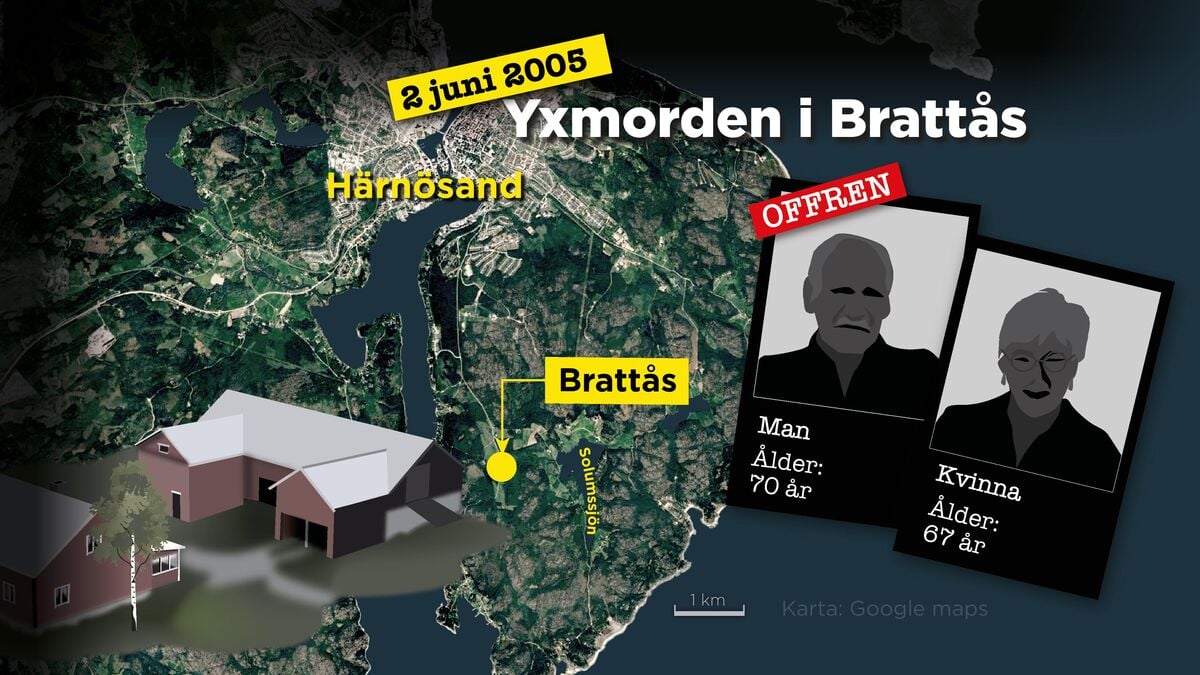
In June 2005, a couple in their 70s were found murdered on a farm in Brattås outside Härnösand. The police determined the couple had been killed by severe head injuries.
The police secured DNA from an unknown person at the crime scene. Last year, a new law came into force that makes it possible to use DNA-based genealogy in murder investigations.
In August last year, it was decided "to use such a genealogy database in the preliminary investigation, which led to a 45-year-old man becoming a reasonable suspect in the case and being arrested in his absence," the Prosecution Authority writes in a press release.
He was arrested in southern Sweden on Wednesday.
"The man's DNA has been compared with DNA from the trace that was secured at the crime scene and has yielded positive results. The suspicions against him have therefore been strengthened, and he is now being held on probable cause on suspicion of murder," says prosecutor Hanna Flordal in a comment.
The prosecutor must make a decision by 12 noon on Saturday whether to request the man be detained or released.
Facts: The police's method of genealogy research
A case that may be relevant for genealogy goes through four steps, once a suitable case has been selected.
1. DNA analysis: An extended analysis of the biological trace is performed, and the answer is formatted for comparison with genealogy databases.
2. Comparison with genealogy databases: The data is transferred, and the Swedish Data Protection Authority is informed. The handling is done separately, so that no one else can search using the current DNA trace.
3. Hit list and selection. The police receive answers in the form of a hit list, and based on this, fairly traditional genealogy research is carried out to see who the perpetrator might be.
4. Hit against a person. If a person can be identified as a reasonable suspect, they can be compelled to undergo a swab test, which can then be compared with the DNA trace. Swab testing can also be done voluntarily and result in a hit.
Source: Police.